Appliance Energy Saving Tips

http://www.homebuilding.co.uk/unmissable-energy-saving-tips-by-appliances-online

Siemens have recently brought out a miracle A+++ fridge; the KG36EAW40. It has the best energy rating on the market right now. Annually it costs you £18 a year to run, compared to a more modest A rated model, which costs you approximately £51. That’s a saving of £33.

Get a frost free freezer

Don’t leave cooking appliances such as your microwave on standby. It wastes approximately 7kW of energy per day – annually that’s a huge £84 per appliance.

An induction hob is the most efficient hob you can get: it’s 90% more efficient than gas or electric, mainly because the hob only heats up when it recognises the pan so no energy is wasted when the pan isn’t present.

Another good tip is to use halogen lighting in your oven as they’re 20% more efficient and 36% brighter than standard light.

The Bosch Logixx WAS32461GB washing machine, which has a function that measures the exact amount of water needed depending on the weight of your wash. It means you won’t waste any extra water or energy to get the load washed. It’ll only cost you £22.68 a year to run, which is minuscule compared to other machines.

EcoBuild: Toilets (waterless urinal & sensor on water tap)

Two toilets and a commercial tap sensor stood out at the Ecobuild expo:

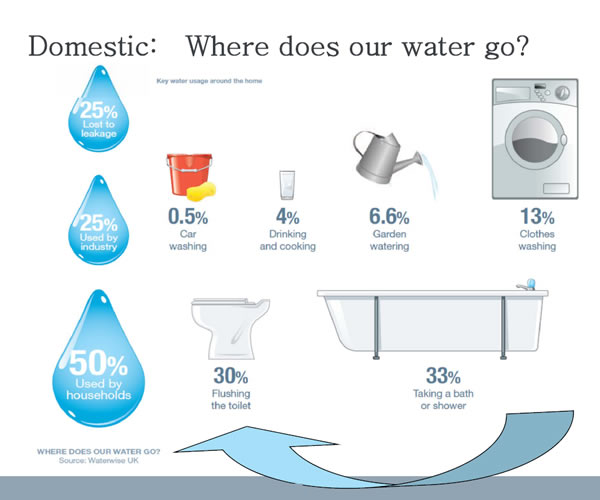
One of the efficiency and eco objectives is a house that is water efficient.

Two slides, from different sources on domestic water use / water consumption:

My initial straw polling, is getting a strong reaction to the idea of a urinal, let alone a waterless urinal, from  at least 50% of the girls reacting!

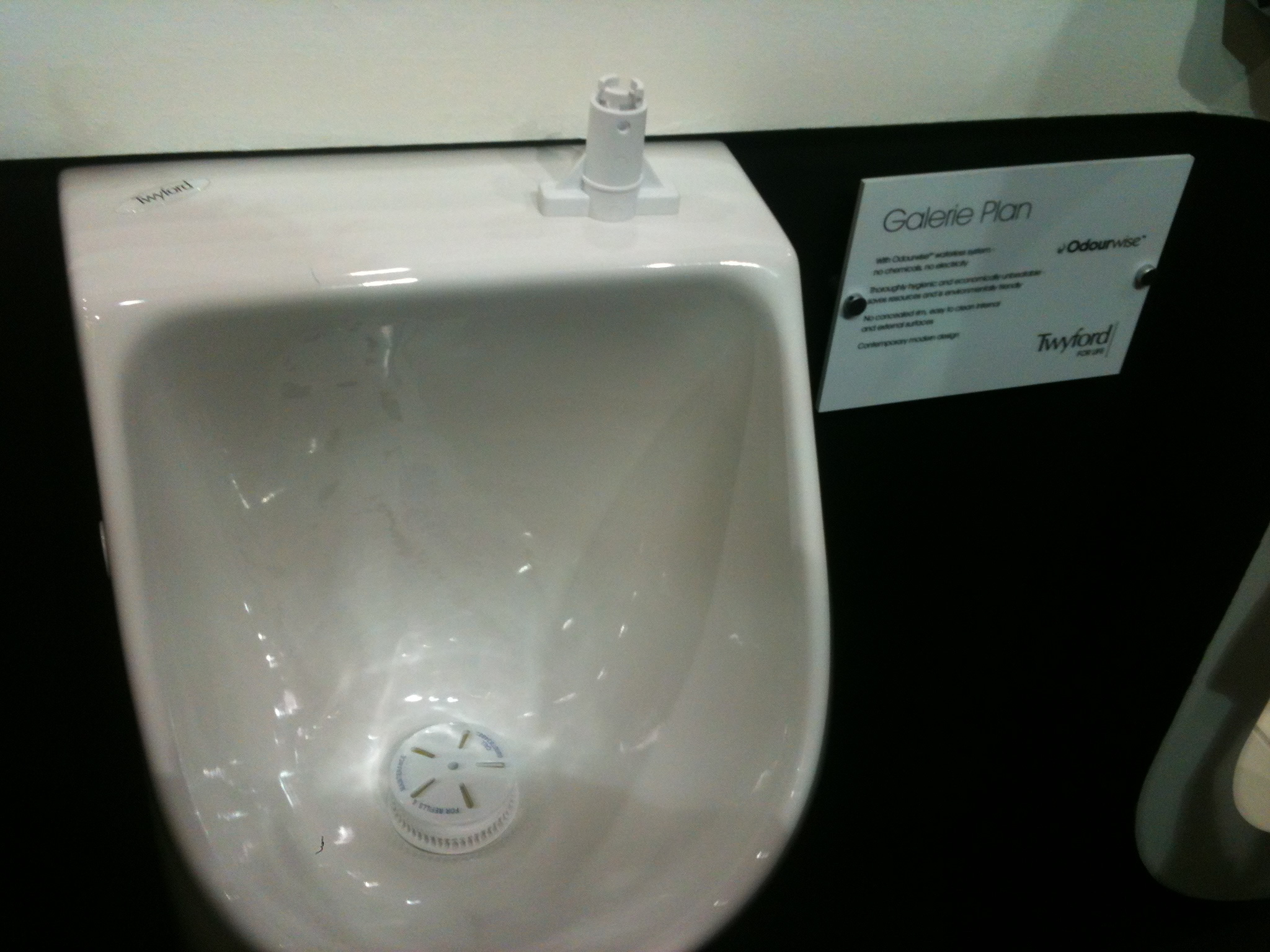
Waterless Urinal

This has the potential to drastically reduce the amount of water used in the house.

They are marketed as “clean, green, odour free and waterless”.

I had it all explained to me on the Odourwise and Twyford stands. The module that fits into the bottom of the urinal converts all uric acid to a form that prevents lime scale, clogging up the system, takes away the smell etc. It seems that urine and water are a big source of limescale and other loo waste pipe problems, hence trying to dilute this away with (usually) lots of water.

All you need to do, is a few times a year (depending on use levels) replace the cartridge. In this photo the plastic bit on the top is the device to extract the Odourwise bit so that it can be replaced with a new cartridge.

A google search reveals there are a few alternatives, so more research needed.

My current thought is a urinal in the bathroom  off the main living area and also one in the bathroom off the study.

Also on show at Ecobuild 2012 will be the Odourwise™ Waterless urinals. Twyford Bathrooms offers the revolutionary Odourwise™ Waterless system for two of its urinal ranges, Centaurus and Galerie Plan. Centaurus is the first hybrid urinal that is truly waterless, combining maximum water savings with enhanced hygiene. The cutting-edge Odourwise™ Waterless technology requires neither chemicals nor electricity, keeping it eco-friendly as well as economical. The urinal is also entirely rimless, making it easy to clean (both within and outside the bowl). Installed with the Odourwise™ Waterless system, Galerie Plan offers the same cost-effective and eco-friendly benefits as Centaurus.

Toilet Sink Taps to be Sensor Driven?

Why use your hands to touch the tap to get the water flowing, before you’ve washed your hands ?

Why have the water running when hands aren’t beneath the taps ?

I need to check out the cost and any other implications. I assume they use a tiny amount of electricity, but best to check.

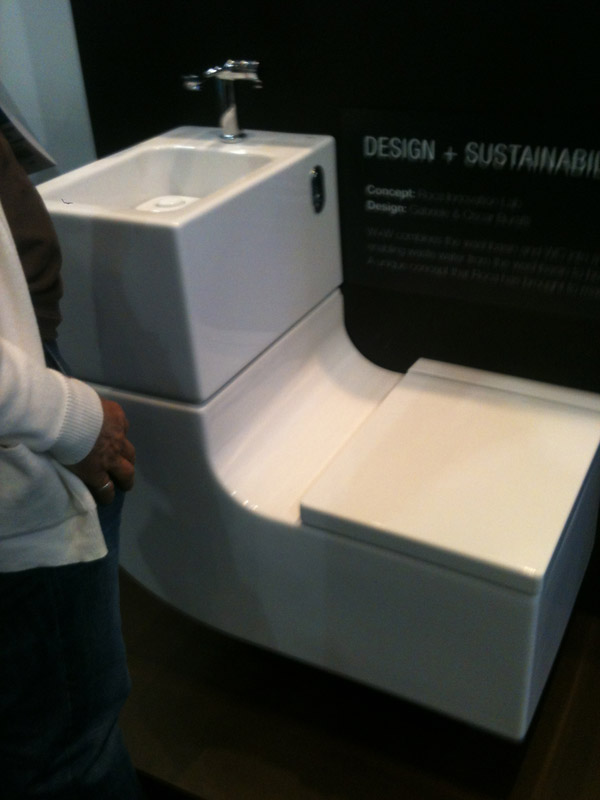
Combine the Sink and Loo ?

This great combined unit captures (there is an optional bypass if you don’t want it to, eg if you’ve cut your hand) the water you use to wash your hand and then stores this to flush the loo. Integrated 1 unit grey water system.

BUT, £2,500 !!!!!

I’m pretty sure I can have an entire house grey water system for a similar amount.


EcoBuild: Thermodynamic Panels (Heat Exchanger)

Thermodynamic Panels

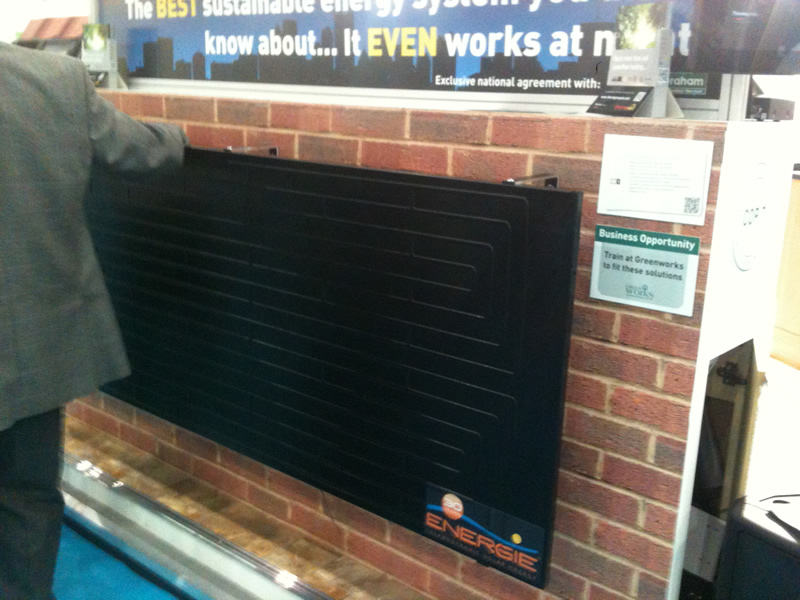
These black panels were on display:
http://www.thermogroupuk.com/thermodynamic.html

These black aluminium panels have refrigerant fluid pumped into them. The heat absorbtion of the black panels changes this to a gas, that is sent to a compressor, which releases heat energy in the heat exchanger where the heat goes into the water. The gas then goes through an expansion valve, putting it back to a liquid before it goes back to the panel. (See explanation & figures below forum comments below).

Claims:

  • 55 degree C water output.
  • Can provide 100% of hot water and heating, 24/7, 365 days a year.
  • Works day or night, as it absorbs heat energy from the atmosphere. It is presumeably helped when it’s sunny !
  • Works when temps are down to -15 degrees C
  • Can be wall installed, which would work well for the Silver Spray proposal.
  • Co-efficient (COP) rating of 4.5 to 7.
  • Distributed by Jewson.
  • 1 panel system (with the boiler and reverse refrigeration bits) is about £4,500.
  • Can have multiple panels in a “toast” stack. Expo figure for that was about £6,500.

Forum Comments:

http://www.greenbuildingforum.co.uk/forum114/comments.php?DiscussionID=7740&page=1#Item_0

  • “Looks like it’s a heat pump with a solar-assisted air to liquid heat exchanger on the outdoors end.” seems to sum it up pretty well !
  • “depending on the heat pump, it’ll be better (better COP) than an ashp in sunlight, but probably worse at night unless there’s much wind to move air across it, although it will have a bigger surface area than in most ASHP’s which will compensate for this to some extent. “
  • “It also has the advantage of not needing (potentially noisy) fans”

Also from the forum, from their N. Ireland distributor:

The system is not new technology; it is basically a freezer “in reverse” and like a freezer consists of a heat collecting panel(s), refrigerant piping and an integrated electric heat pump.  It is a clever application of well tried and tested technology that has been around for almost 100 years.  The panels are made from weather protected anodized aluminium and are not vulnerable to extremes in hot or cold. They are light, weighing only 8 Kg and may be mounted in virtually any orientation or angle.  It has been estimated that 25% of the energy absorbed by a panel comes from solar irradiation, the balance taken from air and rain. Both sides of the panel are available to collect energy. The company that manufactures the system is based in Portugal and to meet growing global demand they have just built a second factory reflecting their 25 year history of success with the product.

You can check them out at http://www.energie.pt/?cult=uk

The Energie system is fully scalable from 1 – 2 panels for domestic hot water, to 4 – 24 panels for central heating right up to 40 panels for large volume hot water requirements. Note that additional panels simply mean faster water heating times, not higher water temperature which is set to between 55 and 60 C maximum.  A typical domestic installation for domestic hot water will have a 250L cylinder with a single panel mounted on the roof.

The heat pump is integrated directly into the Energie cylinder so an existing hot water cylinder cannot be used in this configuration. For central heating and large volume hot water requirements the heat pump (Solar Block in Energie speak) is a stand-alone device. Energie cylinders are either stainless steel or enamelled steel and can come with an additional coil for connecting into a backup heat source if desired. Sizes range from 200L to 6,000L.

All Energie Thermodynamic Systems are accredited under the MCS scheme.

The system uses 407A refrigerant and doesn’t need topping up. The only maintenance may be the occasional replacement of the sacrificial anode in the cylinder should you live in an area with soft water.

Another point raised concerned the panel frosting over in winter. This is possibly best addressed by personal experience.  I installed a 300L single panel system in my home at the start of this year, and although there was some frosting in the very cold weather at that time on the top surface of the panel, the bottom side was clear, and we always had enough hot water. Eight months later we have never had call to revert to either our central heating boiler which has been turned off these past 5 months, or the small integrated immersion that comes with the Energie cylinder. I estimate from measurements I have taken that the Energie system has used an average of 3.6 KWh of electricity per day over the 8 months January to August for our 4-person household at a COP of just over 3.

Hundreds of Energie systems have been installed successfully throughout Ireland over the last 4 years and having come through last winter are well tested for the vagaries of the UK and Irish climate.

Finally some additional information as supplied by Energie can be found using the link below. http://www.e3renewables.com/downloads/

More Information from ThermoGroup

From:

www.thermogroupuk.com/thermogroup_pdfs/Thermodynamic%20Technical%20Information.pdf

1. Aluminium Panels
Refrigerant fluid circulates through the panels and absorbs heat energy from the atmosphere. This increase in temperature changes the fluid into a gas.

2. Compressor
The gas then passes through a compressor and the temperature increases.

3. Hot Water Cylinder
The hot gas then flows through a heat exchanger in the Thermodynamic Block which transfers the heat into the water, which can be used for sanitary hot water, space heating or larger applications such as swimming pools.

4. Expansion Valve
The gas then passes through an expansion valve, reverts back to a liquid and flows back to the panels to
repeat the process.

Figures for Thermodynamic Atmospheric Energy Panels

I read or heard at the show, that increasing the number of panels increases the speed at which the system works. So I think you could add a panel to make the system work faster at grabbing the optimum conditions? (Need to ask them)

Air Source Heat Pump Vs Thermodynamic Atmospheric Energy Panels:

 Air source heat pumps  Thermodynamic
• COP of around 4
• Outputs of 6-18kW
• Outdoor noise pollution
• Requires regular maintenance
• Efficient to just below 0 degrees C
• Fixed sizes
• Fan assisted, low active surface area
• COP of up to 7
• Outputs of 1.7 – 53 kW
Silent outside
• Only one moving part
• Works down to -15 degrees C
• Total flexibility
• Active surface area of 3.2m2 per panel
 Standard Solar Thermal Panel  Thermodynamic
• Provides up to 70% of your hot water
• Must be mounted south facing for best results
• Needs backup from a boiler or immersion heater
• Needs sunlight – low performance in winter/night
• Can only assist central heating
• Fragile glass panels
• Provides up 100% of your hot water.
• Can be mounted south/west/east/north on a wall
• No backup required – Not connected to boiler
• Works in the dark and down to -15OC – 24/7
• Can provide 100% of your central heating
• Aluminium – tough, long lasting, anti corrosive
They can work on a north facing wall, but work best the more direct solar exposure they get.

Case Studies and Cost

Running Cost:

From www.thermogroupuk.com/thermogroup_pdfs/Thermodynamic%20Case%20Studies.pdf:

  • 4 bed house, one panel & 280 L cylinder, for hot water only = £109.50 pa
  • 3 bed house, 6 panels & thermodyanmic block for central heating only = £346.75 pa

So how much would a central heating and hot water system cost per annum ?
– those figures have an assumed electricity tariff of £0.14/kWh. If the system is part driven by my own solar panels, the cost would be reduced (although you need to factor in the capital cost of the solar panels.)

Purchase Cost:

Need to add in the cost of having it all installed and signed off to the level that’ll hopefully get the Renewable Heat Incentive.

From www.thermogroupuk.com/thermogroup_pdfs/Thermodynamic%20Kit%20Retail%20Prices.pdf

Thermodynamic kits ship pre-gassed, ready for installation and include the following:

  • Thermodynamic Panels/s
  • Panel Fixing Kit
  • Hot Water Cylinder with Thermodynamic Block
  • 30m Copper Pipe
  • 30m Low-loss Lagging

The above thermodynamic kits are suitable for supply of sanitary hot water in domestic applications. Thermodynamic systems for Ambient heating or larger applications require a more detailed specification to ensure we provide you with the right solution.

I’ve emailed them for a rough quote.
EcoBuild: Air Source Heat Pumps

Air Source Heat Pumps

The installers / advisors to projects that were speaking at the lectures for self builders were all very positive about air source heat pumps in terms of how they work and how they stack up from an environmental / energy / sustainable point of view.

There are now automated systems for (for example) an air source heat pump to kick in when Photo Voltaic (PV) panels are producing more electricity than the house is using, and so at those times top up the water thermal store in the building. This can then be used for hot water or heating (under floor works at lower temps) at other times (if needed).

Scarlet Hotel inspiration

Robert from ra-studio and myself went to the the The Scarlet Hotel,  for lunch to go over the plans progress and also to look at several aspects of the Scarlet Hotel that Robert had not seen.

As ever, a stunning lunch with amazing service and some more ideas / inspiration.

Some of which was reminding myself and showing Robert their smaller bedroom layout.

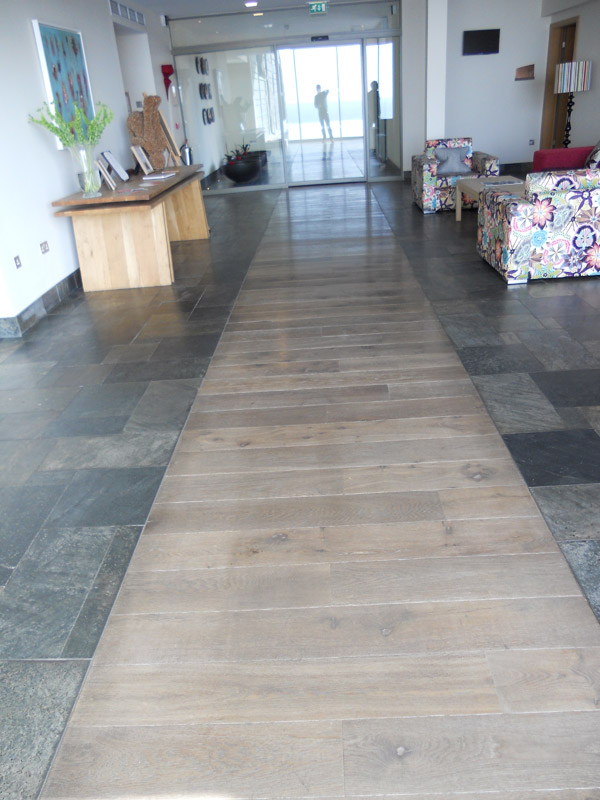
I also thought that we might consider having a central strip / floor corridor of wood from the entrance area, past and through the living area and kitchen, to the top of the 3 stairs down to the lounge. The current plan is slate or tiles for the entrance and living area (dinning, kitchen etc.) and wood for the lower living area.

I also like their stone work fire breast, but not sure this will work.

And good to see further Cornish wood cladding.

Utility, shower and plant room

The idea is that in addition to a downstairs loo and room for shoes and coats, there will be a room for the washing machine, that also has in it a shower, sink, drying rack, and probably screened off, the “plant”.

The plant elements aren’t foliage etc. but the large bits of machinery for the house such as the hot water tank, Mechanical Ventilation with Heat Recovery (MVHR) unit etc.

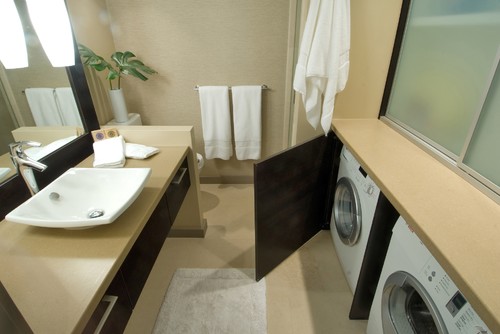
So, not a lot more on this at the moment, but spotted this photo, that could be a start of this room. ie put the washing machine in a cupboard ?

Waikiki Chic contemporary bathroom

Components:

  • Washing machine
  • Shower
  • Hot water tank
  • MVHR unit
  • Sink
  • Drying area – potentially with a drip tray, as it will probably include wetsuits etc.

It’d make sense to look over the photos etc. for the coats, shoes etc. room.

Not a fan of this look and feel, but the storage looks good for the utility plant room.

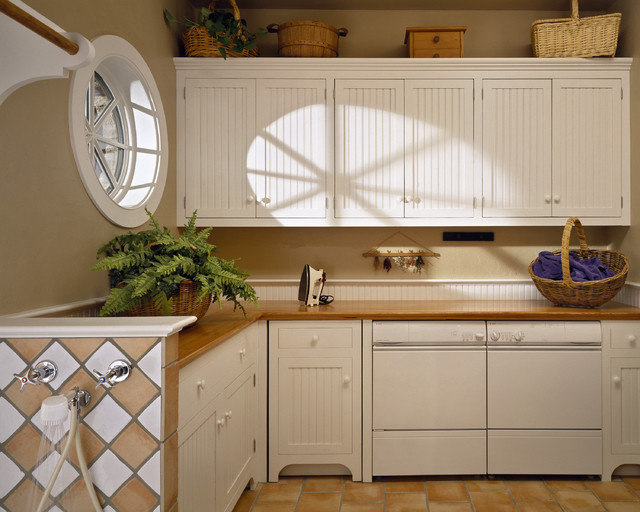
traditional-laundry-room

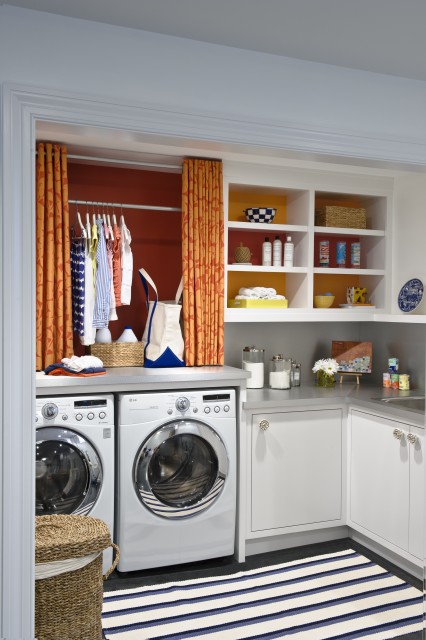
The idea below of an over the washing machines hanging rail could work well. But there also needs to be some full height hanging for wetsuits to dry.

over the washing machines hanging rail

hand rail could be elsewhere:

hanging rail

Washer and dryer platforms. The laundry room below puts the washer and dryer on a pedestal. I’m not having a drying machine, but it might be good to put the washing machine on a slight pedestal.

washing machine raised

Utility room sink to rinse wetsuits etc.

Also some counter top space.

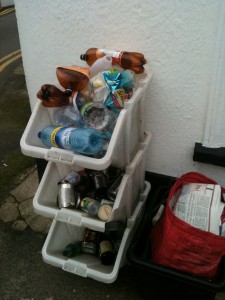
The plant utility room might have extra space for the recycling (there will be some in the kitchen units).

IMG_1335

Coats, shoes etc. room

The first post about this, was creating an area for coats, shoes etc.

I’ve put feedback on these ideas at the bottom of this post >>

The plans are evolving this to a room for coats, shoes etc.

It looks like this is called a Mudroom in the US.

Have a think of what else to add into this room:

  • A safe, as it’s where you might want to leave car keys, wallets etc ?
    • There could be an additional safe for passports, jewellery etc. elsewhere in the house.
  • Black board or other family notice board.
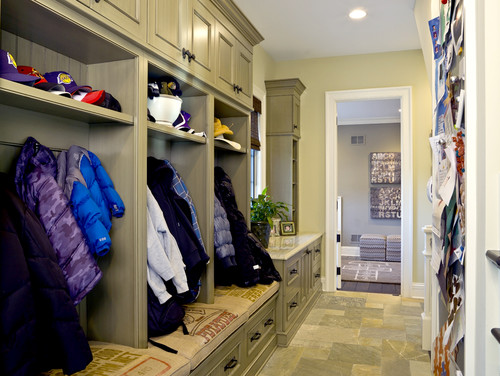
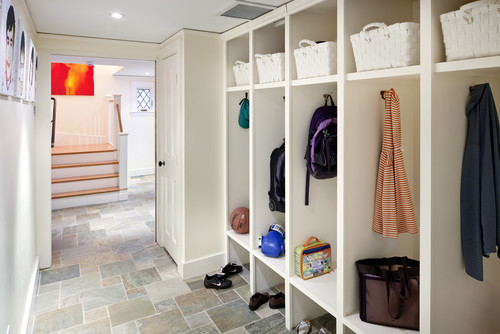
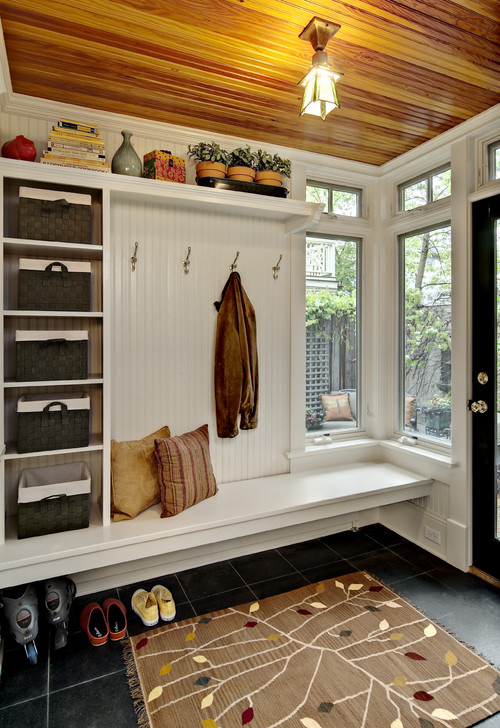
French Country - custom built mud room traditional entry

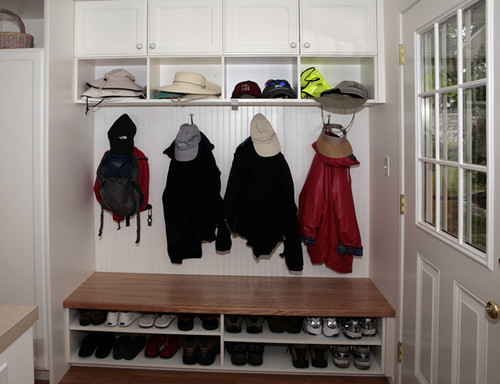
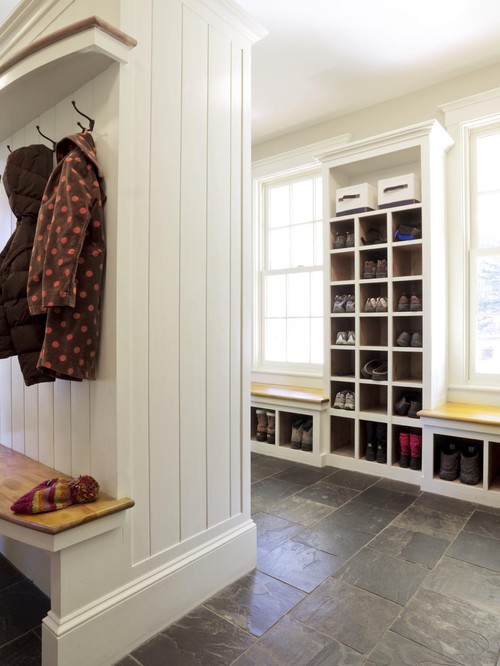
I like the cushion / lip, so that those who want to, can site down to put on shoes, boots etc.

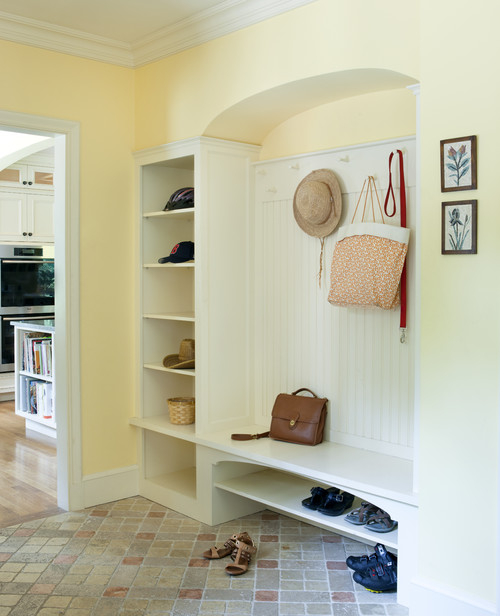
kitchen eclectic kitchen

I like the lower shoes area is straight onto the floor and not a drawer. This should make it easier to clean /tidy.


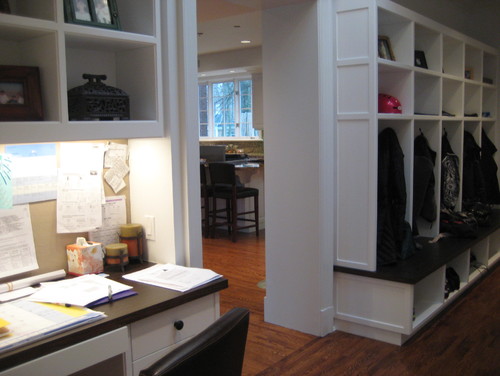
cubbies and desk traditional hall
traditional hall design by
It’d be good to have a coats, shoes etc. area for the office.
 

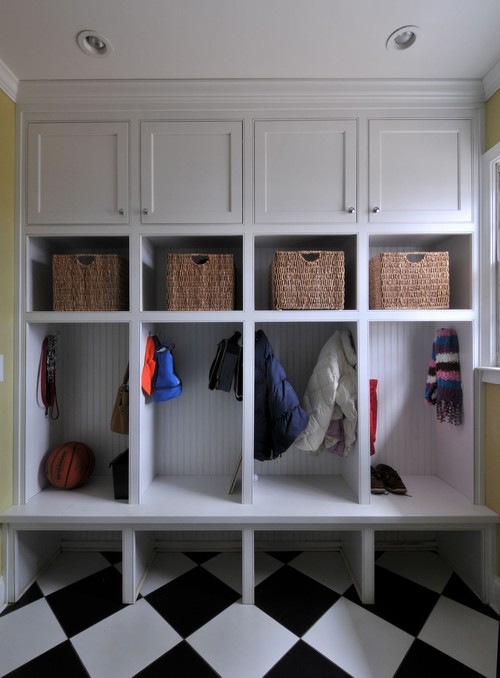
Carpenter Gothic Mudroom traditional entry

Having multiple slots, means you can hang coats on the back and side walls of each “slot”. There could be a per person slot (well it could start like that).

ASID Showcase House traditional entry

Or everybody uses one shared space ?

Tudor Addition Mudroom traditional entry
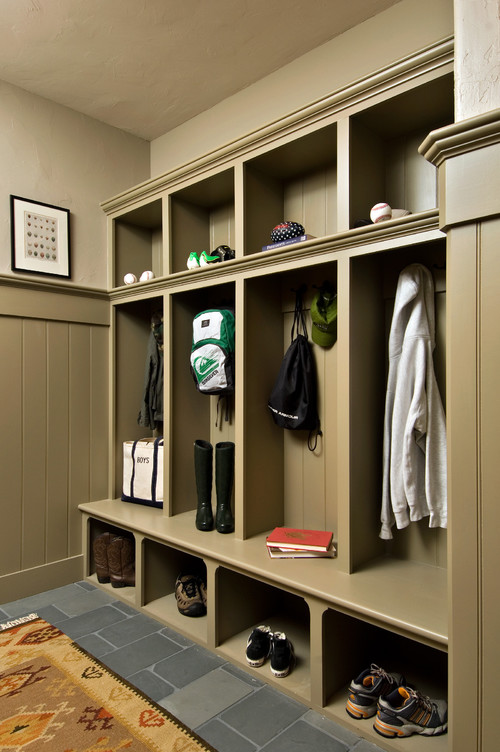
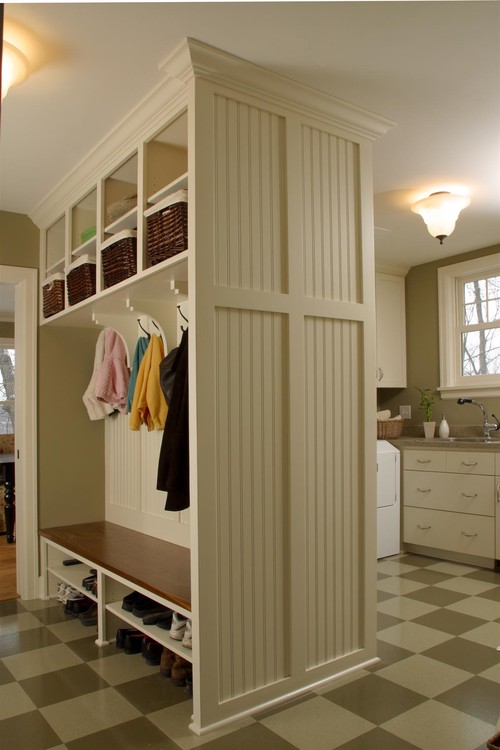
2011 Showcase - Hillside Retreat modern hall

Does this one nail it. Thin walls to segment the spaces and give extra hanging hooks on the separators?

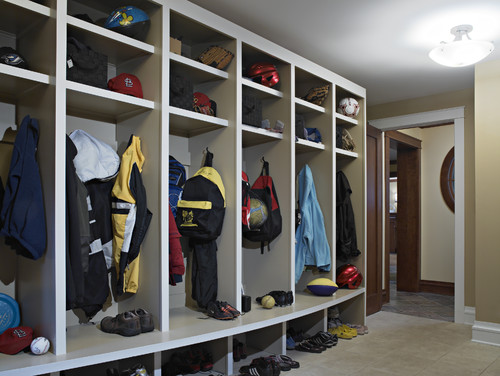
Mudroom Ideas: Locker Room

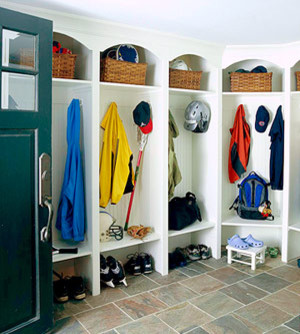
Baskets for up above, so it’s easy to pull down your basket of stuff. eg wool hats and beanie’s.

mudroom storage traditional entry

Get in multi tiers for shoes. But make sure there is also space for taller boots, wellies etc. too.


Farmhouse Revival traditional entry

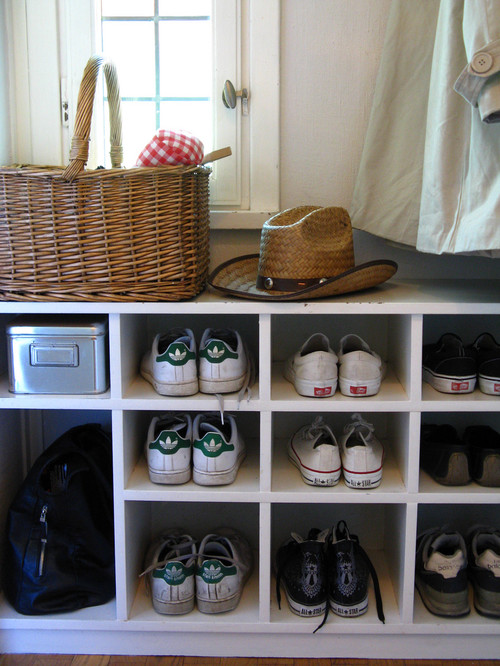
Getting lots of shoe storage here.

Chez Larsson- Shoe cubbies

and here.


better flow - the mudroom / laundry room eclectic laundry room

May as well build storage right to the ceiling !

Mudroom  hall

Feedback on these ideas:

  • There is a danger of the ‘compartments’ being too school like. I prefer maybe 2 large ones, rather than lots of individual ones.
  • Yes to the wood panelling.
  • Should defo go up to the celing with top level shelf/ baskets
  • Keep it simple- maybe half of shoe space double height for wellies & other half 2 shelves
  • Like the sitting bench.

Utility room

  • In my view should also have hanging space for your washing- perhaps like our laundry at home, we have a hanging thing above the washing machines etc .

Mirrors to catch the view.

OK, there are plans for bathroom mirrors, but how about mirrors to reflect the view ?

For example 1 or more mirrors on the south side of the living area or bedrooms that have a northward view over the sea and beach, so that when you look away from the sea, you get these reflected views of the sea.

In the living area, this could be a mirror on the corner post opposite the stairs +/or on the sliding door to the boot room.

from lounge towards the entrance - mirror

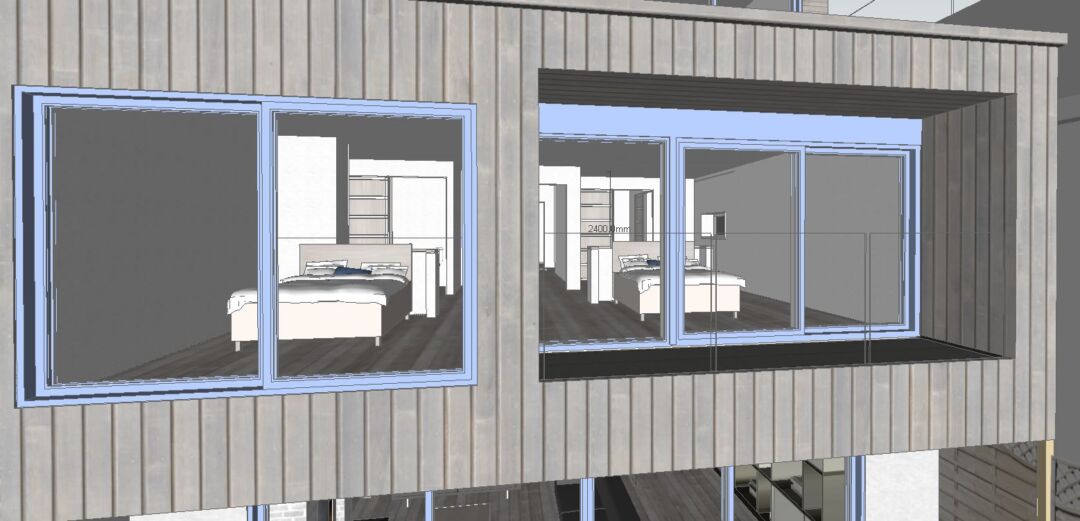
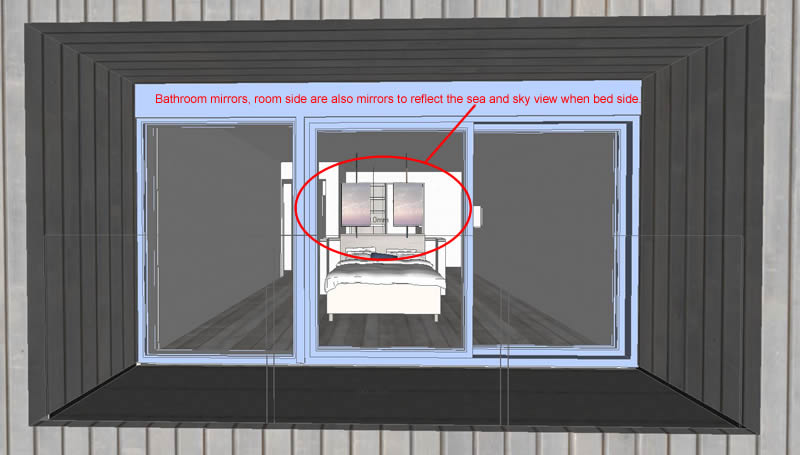
With a half height wall between the bed and bathroom area for the 2 sea side bedrooms, the idea is for mirror(s) that are in this open space:

front bedrooms from outside

The above photo from the SketchUp model shows how you can see from the bed, back into the bathroom areas.

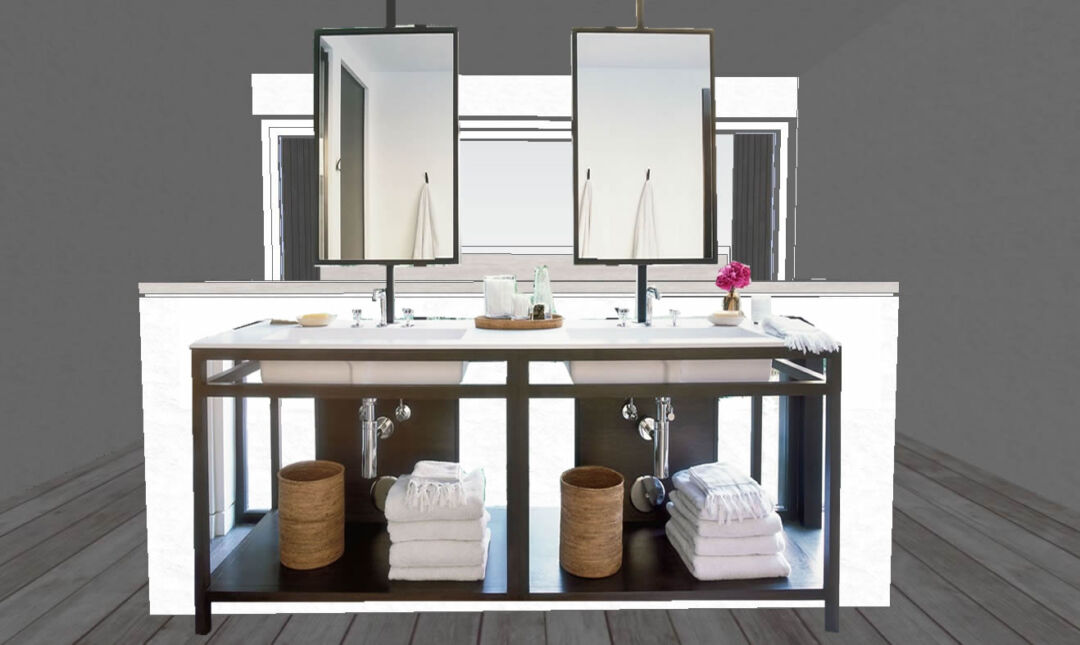
The current idea is mirrors that are on supports from above and below:

double sided mirrors - from inside - mockup

The sinks and storage will probably be different from the above mockup.

From in the bedroom, these can be mirrors on the other side, so that in the bedroom area, they are mirrors of the view out to the sky and sea:

double sided mirrors - from outside