Asbestos removal

17 April 2013

Afternoon site meeting with Martin & James from ARCO2 / Eco Fab and Simon (Project Administrator) and myself.

Site refresher for Martin & Simon. First site visit for James.

Discussion re the best approach for what to dig out first, where to create a crane location etc.

Then back to my place for and around the table good catch up on where ARCO2 / Eco Fab are with regards to the detailed specification & drawings, so that we can firm up on pricing and get to a consequent contract etc.

It looks like ARCO2 / Eco Fab are a few weeks off the detail, so I’m going to crack on with Mark and others with the soft strip and then demolition.

16 April 2013

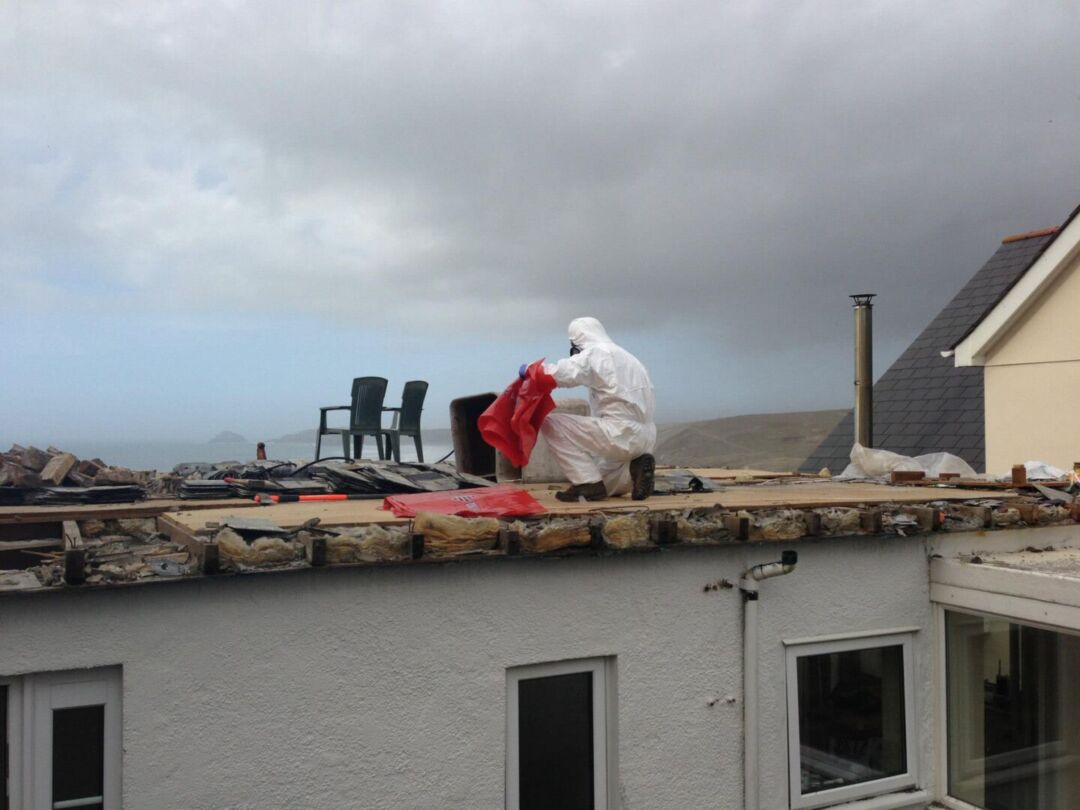
A pre demolition survey for asbestos showed up that the 2 loft water storage tanks were asbestos. As were the floor tiles in the entrance to the front.

These bits of asbestos were removed by Alan. Thanks Alan !

Asbestos removal

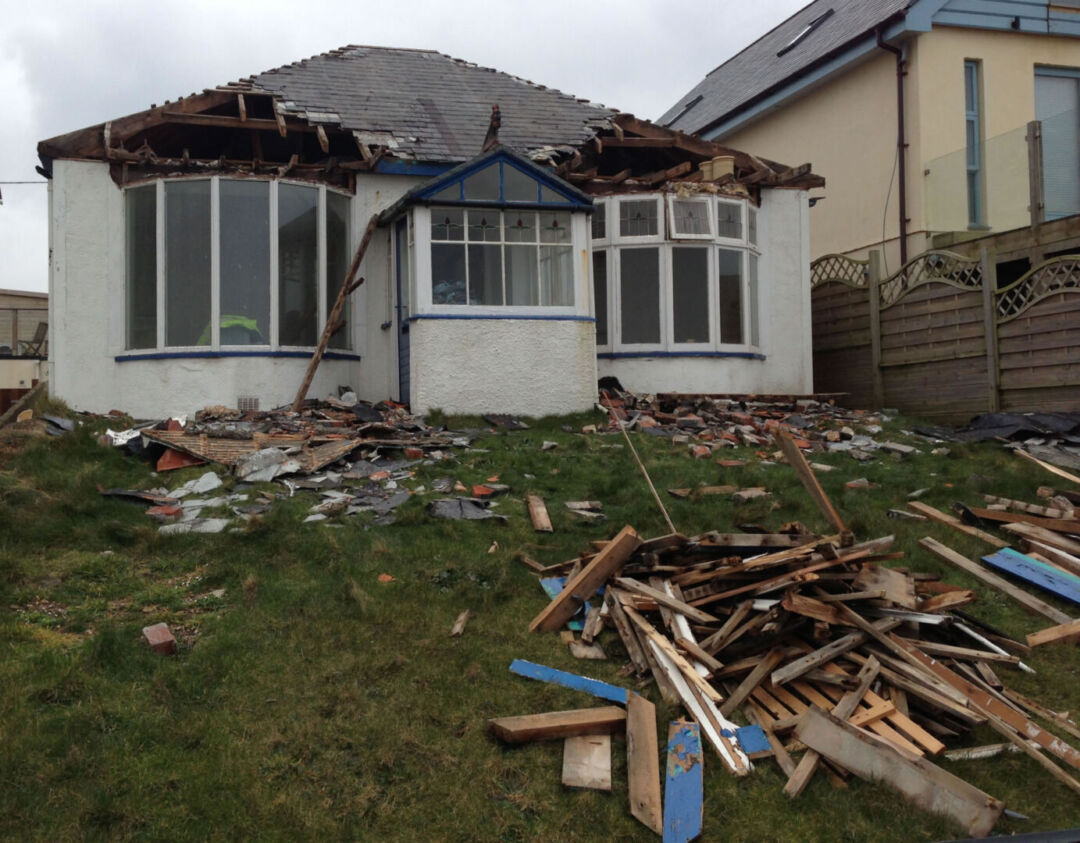
Soft Strip ….. continues a bit further

15th April 2013

Mark continues to crack on with taking the house apart.

It is looking like the tongue and groove floor boards are too well nailed and joined and dry to get up without them all getting wrecked / broken.

There has been a good recovery of the roof tiles that are from 2mm to 6mm thick.
– maybe a series of table place mats and coasters ?

This morning, the 15th of April 2013, although most of the tiles were off at the front, from the back (see picture below) it was till a bungalow with a roof.

Silver Spray still has a roof

Walking up the road in the evening, the roof was gone!
– and the photo opportunity of Mark in the chair was too easy.

Silver Spray roof has gone

Pretty dramatic from the rear garden:

Silver Sprayand a great view from roof that will, roughly be the height of the bedrooms.

Silver Spray view at new bedroom height

From the rear fields, you can only just pick out the bungalow past the rear garage.

2013-04-15-17.14.46


Soft Strip ….. continues

9th April 2013

Well the skirting boards are off, so are all the internal doors and there seems to be a challenge with evolving ideas, to get up the tongue and groove floor boards without wrecking them.

It looks like we may have found a home for a bunch of the skirting boards, internal doors and some of the external doors and windows. A friend is renovating a property in Truro and is going to measure them up 🙂

The loft insulation is being extracted and re-distributed around the village to other properties, new and old.

Extracting the loft insulation for re-distribution

A lot of the wood, that can’t be salvaged is being broken down and used in my multi fuel burner to heat my current house. Better than landfill or on-site burning it.

Soft strip

Some, but not all of the tiles look set to be looking for a new home.

2013-04-09 18 _1024w

Ecofab factory visit

The Ecofab panels are either thicker and filled with straw bales, or a bit thinner and filled with the above sheeps wool. The wool is a waste / by product from the leather industry, often for leather seats in car manufacture.

The cover the top surface with a water replant for if they get wet on-site before they are sealed into the building.

Sewage treatment

Although the main pipe that goes from Perranporth to the sewage treatment plant by Cligga goes past the front of the house, that is under pressure and isn’t a pipe we can discharge into.

At the moment Silver Spray is a soakaway !

So, as the house is being “upgraded” we’ll be fitting an on-site sewage treatment plant. These treat the toilet waste and to a level where the water meets the rules to be discharged into the groundwater.

This is what the neighbouring properties all have.

Next door to the east, Ramoth have a Klargester BA 450 BioDisc (now part of Kingspan Environmental) unit, that was installed by Dorset based Environmental Drain Services Ltd.

Talking to Environmental Drain Services:

  1. As it’s a treatment plant and not a septic tank the 7m minimum distance from a habitable dwelling rule does not apply.
  2. You need to be able to, on-going, access the lid to get into it. So you can build decking etc over it, but you can’t stand, drive or put earth over it.
  3. We should be able to rely on the percolation test / survey done for Ramoth way, as this is just next door. It’d be very unlucky for this to not be indicative of the Silver Spray ground.
Talking to Mark at Ramoth, there is not only the Klargester unit, with it’s small power supply, but the outlet feeds into a series of underground trenches, that in their case are closer to the house than the Klargester. These trenches are rock filled to help the distribution of the discharged treated water.


Contractor Contracts

An email in from a buddy who has managed quite a few commercial and larger (multi dwelling) building projects:

The only other things to be aware of and concerned by is the type of building contract to be used. The standard form JCT contracts, I believe, are biased towards the contactor, the ACA standard form was written by Architects and is more balanced.

You also need to think about the level of damages for overrun on the contract. This is slightly more complicated than it might appear. One of the most crucial decisions made by the contract administrator is the issue of the Practical Completion Certificate as this signals the contract has been satisfied.

If there is an overrun, as invariably there is, he has to decide who is at fault and you are in the territory of the famed “critical path”, ie if the delay prevents progress on the rest of the build its on the critical path and who ever caused that delay in culpable. The reason these decisions are important, even for one week is there is a swing for every week by approximately twice the level of damages assuming damages are set at a level similar to the “preliminaries” figure. Prelims are the costs to the contractor of being on site, ie his admin costs. So if damages are say £2000 pw and prelims say £1500pw and there is just one week delay caused by the contractor he is £3500 down. You get the picture it can get very prickly.

Good luck, I am sure it will go well, new builds tend to be easier, provided they are well planned, because there are less unknowns. Keep an eye on any unusual materials and/or bespoke items that have long delivery lead in times and/or are coming from none standard sources as these can be the source of serious delays.

Pipework seals

I suspect these won’t work for any pipework to and from a fire (they’ll melt !)

The ATK Airtight Membrane Kit has been developed to provide an airtight seal around pipework of all types that passes through the walls of buildings. The ATK Airtight Membrane Kit can fit around any size pipe – from cables right through to soil pipes – and offers a robust, reliable and cost-effective solution.

http://www.greenbuildingstore.co.uk/page–pipework-seals.html

Project Management

A nice article by Charlie Laing on Project Management at:

http://charlielaing.wordpress.com/2012/08/18/controlling-your-building-costs-through-robust-contracting-techniques/

They talk about a  Joint Contracts Tribunal (JCT) contract between builder(s) and client. Going through it and both signing it, so that there is a pre established way to control the work and exchange of money that is fair to all.

For changes during the project, their advice is that:

  • contract changes can only be made by the project manager / contract administrator (which should not be the client).
  • the builder should quote for the changes
  • the contract manager uses this to get client approval. If given, passes this on to the builder.

As I’ve read elsewhere, informal approval changes from the client is the most common area for problems when the consequent bill for this arrives.

A Joint Contracts Tribunal (JCT) contract, brings with it an agreed adjudication / arbitration route, but in most cases, a common sense, sit down and come to an agreement solution is best. Here the contract manager can mediate.

For this, Charlie Laing have some suggested questions to cover the conversation over what is being claimed. Is / was it:

  • described within the contract?
  • described as a revision to the contract and the contract sum?
    – if yes, was it requested, quoted for and approved?
  • related to completed work? Is there any evidence that it has been done?
  • related to work that the contractor had to redo through no fault of his own?
  • requested directly by the client?
  • raised by the contractor to the client directly as an option that they may choose?
  • clearly confirmed by the contractor to the client as being at extra cost?
  • carried out with an element of risk by the contractor through not following procedure?
  • in line with market rates for materials and labour time used
  • related to the actual labour time used

In light of the answers to the above, is full payment of the claim considered fair and reasonable?

This all re-enforces the idea I’ve read elsewhere abut keeping a site / project diary. ie keeping your own notes and other records.

 

The Natural Home – Ecobuilding Consultancy

It was a while ago, that I met up with Adam & Sarah from The Natural Home, Ecobuilding Consultancy.

It was great to get input from a team that don’t have a vested interest with a particular main project supplier, such as the architects or builders.

Amongst their many comments and recommendations:

  • If you find a contractor you trust, they’d recommend their employment under a ‘prime cost’ (also know as ‘cost-plus’) contract. This means the contractor charges for the total price of buying goods, materials and components, of using or hiring plant and of employing labour, in order to delivery the construction project plus a management fee.
    Their are apparently a broad range of contracts available and they could advice / assist with this.
  • Adam pointed out that the distance from the proposed house to the garage at the front may need advance consideration in relation to the surface water run-off  from the building and soak-away. This / these have to be at least 5 meters from the building, so may need to go beneath the garage.
    Adam recommended a permeability test to ensure a soak-away can accommodate the volume of discharge.
  • Current building re-use. As clearing the current building will give a large amount of aggregate, Adam suggested that it might be possible to crush and use some of this in the concrete mix for retaining wall sections.

Second pre-app meeting with Cornwall Council

Today, Robert (the architect) and I had our second pre application meeting with Cornwall Council.

The first pre-app was great. We felt the verbal meeting and post meeting written response were both very positive. They wanted some tweaks / work done on 2 small areas. The first was more that we hadn’t covered that we were making all the considerations we should. We did have it all covered, but this was written up in the pre-application we made. The second was that they felt we could change the treatment of one of the areas to visually improve it.

So this second pre-app was to go over our submitted suggestions and ideas. The planning officer had a preferred option, which, in our view, looks great and lets us crack on with finalising plans.

The next step is to run the general scheme past a few potential builders, and probably a structural engineer and probably a Quantity Surveyor (QS) so that we can confirm it’s all feasible to build and that the budget is sufficient for the current plans and ideas.