Recycled Foamed Glass Insulation

28 May 2012 Update:

I put a post on greenbuildingforum.co.uk and the consistent reply is that it’s more expensive than well used and well know Leca, which is usually used with a breathable Limecrete floor. I’m not sure if it’d work / work as well under a non breathing floor.

http://www.greenbuildingforum.co.uk/forum114/comments.php?DiscussionID=9113&page=1#Comment_147104


I was at a Green Building show / expo / day at the Eden Project last week and there was a talk by a German sounding chap, who is part of the UK Epoc Europe Ltd team promoting / pushing their TECHNOpor (Recycled Foamed Glass).

The key points seemed to be:

  • uses 100% (or close to 100%) recycled materials (glass bottles etc.)
  • German factory is powered by HEP electricity.
  • light to transport on low emmisions trucks from Germany.
  • easy to work with.
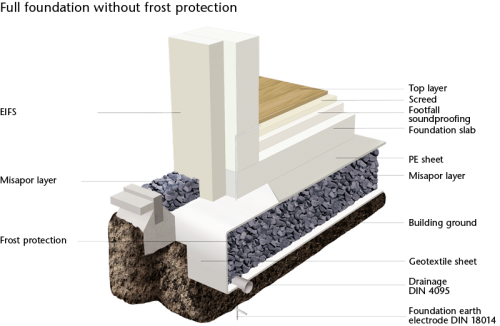
  • good insulation values for under the floor, behind retaining walls.
  • can even be used for between floor and in ceilings insulation (as super light).

I’ve found 2 UK Websites related to this:

The German site for TECHNOpor is http://www.technopor.com/English/Granulat/

The Swiss site has a great idea of using bags for when you use the Recycled Foam Glass to insulate a wall. Given that there will be 2 retaining walls, this could be great.

From www.misapor.ch:

Saving energy and water :: Pipework

An interesting GreenBuildingForum.co.uk thread.

Long +/or copper pipes mean that the amount of water that needs to flow to a tap, before you have a hot tap can be a lot. Shorter plastic (that don’t absorb the heat, until they heat up) pipes will have a big impact on reducing the amount house users will run a tap in order to get their hot water needs / desires.

Also discussed is having thinner diameter pipework. If you have enough pressure, this means there is less water sitting in the pipes between times the hot water is requested. Suggestion is 12mm pipework.

Construction (embodied) Energy Vs Operational Energy

My Summary / Conclusion

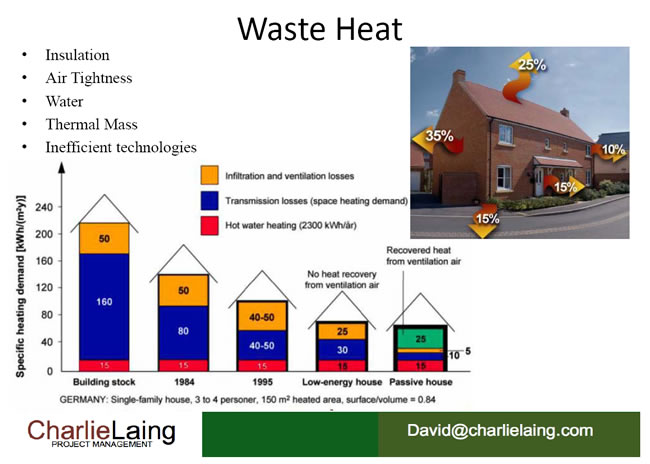
  • In 2007, 16% of CO2 equiv impact is construction of a building, 84% is operational / in-use.
  • Today the split is roughly 20% embodied and 80% operational.
  • The modelling shows that we are moving to a CO2eq (CO2 equivalent) of 38/62% for masonry construction, and 35/65% for timber-frame construction.
  • No significant differences emerged between masonry and timber construction in terms of overall CO2 impact over the 60- and 120-year study periods. The largest difference observed between comparable masonry and timber constructions was 4%.
  • No clear / significant impact of thermal mass.
  • Emissions are cumulative, so 1 tonne of CO2 equiv at the point of construction roughly equals a tonne of CO2 equiv during the 60 year life of a building.

Which aspects of a dwelling are responsible for the largest CO2 impact?

  • Space and water heating have the largest CO2 impact in dwellings.
  • Appliances also have a large operational CO2 impact.
  • In both masonry and timber constructions, the impact of foundations and ground floors dominates the embodied CO2eq impact.
  • In masonry construction, the external walls also have a major impact.
  • Other elements, such as windows/doors and floor finishes, have a relatively large impact because they are repeatedly replaced throughout the life of the dwelling.
    • Waste water heat recovery systems have a 60 year assumed life span (windows and doors – 40, MVHR 15, flooring 10 ….)
  • The embodied impact of services was found to be approximately 5% of impact at 60 years and 7% at 120 years.

Construction Vs Operational Energy

I’ve come across some interesting figures and links to research in an article in the Green Building Magazine (by www.greenbuildingpress.co.uk).

  • Embodied Energy – a ticking time bomb (Spring 2012)

In 2007, around 16% of the CO2 equivalence impact was constructing a building.
– This covers the manufacture of materials and components, transport and construction.

84% of the CO2 equivalence impact of a building was down in use emissions.

This data is from http://www.bis.gov.uk/assets/biscore/business-sectors/docs/l/10-671-low-carbon-construction-igt-emerging-findings.pdf

That is why policy to date has been biased to making buildings more operationally efficient.

The article then makes the point that raises the importance of embodied (construction) emissions. Namely that since emissions are cumulative, 1 tonne of CO2 equivalence impact occurs for every year this “CO2” is in the atmosphere. So 1 tonne of CO2 at the start of a buildings 60 year life will have twice the impact of 1 tonne emitted during the building’s life.

The longer a tonne of CO2 hangs around in the atmosphere, the more damage it can do.

So it’s potentially dangerous to focus on carbon-intensive solutions that are installed at the point of construction, so that they reduce the operational emissions.

So, it is best to look for principles, materials, solutions etc. that will reduce both the construction (embodied) and operational energy of a building. So, as it’s often said, the general advice is still to optomise the fabric efficiency of a building before other measures.

October 2011 Update

The October 2011 report by the NHBC Foundation (“Housing Research in partnership with BRE Trust”) – Operational and embodied carbon in new build housing – A reappraisal:

Until now, focus has been almost entirely on the carbon emissions resulting from using homes, but clearly the balance between those operational carbon emissions and emissions from producing and installing the materials – the embodied carbon – needs to be considered.

This publication explores a subject which has to date lacked a strong and accessible evidence base. It looks at a range of carbon reduction scenarios as delivered through typical house types and estimates the likely impact both in terms of operational and embodied carbon – providing an insight into the contribution of different technical responses to the low carbon agenda, including the balance between operational and embodied carbon.

Evaluated Scenarios:

Twenty-four scenarios were appraised, using SAP software to determine operational CO2 emissions and BRE Global’s Environmental Profile methodology to analyse embodied CO2eq emissions.

The research considered the following variables:

  • two built forms (detached and mid-terraced)
  • two construction weights (masonry and timber frame)
  • three operational CO2 performance levels (25, 31 and 40% reductions over Part L1A 2010)
  • two dwelling lifespans (60- and 120-year study periods)
  • varying grid electricity CO2 intensity (to account for the expected impacts of grid decarbonisation).

Extracts from the report:

  • The modelling showed a typical percentage split between operational and embodied CO2eq (CO2 equivalent) of 62/38% for masonry construction, and 65/35% for timber-frame construction. These are averaged figures.
  • No significant differences emerged between masonry and timber construction in terms of overall CO2 impact over the 60- and 120-year study periods. The largest difference observed between comparable masonry and timber constructions was 4%.
  • The modelling showed that space and water heating, along with foundations, ground floors, windows/doors and floor coverings, were the largest contributors to overall lifetime CO2 impact. Appliances were also a significant contributor, but building designers have limited opportunity to reduce these emissions via their designs.
  • The typical split between operational and embodied CO2eq in new build housing has been taken as 80% operational, 20% embodied, a position largely confirmed by recent studies[1]. However, within the context of future Building Regulations requirements – which are expected to tighten to the point that new homes will be significantly lower in CO2 from 2016[2] – operational CO2 emissions are set to fall radically. This means that embodied CO2eq emissions will become increasingly significant in terms of the percentage they contribute to the overall CO2 impact of new build dwellings. In addition, typically the more energy efficient a given house type becomes, the greater the quantity of additional materials required to construct it (eg additional insulation, more services). There is also potential that such additional materials (eg renewable generation installations) may have particularly high embodied CO2eq levels. Both these considerations suggest that, as operational CO2 emissions reduce, embodied CO2eq emissions will increase.
  • The replacement of services and other building components has a direct bearing on both operational and embodied CO2eq emissions across the 60- and 120-year study periods.

Assumed lifespan of construction elements:

  • The proportion of embodied CO2eq in masonry construction was found to be higher than that in timber construction. However, this difference was relatively marginal, the maximum difference being 4%. This is because, other than the walls, the majority of building elements were similar in both the masonry and timber constructions modelled.

Which aspects of the dwelling are responsible for the largest CO2 impact?

  • Space and water heating have the largest CO2 impact in dwellings; this remains significant in all scenarios despite diminishing slightly as designs move from 25 to 40% CO2 reduction.
  • Appliances also have a large operational CO2 impact, although dwelling designers have limited ability to help achieve reductions in this area.
  • In both masonry and timber constructions, the impact of foundations and ground floors dominates the embodied CO2eq impact.
  • In masonry construction, the external walls also have a major impact.
  • Because both of these areas will last the lifetime of the dwelling, they should be considered at the design stage when seeking to reduce the overall dwelling CO2 impact.
  • Other elements, such as windows/doors and floor finishes, have a relatively large impact because they are repeatedly replaced throughout the life of the dwelling.
  • The embodied impact of services was found to be approximately 5% of impact at 60 years and 7% at 120 years. However, these results should be treated with caution as some aspects, such as controls, had to be omitted due to lack of available data, and the services were not studied in depth during this project.

Did the varying thermal mass levels have a significant impact on cooling?

  • No clear trend was identified from the modelling carried out, with minimal impact from space cooling in both masonry and timber designs.

Ecobuild: An “air tight” building

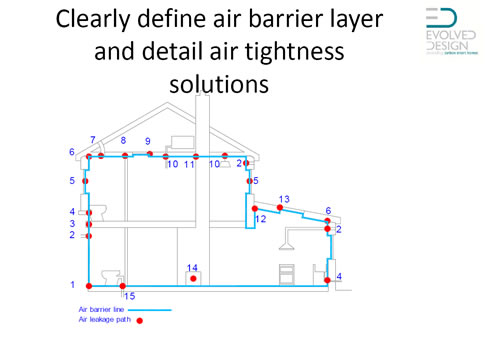
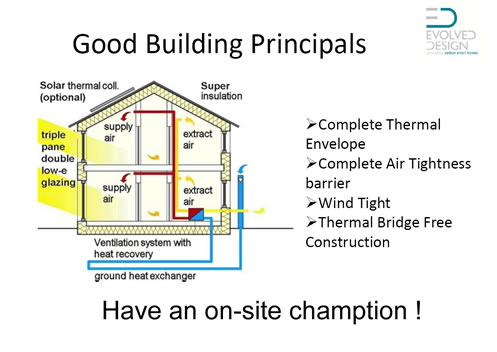
A principal of modern buildings to achieve thermal efficiency and improved health is to make an “air tight” building .

The aim is to head towards and perhaps meat the Passivhaus standard of air change rate of no more than 0.6 air changes per hour @ 50 Pa. (UK Building Regulation Standard is 10m³/m²/hr @ 50Pa).

Then to control / manage the air, by a mechanical ventilation heat recovery system (MVHR) that exchanges inside air with outside air, BUT heat exchanges the outgoing air with incoming air, so you don’t loose the warmth.

The idea worries people, “I want to sleep with the window open ….”. But reading more and more about this, even sceptics rapidly find the air quality is better in these buildings than those with open windows. And, you can just open the window if you want to ! (eg in summer).

Notes from  the Ecobuild expo talks:

I’ve read elsewhere, that the builders being on-side re the thermal, sealed objectives is key.


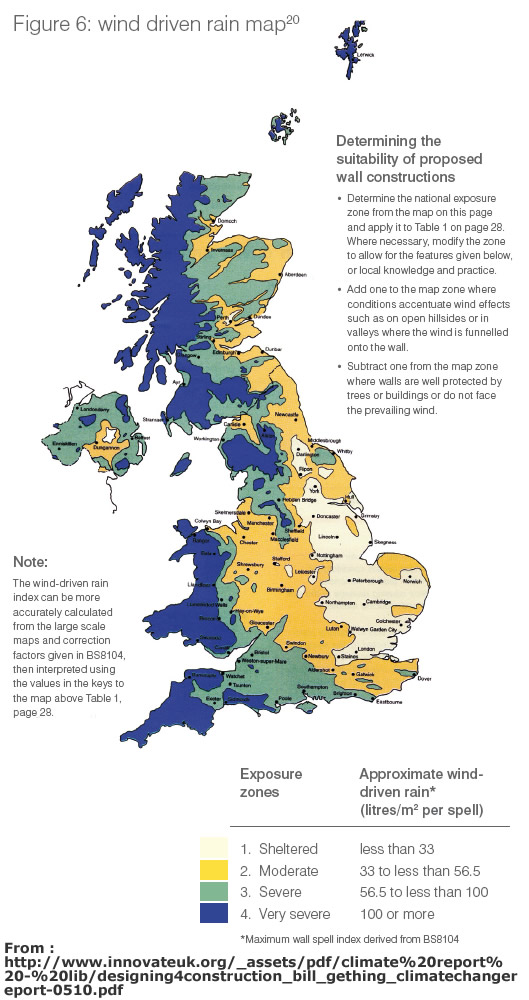
Winter Driving Rain May Increase

OK, we know that man made climate change is here, but don’t know how much the systems will tip it to being worse or to self regulate (or stay on the current trajectory).

But it does mean, that on top of it being a very exposed site, there is the potential for driving rain to increase. See the map below, taken from www.innovateuk.org (PDF).

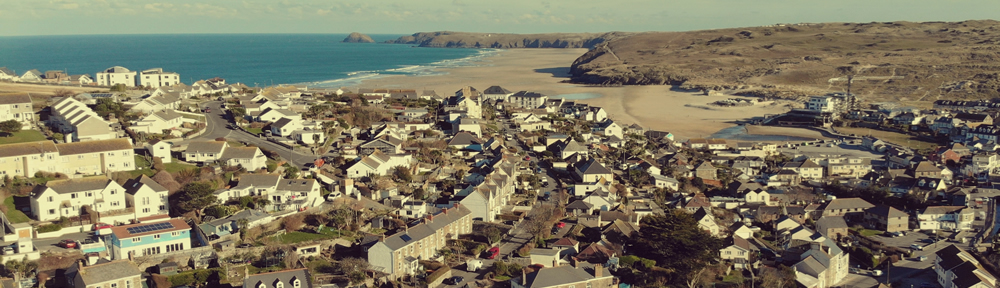
Talking to surrounding residents, that also look out over Perranporth beach, they all say the site gets a full weather beating on a regular basis. The www.innovateuk.org (PDF) recommends the following detailing, that I’m sure ra-studio are already on top of:

  • recessed window and door reveals
  • projecting cills with drips
  • render finishes
  • extended eaves
  • greater laps and fixings to roof and cladding fixings
  • avoidance of fully filled cavities.
There is also (apparently) the issue that materials may behave differently. Again, I’ll leave that to Robert at ra-studio.

Choosing a builder

The Housebuilders Bible outlines how to choose a builder on page 88.

This will, in part be determined by the building method.

Simon Crabb (planned project administrator) has suggested that in terms of managing the project cost, to get each of the contractors to provide a separate quote for the groundworks as this could be done by an additional separate contractor.

It seems to make sense to get builders / contractors to break down the quote, so that they can be compared with others.

Contractors / Routes

There are a LOT of companies that have a variety of full service or part service systems to consider:

Homebuilding & Renovating magazine are piloting a new service within My Building Project, and have teamed up with HBXL to create a unique network of builders local to you to help build your dream home. So when looking for estimates, a local builder etc. could be worth looking at http://www.mybuildingproject.co.uk/en/builder-network.html

Have a look at this blog post, on companies that will off-site build the house (usually with SIPs).

Suppliers:

  • The Cornwall Sustainable Partnership (www.csep.co.uk) provided initial information on local energy experts and green roof suppliers.
  • The Association of Environmentally Conscious Builders (www.aecb.co.uk) is a British-wide network that promotes sustainable building; find local professionals and product suppliers via its website.
  • The Green Roof Centre (www.thegreenroofcentre.co.uk) is an independent research hub founded by the University of Sheffield that has excellent general information about green roof uses.

Partial Builders Short List:

Also see this post re What to do, with who.

The NASA Design Process

http://www.nasa.gov/audience/foreducators/plantgrowth/reference/Eng_Design_5-12.html

STEP 1: Identify the Problem — Students should state the challenge problem in their own words. Example: How can I design a __________ that will __________?

STEP 2: Identify Criteria and Constraints — Students should specify the design requirements (criteria). Example: Our growth chamber must have a growing surface of 10 square feet and have a delivery volume of 3 cubic feet or less. Students should list the limits on the design due to available resources and the environment (constraints). Example: Our growth chamber must be accessible to astronauts without the need for leaving the spacecraft.

STEP 3: Brainstorm Possible Solutions — Each student in the group should sketch his or her own ideas as the group discusses ways to solve the problem. Labels and arrows should be included to identify parts and how they might move. These drawings should be quick and brief.

STEP 4: Generate Ideas — In this step, each student should develop two or three ideas more thoroughly. Students should create new drawings that are orthographic projections (multiple views showing the top, front and one side) and isometric drawings (three-dimensional depiction). These are to be drawn neatly, using rulers to draw straight lines and to make parts proportional. Parts and measurements should be labeled clearly.

STEP 5: Explore Possibilities — The developed ideas should be shared and discussed among the team members. Students should record pros and cons of each design idea directly on the paper next to the drawings.

STEP 6: Select an Approach — Students should work in teams and identify the design that appears to solve the problem the best. Students should write a statement that describes why they chose the solution. This should include some reference to the criteria and constraints identified above.

STEP 7: Build a Model or Prototype — Students will construct a full-size or scale model based on their drawings. The teacher will help identify and acquire appropriate modeling materials and tools. See the design brief for a sample list.

STEP 8: Refine the Design — Students will examine and evaluate their prototypes or designs based on the criteria and constraints. Groups may enlist students from other groups to review the solution and help identify changes that need to be made. Based on criteria and constraints, teams must identify any problems and proposed solutions.

Steel frame with Adaptahaus

This is a follow on from posts about perhaps constructing the house with a steel (and not wood) frame to give better rigidity, given the exceptionally exposed site location.

  • Steel (not timber) frame ?
  • I’ve read a report that shows we should expect an increase in weather severity (magnitude and frequency) in the SW of the UK, over and above global trends in that direction.

Alan at Adaptahaus have got back that yes, we could work with them to:

  • Liaise with local architect / planning consultant, which would let us carry on in that direction re ideas and the general space etc.
  • Liaise with local builder for the groundwork’s / foundations.
  • Attend the site to inspect and install anchor bolts into the cast concrete foundations.
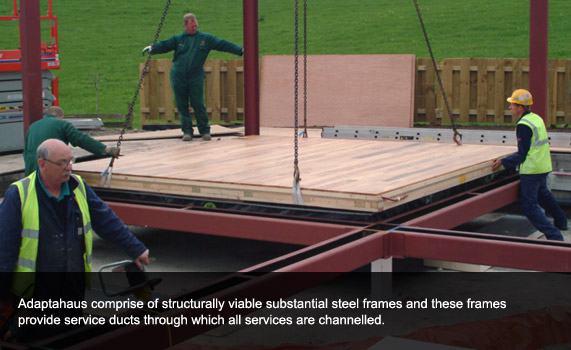
  • Arrive on site with the steel frame + all external panels + floor panels + roof sections.
    • External panels to have external larch cladding, windows installed, insulation and waterproof and breather membranes in place, a services void behind the inner wall face (this inner face to be Fermacell board which requires no plaster skim) and a services connection route at the sides and bottom of each wall panel.
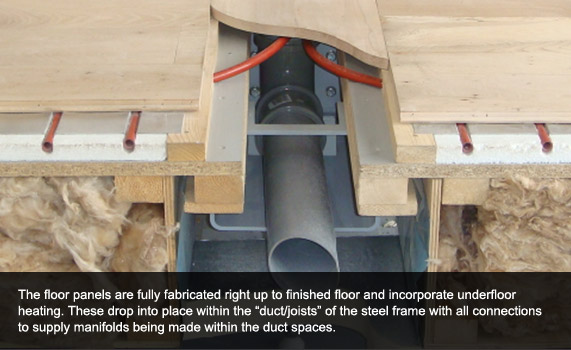
  • The floor panels to be prefabricated timber framed cassettes (ground floor complete with insulation and first floor complete with ceilings beneath) and these to be dropped into the spaces between the steel joists of the steel frame.
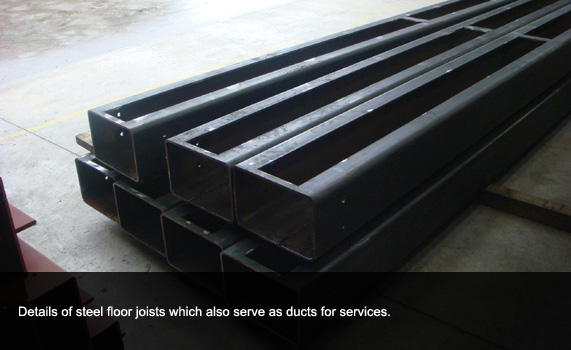
  • The steel joists (accessible between all floor cassettes) are hollow channels to provide conduit routes for all services
  • The three roof sections with zinc cladding over insulated timber framed panels and Fermacell ceilings to the underside to be installed on to the top of the steel frame of the house. This to complete a weathertight and secure, lockable building shell.
  • This would be the end of the Adaptahaus stage of the build.
  • Your local (partnering) building contractor to now take over the shell and discuss and agree with you the final location and configuration of your internal room layout. We would probably stay connected with this process and provide computer modeling of the internal layout to help assist the decision making. NOTE, no other build system will allow you to delay the final choice of internal layout until the house envelope is complete.
  • Once your room layout is agreed the local building contractor to install all of the services using the conduit routes throughout the whole building leaving tail ends to suit the fixtures and fittings that will be positioned in those places once the internal walls are built. The conduit routes then to be closed over with cover strips
  •  The floors to be laid (possibly with underfloor heating if chosen)
  •  The internal walls to be built and doors fitted
  •  The fixtures and fittings to be installed and all commissioned.

So it looks VERY interesting and something we should come back to as we move the project along.


I don’t like the in floor coverings to the channels as per the picture below:

So I asked about this and got the reply that:

Thanks for your reply and, yes, the floor covering can be continuous. That is what I have suggested in the proposed build procedure. The conduit access throughout the building would give good access for a speedy installation of the services but all the finished floors would be laid over the covered over conduits once the services were installed.

Design according to NASA

I’m reading Kevin McCloud’s 43 Principles of Home. From watching Grand Designs I didn’t get this much of an impression of him being aware of eco / environmental / sustainable issues.

Anyway, not related to that, but a great design methedology bit from NASA:

How to Design according to NASA:

From http://www.nasa.gov/audience/foreducators/plantgrowth/reference/Eng_Design_5-12.html

STEP 1: Identify the Problem — Students should state the challenge problem in their own words. Example: How can I design a __________ that will __________?

STEP 2: Identify Criteria and Constraints — Students should specify the design requirements (criteria). Example: Our growth chamber must have a growing surface of 10 square feet and have a delivery volume of 3 cubic feet or less. Students should list the limits on the design due to available resources and the environment (constraints). Example: Our growth chamber must be accessible to astronauts without the need for leaving the spacecraft.

STEP 3: Brainstorm Possible Solutions — Each student in the group should sketch his or her own ideas as the group discusses ways to solve the problem. Labels and arrows should be included to identify parts and how they might move. These drawings should be quick and brief.

STEP 4: Generate Ideas — In this step, each student should develop two or three ideas more thoroughly. Students should create new drawings that are orthographic projections (multiple views showing the top, front and one side) and isometric drawings (three-dimensional depiction). These are to be drawn neatly, using rulers to draw straight lines and to make parts proportional. Parts and measurements should be labeled clearly.

STEP 5: Explore Possibilities — The developed ideas should be shared and discussed among the team members. Students should record pros and cons of each design idea directly on the paper next to the drawings.

STEP 6: Select an Approach — Students should work in teams and identify the design that appears to solve the problem the best. Students should write a statement that describes why they chose the solution. This should include some reference to the criteria and constraints identified above.

STEP 7: Build a Model or Prototype — Students will construct a full-size or scale model based on their drawings. The teacher will help identify and acquire appropriate modeling materials and tools. See the design brief for a sample list.

STEP 8: Refine the Design — Students will examine and evaluate their prototypes or designs based on the criteria and constraints. Groups may enlist students from other groups to review the solution and help identify changes that need to be made. Based on criteria and constraints, teams must identify any problems and proposed solutions.

Steel (not timber) frame ?

8 Dec 2011 Update on this topic:

I found this company, http://www.eurban.co.uk, who specialise in pre-made timber panels (SIPs) that by their construction are already weather proof (apparently).
On this project (that was on Grand Designs, it’s the Mimi and Andre De Costa project), http://www.eurban.co.uk/Projects/PRIVATE+HOUSES/Headcorn+Minimalist+House, the PDF factsheet, says that Eurban provided the structural design of hybrid timber and steel superstructure. The used materials were crosslam, steel and exposed timber finish throughout. Installation took 4 weeks. The stored carbon due to the wood panels was 139 tonnes of CO2.

I also like the possible idea of leaving the inner walls wooden !
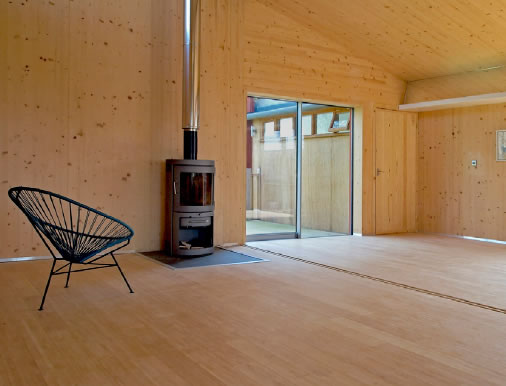
There are firms about such as the one in Bodmin and http://www.modcell.com/ that make units with straw or other insulation, that could go into a steel frame.


Origional Post:

One of the architects I’ve been chatting with has suggested / pointed out, that given the site a timber frame could flex too much in the exposed site, so damaging the building envelope.

He comes from a background of creating sustainable / environmental buildings and has no building /builders allegiance, so I’m taking the comment as not biased.

Stell has high embodied energy, so the environmental “cost” of building with stell goes up, but it is potentially a lot more recyclable in the long run than say brick or concrete.

I have therefore been thinking and looking out for an eco/sustainable way to build a steel framed house with timber and natural insulation between within and between the steel frame.

And up pops a Grand Designs programme about a house that is almost exactly this !

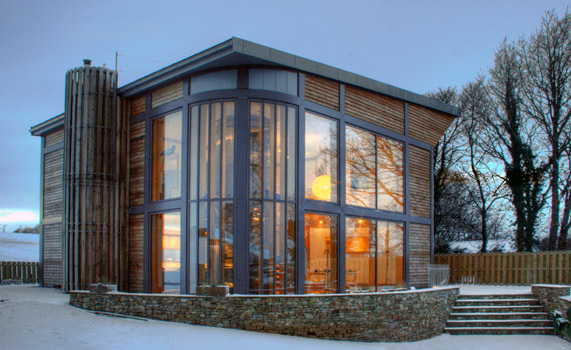
The house, built by www.adaptahaus.co.uk has a steel frame, then wooden and naturally insulated panels. They also have a funky looking system where you can move internal walls about at a future date !

On their http://www.adaptahaus.co.uk/buy.php page they have:

Budget on £180 per square foot for the completed house (not including renewable energy systems)

  • £180 per sqare foot = £ 1937.50 per square meter (so a higher end price).
  • Although the PDF brochure from their site (great detailing of their system) has a price indication of “£1000-£1800/m² depending on the requirements.”
  • From http://www.adaptahaus.co.uk/benefits.php, they imply that the price is for all of the house (there is the earlier caveat that the price excludes renewable energy systems:
    “The house will be delivered to a completely finished site with all hard landscaping in place and bolted together on to prefixed and levelled anchor bolts. The house will be weathertight within 1 week and fitted with fixed furnishings (kitchen and bathrooms) and commissioned within a further 2 weeks.”

Also, nice to see that “our system achieves a level 4-5 CSH qualifi cation, which is above the current standards for social housing.”

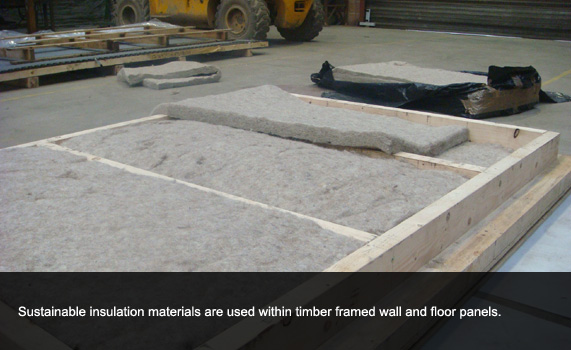
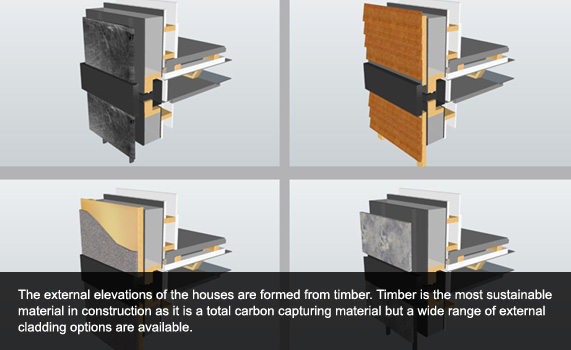
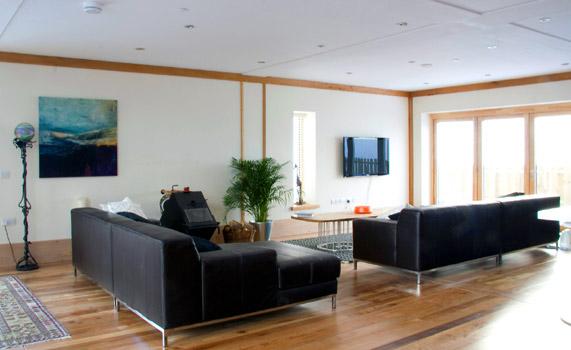
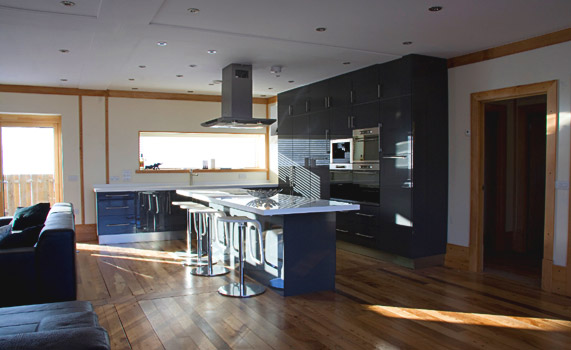
Pictures from Adaptahouse below.


Notes on Steel Houses from 4Homes site:

One thing that can be important though if it is near the sea is to ensure that the steel is galvanised, which will stop it from eroding too quickly.
– I was assuming it’d also make sense to have no or minimal exposed steel.

How Eco-Friendly Is Steel?

Possible erosion is one of only very few downsides to building with steel. However, another is its lack of green qualities. Compared to timber, steel is not as environmentally friendly. A spokesperson for eco homes and sustainable development portal www.whatgreenhome.com says, ‘Whichever way you look at it, steel can’t be considered a “green” material. Making it requires burning fossil fuel bi-products at extremely high temperatures, which uses large amounts of energy and releases CO2 into the atmosphere.’

Kane notes that compared to building with timber, steel constructions don’t require cutting down trees. It is a fair point – if indiscriminate or illegal felling is practised – but from an environmental perspective, when trees are forested (managed) and only used from FSC sources they are beyond compare because no CO2, which is the major greenhouse gas that causes climate change is emitted when trees are felled.

What Does Steel Cost?

On the issue of price Kane says steel costs less than either masonry or brickwork. ‘There isn’t really an approximate cost, though. It really depends on the size of the building as it is priced per tonne and the amount used in any one building may not be the same as any other. It is a very cost-effective material though, which is another reason it is used in the construction of so many modern skyscrapers. Another benefit is that it can help to keep labour costs low because the work can be done so quickly.’