EcoBuild: Waste Water / Drain Water / Shower, Heat Recovery

At Passivhaus levels of energy efficiency hot water accounts for more energy than space heating.

At last weeks Ecobuild, I saw a couple of systems that do this. They capture the heat from hot water that is going down the drain and feed it back into the hot water system. It seems there are 2 systems:

  1. A vertical pipe that the hot water flows down, usually slowed, around the cold water mains supply. Their is heat exchange from the waste water to the cold water, that, in these systems typically, feeds into the water heater / hot water tank.

  2. A system linked to just the shower. So that the heat in the shower waste is immediately put back into the shower. As most showers have a thermostatic valve, this means an instant and guaranteed gain.

+ & – Thoughts

Check the cost of the system Vs the predicted and probable saving for an evaluation of how long the system will take to pay for itself.

  • One of the 2 systems at Ecobuild was the, €299 retail price, system, that you can see at http://zypho.eu/english.html. So price wise, VERY worth considering,  but need to see if:
    • Have to use, what looked like, the integrated shower tray cap / valve bit, or can this work with any shower tray and it’s drainage inlet?
    • Will it cope with sand if used as the post surf outside shower?
    • What is the cost implication of this on each shower Vs a system that copes with multiple showers and other hot water drain pipes (bath, washing machine, dish washer).
    • Does it reduce the cold water pressure? (Does this matter ?)
      I’ve emailed Zypho these questions 
    • Nice write up on the Zypho unit at Ecobuild on the HardHouse blog by Mark.
      – looks good, but questions the heat exchanger and it isn’t yet fully UK approved.
  • Cost Implications:

If used for an external, post surfing, shower, will the system cope with sand, mud, dirt etc?
– it does look like the  Bristol based shower tray system could be put in post a sand trap !
– could even have this bit under the floor in the house and not outside where the cold, frosts etc. could be a problem. It could then also link in to the water outflow from the washing machine, dishwasher and any other ground water outflows of warm / hot water.
–  http://shower-save.com/Joomla_SS/pdfs/Adaptor%20to%2040mm%20for%20RT1-e.pdf
–  http://shower-save.com/pdfs/Recoh-Tray%20grey%20water%20heat%20recovery.pdf

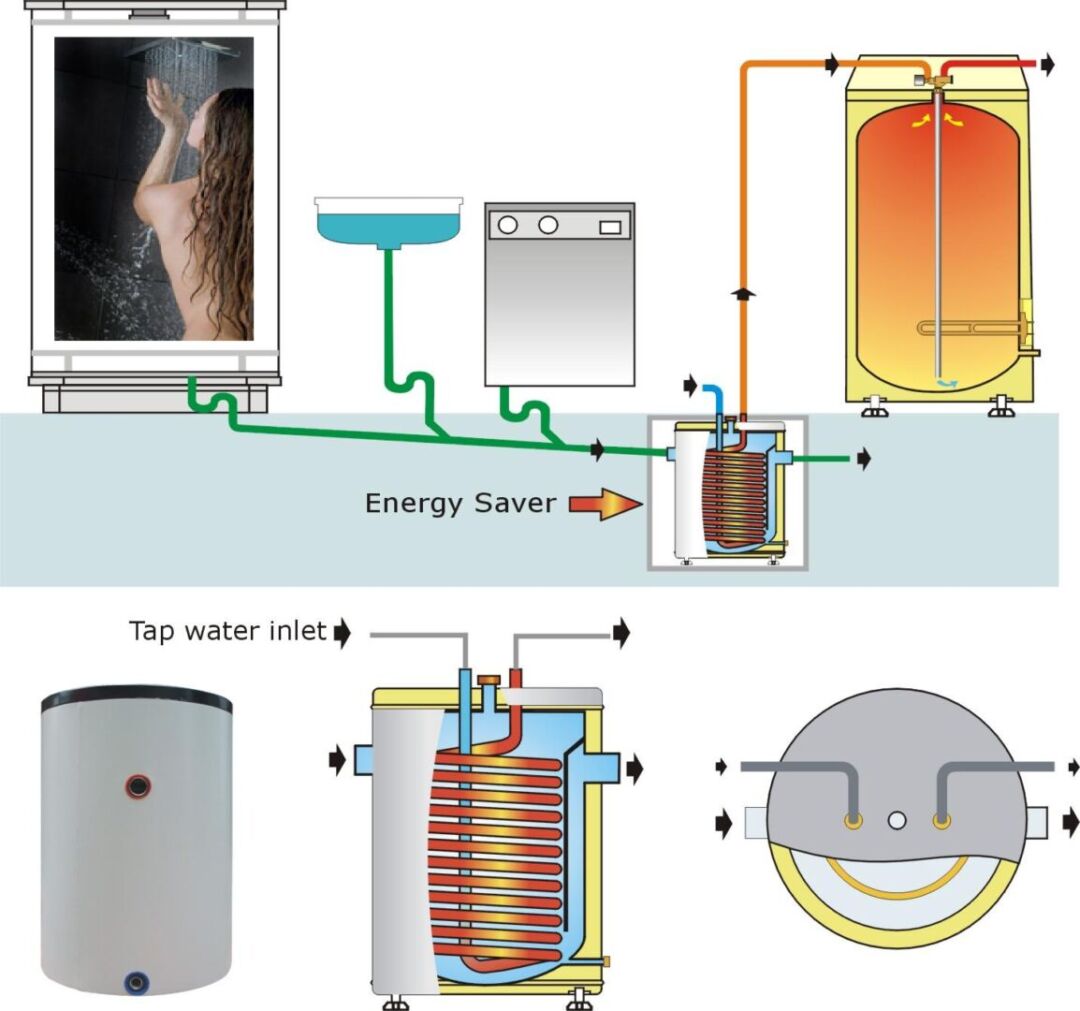
It seems that if you could get a single whole house heat recovery system that auto feeds the cold water supply to showers, and if they aren’t being used sends the preheated cold water to the water boiler (if it’s not full) would be the best. See the schematic below from http://www.gfxtechnology.com/H-3.pdf

This is also how it’s been set up in the schematic at Bristol (UK) based  http://shower-save.com/
 – also see animation they have at http://content.wavin.com/WAXUK.NSF/pages/Certus-ShowerSave-Animation-EN/$FILE/ShowerSave.swf

UK Water Heat Recovery Supplier Listing:

Test Data for Recoh Units:

From http://shower-save.com/gastec.html

  • Recoh-vert 61.2% efficient, with a mixer shower
  • Recoh-tray is 46.9% efficient, with a mixer shower

Shower-Save is even more efficient with a low flow rate or electric shower:

  • Recoh-vert 64.0% efficient with electric or other low flowrate shower
  • Recoh-tray is 52.6% efficient with electric or other low flowrate shower

Schematics of Waste Water Heat Recovery Systems

Notes from other Websites re these systems:

From http://www.gfxtechnology.com/H-3.pdf:

  • Typically, 80–90 percent of the energy used to heat water in the home goes down the drain. Heat exchangers capture some of the heat in drain-water, allowing it to be reused by incoming water. One type, called a gravity film exchange drain-water heat recovery system, has been found to save 25–30 percent of total water-heating energy needed.
  • This technology is compatible with all types of water heating systems, but it is especially suitable with on-demand water heaters and solar thermal systems. Prices range from $300–400 and paybacks are in the range of 2.5 to 7 years, depending on how often it is used.

From http://www.renewability.com/power_pipe/index.html:

  • Falling film heat exchangers have been around for decades. Other than utilizing the “falling film” effect, however, the Power-Pipe® has little in common with other Drain Water Heat Recovery (DWHR) devices.
  • First generation units suffer from high water pressure loss in the freshwater supply, which causes flow problems. Second generation units resolve the pressure loss issue by adopting a non-counter flow heat exchanger design, which delivers a low heat transfer performance.

Other Water Heat Exchange Systems & Discussions:

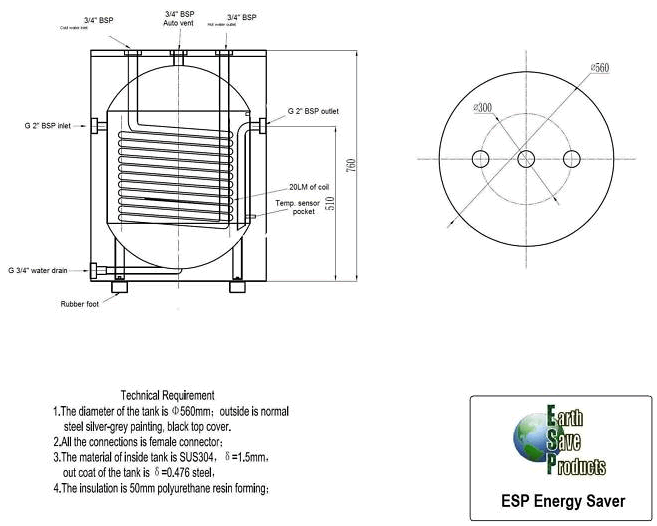
From Earth Save Products (bottom of the page) their Heat Squirrel – 120ltr heat recovery vessel (for domestic waste water)
Heat Squirrel - schematic
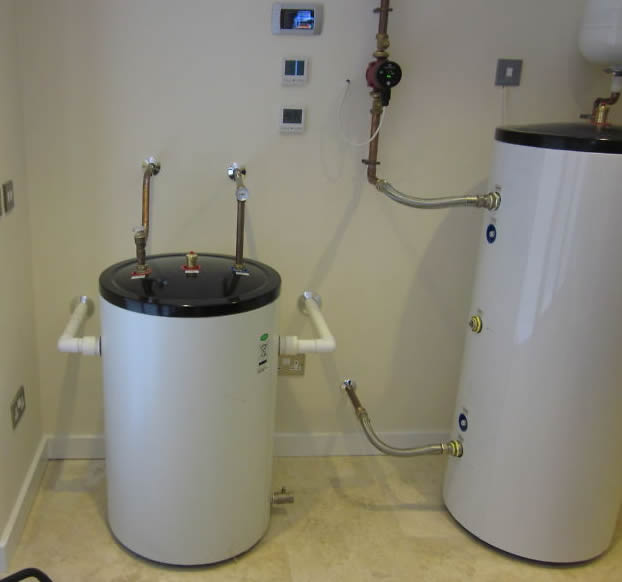
Heat Squirrel - installed

Change Your Behaviour – Bath water heat recovery

One behavioural solution to waste water heat recovery, is to just leave a hot bath, hot sink of water full to cool down and transfer it’s heat to the room(s) before you pull the plug. How often do we pull the plug on a bath of hot water to let that heat head off down the drain, when we could let it cool down (ie heat the interior or the house) first ?
Life cycle of window materials – energy consumption and environmental impacts

A great report by the School of Engineering at Napier University in Edinburgh on windows:

Frames of different materials have been assessed on the basis of their production, energy consumption and environmental impacts.

The investigation shows that aluminium and PVC frames exhibit large amounts of
environmental burdens. Accelerated ageing tests have been carried out to test the
durability of windows against weathering impacts. These tests show that aluminium clad timber windows are comparatively least affected by environmental impacts.

CONCLUSIONS (from the article)

  • Aluminium frames cause the highest burden to the environment because of the dangerous pollutants release and high energy consumption during aluminium production. PVC contributes large amounts of poisonous pollutants throughout its life cycle, while timber window frames have the least environmental burdens.
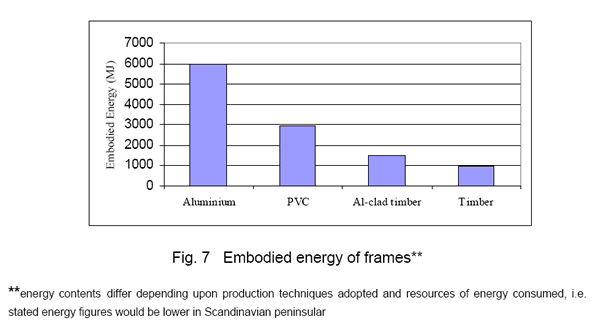
  • Embodied energy analysis has been carried out for a standard 1.2m × 1.2m window. Aluminium windows have the highest embodied energy, amounting to 6GJ. PVC, Al-clad timber and timber windows have embodied energy of 2980MJ, 1460MJ and 995MJ respectively.
  • All frame materials deteriorate to various degrees by environmental impacts. PVC is sensitive towards heat and UV radiation. Timber if not frequently treated, can easily be affected by environment. Aluminium, if not protected well by coatings, gets damaged under corrosive conditions especially in coastal and industrial areas. Al-clad frames are unlikely to deteriorate due to their protective coatings and appear to be the best choice from this point of view.
  • A survey analysis shows that aluminium and timber windows can easily last more than 40 years. Al-clad timber being new on the market, is expected to have a service life well over 40 years. PVC windows, in most cases, are reported to have an optimum service life of 25 years.

Winter Driving Rain May Increase

OK, we know that man made climate change is here, but don’t know how much the systems will tip it to being worse or to self regulate (or stay on the current trajectory).

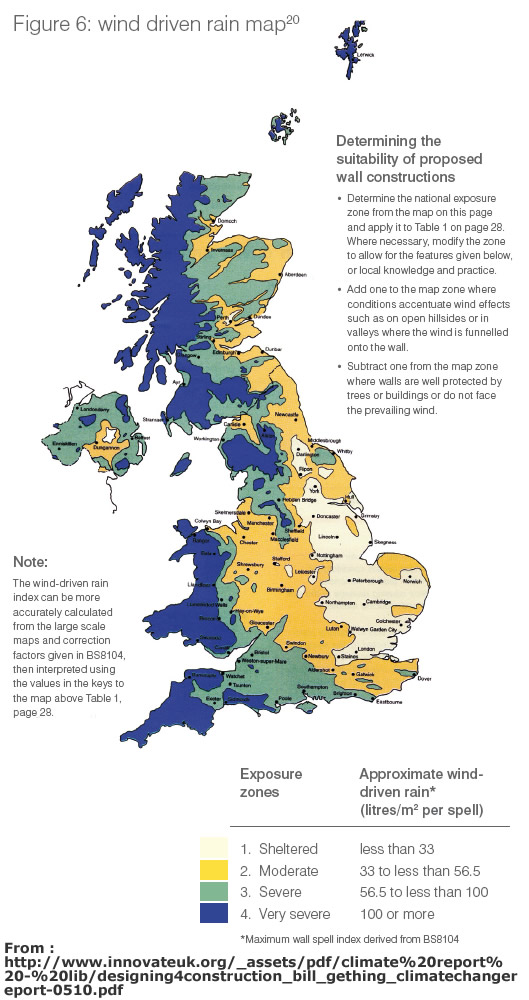
But it does mean, that on top of it being a very exposed site, there is the potential for driving rain to increase. See the map below, taken from www.innovateuk.org (PDF).

Talking to surrounding residents, that also look out over Perranporth beach, they all say the site gets a full weather beating on a regular basis. The www.innovateuk.org (PDF) recommends the following detailing, that I’m sure ra-studio are already on top of:

  • recessed window and door reveals
  • projecting cills with drips
  • render finishes
  • extended eaves
  • greater laps and fixings to roof and cladding fixings
  • avoidance of fully filled cavities.
There is also (apparently) the issue that materials may behave differently. Again, I’ll leave that to Robert at ra-studio.

Light and ventilation tunnel ?

With the stairs going from the floor of the house, to the top and being capped by a sky-light, and also a south facing window (or two) at the top of this “column”, I was reminded of the Potton Lighthouse, with it’s “wind catcher / light funnel”.

I’m wondering if these windows could be an automatic, intrinsic way that the house heats and cools itself down?

Below is a screen shot from a PDF about the Potton Lighthouse.

Perranporth Low Carbon Limited ?

Wouldn’t it be great to set-up Perranporth Low Carbon Limited ?

Attending some eco-build talks at the Eden Project, one of the speakers is involved with Hook Norton Low Carbon Limited.

It is an Industrial Provident Society, set up by Low Carbon Hook Norton members to help the community reduce its energy consumption, carbon emissions and save money, with a range of community-based schemes and individual household projects based on interest-free loans.

http://www.hn-lc.org.uk/

From the talk, it seems they coordinated getting funding and then the residents and suppliers to slowly help everybody (residents, the school, local firms ….) benefit (lower fuel bills, jobs to implement the projects …..) and move to a lower carbon / more sustainable village.

In relation to this, it’d probably make sense to chat with http://sustaincornwall.co.uk/ and the linked Cornwall Sustainable Building Trust

Design according to NASA

I’m reading Kevin McCloud’s 43 Principles of Home. From watching Grand Designs I didn’t get this much of an impression of him being aware of eco / environmental / sustainable issues.

Anyway, not related to that, but a great design methedology bit from NASA:

How to Design according to NASA:

From http://www.nasa.gov/audience/foreducators/plantgrowth/reference/Eng_Design_5-12.html

STEP 1: Identify the Problem — Students should state the challenge problem in their own words. Example: How can I design a __________ that will __________?

STEP 2: Identify Criteria and Constraints — Students should specify the design requirements (criteria). Example: Our growth chamber must have a growing surface of 10 square feet and have a delivery volume of 3 cubic feet or less. Students should list the limits on the design due to available resources and the environment (constraints). Example: Our growth chamber must be accessible to astronauts without the need for leaving the spacecraft.

STEP 3: Brainstorm Possible Solutions — Each student in the group should sketch his or her own ideas as the group discusses ways to solve the problem. Labels and arrows should be included to identify parts and how they might move. These drawings should be quick and brief.

STEP 4: Generate Ideas — In this step, each student should develop two or three ideas more thoroughly. Students should create new drawings that are orthographic projections (multiple views showing the top, front and one side) and isometric drawings (three-dimensional depiction). These are to be drawn neatly, using rulers to draw straight lines and to make parts proportional. Parts and measurements should be labeled clearly.

STEP 5: Explore Possibilities — The developed ideas should be shared and discussed among the team members. Students should record pros and cons of each design idea directly on the paper next to the drawings.

STEP 6: Select an Approach — Students should work in teams and identify the design that appears to solve the problem the best. Students should write a statement that describes why they chose the solution. This should include some reference to the criteria and constraints identified above.

STEP 7: Build a Model or Prototype — Students will construct a full-size or scale model based on their drawings. The teacher will help identify and acquire appropriate modeling materials and tools. See the design brief for a sample list.

STEP 8: Refine the Design — Students will examine and evaluate their prototypes or designs based on the criteria and constraints. Groups may enlist students from other groups to review the solution and help identify changes that need to be made. Based on criteria and constraints, teams must identify any problems and proposed solutions.

Steel (not timber) frame ?

8 Dec 2011 Update on this topic:

I found this company, http://www.eurban.co.uk, who specialise in pre-made timber panels (SIPs) that by their construction are already weather proof (apparently).
On this project (that was on Grand Designs, it’s the Mimi and Andre De Costa project), http://www.eurban.co.uk/Projects/PRIVATE+HOUSES/Headcorn+Minimalist+House, the PDF factsheet, says that Eurban provided the structural design of hybrid timber and steel superstructure. The used materials were crosslam, steel and exposed timber finish throughout. Installation took 4 weeks. The stored carbon due to the wood panels was 139 tonnes of CO2.

I also like the possible idea of leaving the inner walls wooden !

There are firms about such as the one in Bodmin and http://www.modcell.com/ that make units with straw or other insulation, that could go into a steel frame.


Origional Post:

One of the architects I’ve been chatting with has suggested / pointed out, that given the site a timber frame could flex too much in the exposed site, so damaging the building envelope.

He comes from a background of creating sustainable / environmental buildings and has no building /builders allegiance, so I’m taking the comment as not biased.

Stell has high embodied energy, so the environmental “cost” of building with stell goes up, but it is potentially a lot more recyclable in the long run than say brick or concrete.

I have therefore been thinking and looking out for an eco/sustainable way to build a steel framed house with timber and natural insulation between within and between the steel frame.

And up pops a Grand Designs programme about a house that is almost exactly this !

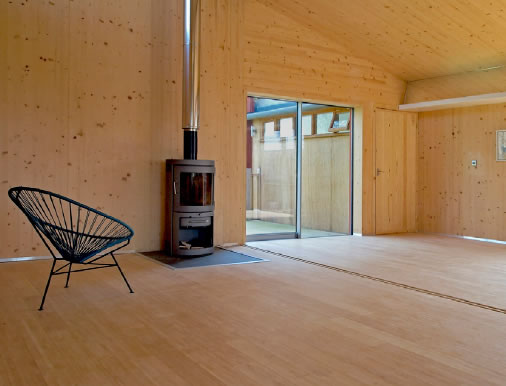
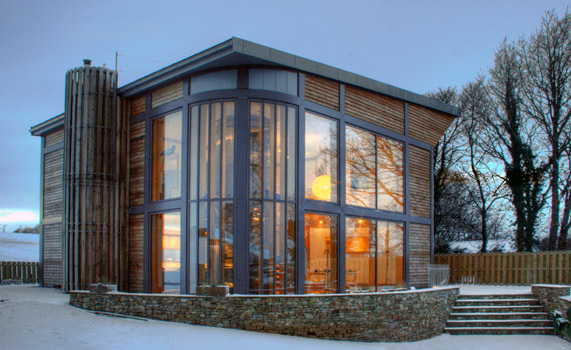
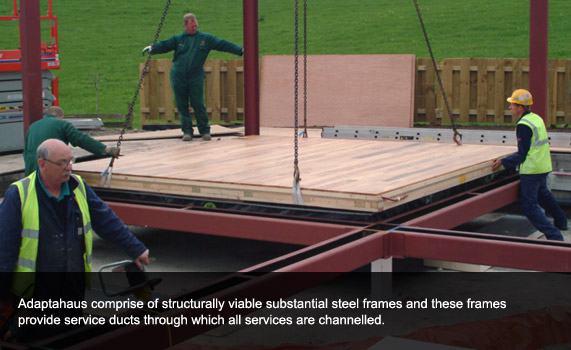
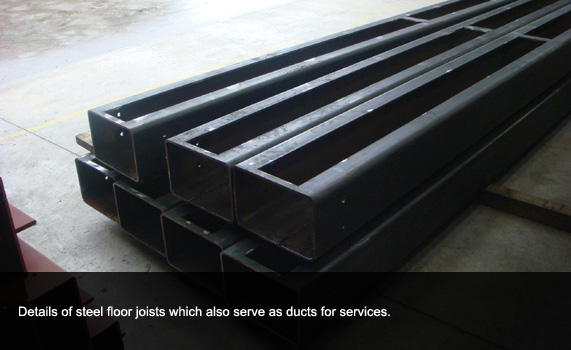
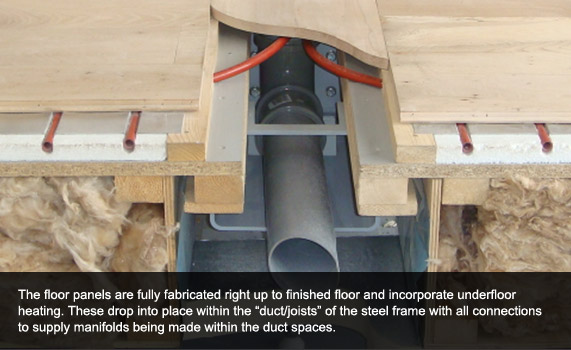
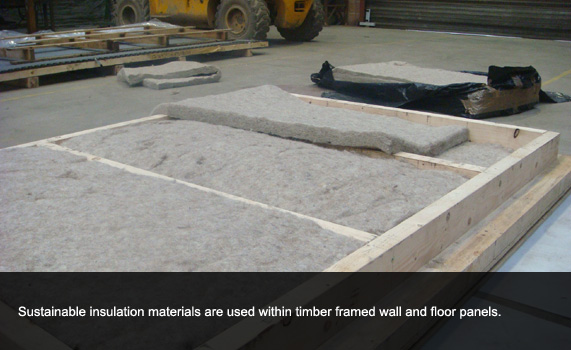
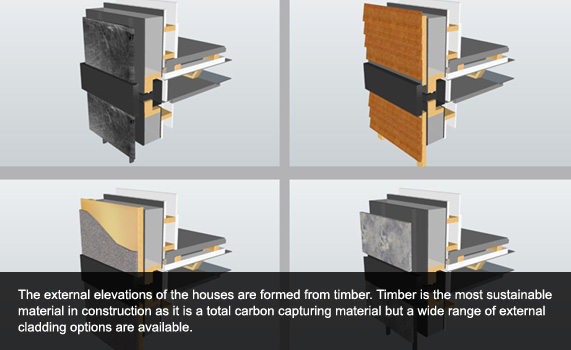
The house, built by www.adaptahaus.co.uk has a steel frame, then wooden and naturally insulated panels. They also have a funky looking system where you can move internal walls about at a future date !

On their http://www.adaptahaus.co.uk/buy.php page they have:

Budget on £180 per square foot for the completed house (not including renewable energy systems)

  • £180 per sqare foot = £ 1937.50 per square meter (so a higher end price).
  • Although the PDF brochure from their site (great detailing of their system) has a price indication of “£1000-£1800/m² depending on the requirements.”
  • From http://www.adaptahaus.co.uk/benefits.php, they imply that the price is for all of the house (there is the earlier caveat that the price excludes renewable energy systems:
    “The house will be delivered to a completely finished site with all hard landscaping in place and bolted together on to prefixed and levelled anchor bolts. The house will be weathertight within 1 week and fitted with fixed furnishings (kitchen and bathrooms) and commissioned within a further 2 weeks.”

Also, nice to see that “our system achieves a level 4-5 CSH qualifi cation, which is above the current standards for social housing.”

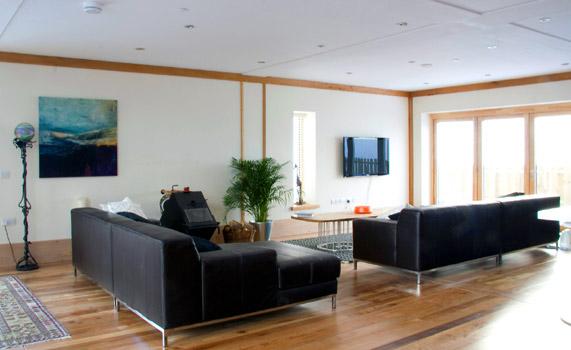
Pictures from Adaptahouse below.


Notes on Steel Houses from 4Homes site:

One thing that can be important though if it is near the sea is to ensure that the steel is galvanised, which will stop it from eroding too quickly.
– I was assuming it’d also make sense to have no or minimal exposed steel.

How Eco-Friendly Is Steel?

Possible erosion is one of only very few downsides to building with steel. However, another is its lack of green qualities. Compared to timber, steel is not as environmentally friendly. A spokesperson for eco homes and sustainable development portal www.whatgreenhome.com says, ‘Whichever way you look at it, steel can’t be considered a “green” material. Making it requires burning fossil fuel bi-products at extremely high temperatures, which uses large amounts of energy and releases CO2 into the atmosphere.’

Kane notes that compared to building with timber, steel constructions don’t require cutting down trees. It is a fair point – if indiscriminate or illegal felling is practised – but from an environmental perspective, when trees are forested (managed) and only used from FSC sources they are beyond compare because no CO2, which is the major greenhouse gas that causes climate change is emitted when trees are felled.

What Does Steel Cost?

On the issue of price Kane says steel costs less than either masonry or brickwork. ‘There isn’t really an approximate cost, though. It really depends on the size of the building as it is priced per tonne and the amount used in any one building may not be the same as any other. It is a very cost-effective material though, which is another reason it is used in the construction of so many modern skyscrapers. Another benefit is that it can help to keep labour costs low because the work can be done so quickly.’


Photovoltaic Thermal (PVT)

Latest:

  • See this post on Photovoltaic, PVT Vs PV or PT.
    – it seems that PVT just doesn’t yet work, and may never work as they have very different optimal temperatures.

Photovoltaic Thermal (PVT) with New Form Energy ?

In late Feb 2012 I dropped an message to www.newformenergy.com (via their on-line enquiry form) for a call to chat over the Silver Spray project.

  • Saying that  the current plans (pre planning application) have allocated a 8 x 5 m (approx) flat roof area for solar panels.This is on the south facing side of the building. The long north to south edge is just over 8m, the short edge is just under 5m (about 4.8m).
  • I’ve not had a reply / response and that was almost a month ago. Not ideal. OK I know a single email from their site form could get lost but ……

Origional Post:

Photovoltaic Thermal (PVT) is relativly new, but regarded as the most efficient at year round producing electricity and hot water.

” A well insulated 200m sq. house would need a 4kWp system costing around £20,000 installed, including a heat pump and hot water cylinder.” Homebuilding and Renovation magazine.

Supplier: www.newformenergy.com, where they claim:

  • A drawback with Photovoltaic panels (PV) is that as the surface temperature of the panel rises, the output drops. PV panels typically lose efficiency of up to 0.5% per degree rise in panel temperature.
  • Solar thermal collectors for hot water can give little or no hot water when there is little or no sun.
  • Although heat pumps are potential greener than burning fossil fuels, they do still use large amounts of electricity.

So a combined system:

  • One panel for PV and thermal means that:
    • 1st the growing heat is drawn away from the panel
    • 2nd, less total roof area needed for same output.
      • The Hybrid Solar Solution, with PowerVolt panels installed on a UK house with 28m2 of available south facing roof area, will produce the equivalent annual electrical output from 38m2 of conventional monocrystalline photovoltaics. The same area of PowerVolt collectors will offset approximately the same amount of thermal energy as 8m2 of conventional solar thermal collectors (without any contribution from the heat pump). Using separate PV plus solar thermal systems would therefore require 46m2 to generate the same electrical and thermal energy produced by 28m2 of PowerVolt thermal collectors.In addition, with the size of solar installation referred to above, the heat pump can produce up to 22,000kWh of heat in winter months when the demand is highest.
  • Solar thermal+ heat pump, means that at night or when low sunlight, the panel can act as a thermal collector (not a solar collector). This, then via the heat pump generates hot water.

Summary

  • All year round solution
  • Significantly increases your electricity production
  • Fastest payback of all renewable heating systems
  • Low maintenance and user friendly
  • Solution that optimises efficiency, saves space and money.

Perranporth Low Carbon Limited ?

Wouldn’t it be great to set-up Perranporth Low Carbon Limited ?

Attending some eco-build talks at the Eden Project, one of the speakers is involved with Hook Norton Low Carbon Limited.

It is an Industrial Provident Society, set up by Low Carbon Hook Norton members to help the community reduce its energy consumption, carbon emissions and save money, with a range of community-based schemes and individual household projects based on interest-free loans.

http://www.hn-lc.org.uk/

From the talk, it seems they coordinated getting funding and then the residents and suppliers to slowly help everybody (residents, the school, local firms ….) benefit (lower fuel bills, jobs to implement the projects …..) and move to a lower carbon / more sustainable village.