Single Vs Double Glazing

I’m going to have a problem, sorry challenge.

The sliding doors from the planned living room at the bottom are due to be around 2.8m tall.

This is taller than most companies produce triple glazing. In part due to the total weight of the glazing units.

Triple glazing gives better insulation, and less thermal gain. But as this is north facing, the solar gain isn’t an issue.

  • The very best double glazed windows are already capable of being net heat contributors over the course of a heating season. In contrast, triple glazed windows slightly reduce the heat absorption characteristics of a window.

BUT, how much more expensive is triple glazing and how much better is it ?

  • http://www.homebuilding.co.uk/advice/key-choices/green/triple-glazing
  • Current Building Regulations insist that any window you install today should have a U-value no worse than 1.6.
    – for  reference, walls should be less than 0.3. So windows are a thermal weak spot.
  • PassivHaus standard requires triple glazed windows with a Uvalue of no more than 0.8.
  • Although a U-value as low as 0.8 sounds very impressive, the additional energy we are saving is minuscule whilst the payback time for triple glazing (like double glazing) is high compared to other energy-efficiency improvements. So why bother ?

The key benefits are really to do with comfort. If you insulate the walls, roof and floor of a house, and you ignore the glazing, you end up with cold spots surrounding the windows at night, which cause draughts, draw heat away from you if you sit next to them, and can result in streams of condensation running down the panes. So, in essence, the standard of glazing has to match the standard of the insulation elsewhere in the house, so that the warm wrapping around the house performs consistently.

The PassivHaus Institute, in Germany, has looked at the surface temp­eratures on various forms of glazing when it gets really cold outside, and the internal air temperature is designed to be at 21°C:

  • Next to a single-glazed window, the internal surface temperature is around 1°C.
  • Next to a double-glazed window (2000 vintage), the surface temperature is around 11°C.
  • Next to a modern, energy-efficient double-glazed window, the surface temperature is 16°C.
  • Next to a triple-glazed window, with a centre-pane U-value of just 0.65, the temperature is 18°C.

So whilst triple glazing may make little difference to your heating bills, you will notice the difference inside the house.

BUT, this is all based on the situation in Germany, where it’s a lot colder than the UK. Cornwall is itself a relatively warm bit of the UK.

The upshot of this is that there are many who argue that triple glazing simply doesn’t make sense in a climate like ours. Triple glazing is more costly to produce, produces much heavier sections and has an embodied energy approximately 50% higher than double glazing.

An alternative option that might make more sense is to revisit the traditional practice of drawing curtains across windows after dark. It may be low-tech, in comparison with glazed cavities filled with krypton, but it’s something of a natural British habit and it does cut down on heat loss. Perhaps it’s time we paid attention to improving the heat retention characteristics of curtains and blinds, rather than continuing to engineer glazing units to ever lower and lower U-values.

  • Maybe, as a life style strategy, I’ll have curtains, that I might only draw when I go to bed, or some time after it gets dark. But curtains and top efficiency double glazing could be the way to go.

Window Efficiency Article

Houzz have this US biased article on Energy-Efficient Windows: Understand the Parts

Window Frames

All have their advantages and disadvantages, but the U.S. Department of Energy (DOE) recommends vinyl, wood, fiberglass or composite. (Aluminum is easily heated, so it isn’t a great insulator.) Wood has efficiency problems due to expansion and contraction, so consider aluminum- or vinyl-clad windows. But if you choose vinyl, consider an insulated version, depending on your climate and house requirements.

Window elements from http://www.energysavers.gov/your_home/windows_doors_skylights/index.cfm/mytopic=13370

Window Glazing

Different gas fills impact cost and efficiency.

The most common gasses used are argon, which is relatively less expensive, and krypton, which is more expensive but has a better ability at decreasing a window’s U-factor.

Tints and inner glass layers or spectrally sensitive coatings can impact the U-Value.

Low-E coatings. These coatings increase a window’s cost by 10 to 15 percent, the DOE says, but they can reduce energy loss by about 30 to 50 percent.

For keeping heat inside the house in the winter, the coating should be on the inside of the glass.


Construction (embodied) Energy Vs Operational Energy

My Summary / Conclusion

  • In 2007, 16% of CO2 equiv impact is construction of a building, 84% is operational / in-use.
  • Today the split is roughly 20% embodied and 80% operational.
  • The modelling shows that we are moving to a CO2eq (CO2 equivalent) of 38/62% for masonry construction, and 35/65% for timber-frame construction.
  • No significant differences emerged between masonry and timber construction in terms of overall CO2 impact over the 60- and 120-year study periods. The largest difference observed between comparable masonry and timber constructions was 4%.
  • No clear / significant impact of thermal mass.
  • Emissions are cumulative, so 1 tonne of CO2 equiv at the point of construction roughly equals a tonne of CO2 equiv during the 60 year life of a building.

Which aspects of a dwelling are responsible for the largest CO2 impact?

  • Space and water heating have the largest CO2 impact in dwellings.
  • Appliances also have a large operational CO2 impact.
  • In both masonry and timber constructions, the impact of foundations and ground floors dominates the embodied CO2eq impact.
  • In masonry construction, the external walls also have a major impact.
  • Other elements, such as windows/doors and floor finishes, have a relatively large impact because they are repeatedly replaced throughout the life of the dwelling.
    • Waste water heat recovery systems have a 60 year assumed life span (windows and doors – 40, MVHR 15, flooring 10 ….)
  • The embodied impact of services was found to be approximately 5% of impact at 60 years and 7% at 120 years.

Construction Vs Operational Energy

I’ve come across some interesting figures and links to research in an article in the Green Building Magazine (by www.greenbuildingpress.co.uk).

  • Embodied Energy – a ticking time bomb (Spring 2012)

In 2007, around 16% of the CO2 equivalence impact was constructing a building.
– This covers the manufacture of materials and components, transport and construction.

84% of the CO2 equivalence impact of a building was down in use emissions.

This data is from http://www.bis.gov.uk/assets/biscore/business-sectors/docs/l/10-671-low-carbon-construction-igt-emerging-findings.pdf

That is why policy to date has been biased to making buildings more operationally efficient.

The article then makes the point that raises the importance of embodied (construction) emissions. Namely that since emissions are cumulative, 1 tonne of CO2 equivalence impact occurs for every year this “CO2” is in the atmosphere. So 1 tonne of CO2 at the start of a buildings 60 year life will have twice the impact of 1 tonne emitted during the building’s life.

The longer a tonne of CO2 hangs around in the atmosphere, the more damage it can do.

So it’s potentially dangerous to focus on carbon-intensive solutions that are installed at the point of construction, so that they reduce the operational emissions.

So, it is best to look for principles, materials, solutions etc. that will reduce both the construction (embodied) and operational energy of a building. So, as it’s often said, the general advice is still to optomise the fabric efficiency of a building before other measures.

October 2011 Update

The October 2011 report by the NHBC Foundation (“Housing Research in partnership with BRE Trust”) – Operational and embodied carbon in new build housing – A reappraisal:

Until now, focus has been almost entirely on the carbon emissions resulting from using homes, but clearly the balance between those operational carbon emissions and emissions from producing and installing the materials – the embodied carbon – needs to be considered.

This publication explores a subject which has to date lacked a strong and accessible evidence base. It looks at a range of carbon reduction scenarios as delivered through typical house types and estimates the likely impact both in terms of operational and embodied carbon – providing an insight into the contribution of different technical responses to the low carbon agenda, including the balance between operational and embodied carbon.

Evaluated Scenarios:

Twenty-four scenarios were appraised, using SAP software to determine operational CO2 emissions and BRE Global’s Environmental Profile methodology to analyse embodied CO2eq emissions.

The research considered the following variables:

  • two built forms (detached and mid-terraced)
  • two construction weights (masonry and timber frame)
  • three operational CO2 performance levels (25, 31 and 40% reductions over Part L1A 2010)
  • two dwelling lifespans (60- and 120-year study periods)
  • varying grid electricity CO2 intensity (to account for the expected impacts of grid decarbonisation).

Extracts from the report:

  • The modelling showed a typical percentage split between operational and embodied CO2eq (CO2 equivalent) of 62/38% for masonry construction, and 65/35% for timber-frame construction. These are averaged figures.
  • No significant differences emerged between masonry and timber construction in terms of overall CO2 impact over the 60- and 120-year study periods. The largest difference observed between comparable masonry and timber constructions was 4%.
  • The modelling showed that space and water heating, along with foundations, ground floors, windows/doors and floor coverings, were the largest contributors to overall lifetime CO2 impact. Appliances were also a significant contributor, but building designers have limited opportunity to reduce these emissions via their designs.
  • The typical split between operational and embodied CO2eq in new build housing has been taken as 80% operational, 20% embodied, a position largely confirmed by recent studies[1]. However, within the context of future Building Regulations requirements – which are expected to tighten to the point that new homes will be significantly lower in CO2 from 2016[2] – operational CO2 emissions are set to fall radically. This means that embodied CO2eq emissions will become increasingly significant in terms of the percentage they contribute to the overall CO2 impact of new build dwellings. In addition, typically the more energy efficient a given house type becomes, the greater the quantity of additional materials required to construct it (eg additional insulation, more services). There is also potential that such additional materials (eg renewable generation installations) may have particularly high embodied CO2eq levels. Both these considerations suggest that, as operational CO2 emissions reduce, embodied CO2eq emissions will increase.
  • The replacement of services and other building components has a direct bearing on both operational and embodied CO2eq emissions across the 60- and 120-year study periods.

Assumed lifespan of construction elements:

  • The proportion of embodied CO2eq in masonry construction was found to be higher than that in timber construction. However, this difference was relatively marginal, the maximum difference being 4%. This is because, other than the walls, the majority of building elements were similar in both the masonry and timber constructions modelled.

Which aspects of the dwelling are responsible for the largest CO2 impact?

  • Space and water heating have the largest CO2 impact in dwellings; this remains significant in all scenarios despite diminishing slightly as designs move from 25 to 40% CO2 reduction.
  • Appliances also have a large operational CO2 impact, although dwelling designers have limited ability to help achieve reductions in this area.
  • In both masonry and timber constructions, the impact of foundations and ground floors dominates the embodied CO2eq impact.
  • In masonry construction, the external walls also have a major impact.
  • Because both of these areas will last the lifetime of the dwelling, they should be considered at the design stage when seeking to reduce the overall dwelling CO2 impact.
  • Other elements, such as windows/doors and floor finishes, have a relatively large impact because they are repeatedly replaced throughout the life of the dwelling.
  • The embodied impact of services was found to be approximately 5% of impact at 60 years and 7% at 120 years. However, these results should be treated with caution as some aspects, such as controls, had to be omitted due to lack of available data, and the services were not studied in depth during this project.

Did the varying thermal mass levels have a significant impact on cooling?

  • No clear trend was identified from the modelling carried out, with minimal impact from space cooling in both masonry and timber designs.

GRP windows ?

I saw a stand at the  the Ecobuild show with great looking GRP windows and doors.

Apparently cheaper and better than Alu clad windows for sea environment resistance and also cheaper.

I’ve been in touch with Yprado. Their reply is in italics below. This mirrors what is in their brochures.

Posting to the Green Building Forum got a discussion going, including:

I pioneered pultruded GRP windows in UK over 10 years ago – as ‘Pultec’, (PULtrusion TEChnology) – still available but now owned by Yprado UK Ltd, in Bristol and highly successful. FRP composite materials (like carbon-fibre, fibreglass etc) are not just for windows but a worldwide development for superior performance outdoors. Best example: New Boeing 787 Dream-Liner is first aircraft to progress beyond aluminium to ‘FRP composites’ for wings and body, for greater strength, longer life and better sustainability! Definitely the window frame material of the future, as already happening in North America. Lower U values due to inherently low thermal conductance of material (65% glass, fibres), 75 year life! Impervious to all weather, chemicals and salt corrosion (coastal) and even termites; Indestructible by natural forces. Zero maintenance yet unlimited repair/repaint options if required! Double and triple glazing, solar control, acoustic, the lot! Well worth looking into! (www.yprado.co.uk) Final news? Lower cost than timber/aluminium windows by a good margin!

Also from the Green Building Forum:

Both Velfac and ProTec were exhibiting GRP/timber composites at EcoBuild.
– I only saw / noticed the Yprado GRP products at the show, but will email the others.


Yprado Email about their GRP Windows and Doors

Pultec® pultruded glass reinforced composite windows are made from the same advanced composite materials technology as the new Boeing 787. ‘Composites’ are a significant technological breakthrough World-wide, in the quest for increasingly durable, lighter, stronger and more sustainable materials generally – not just for windows – but having adopted that technology for fenestration, we find the benefits supersede the performance of all other window frame materials, by some considerable margin, as detailed below.

What is even better is that our customers agree with us and tend to continue to use us long after their first scheme has been completed.

Pultec® is setting new standards of energy efficiency, durability and sustainability.

Summary of advantages:-

  • · Sustainability:
    • “A” Rated in BRE Green Guide to Specification for Sustainable Construction (UK)
    • BREEAM: 4½ extra credits potentially available.
    • 22% is from a recycled source. Product 100% recyclable upon disposal. (see update below)
    • 65% glass content, (silica/sand, the most abundant substance on the planet)
    • Sensitivity Report attached, quantifying environmental credentials by sustainability consultants Price & Myers, London.
  • Energy Efficiency:
    • “U” values 0.8 – 1.6 “U” W/M2K on the total window. 1.2 U value achieved with double glazing only, no need for triple (thus cheaper and less wear on hinges)
    • Low embodied energy in pultrusion manufacturing process
  •  Durability:
    • Twice the strength to weight ratio of mild steel – cannot deform like aluminium
    • 75 years service life + 12 year Warranty.
    • Negligible coefficient of expansion, even if coated black
    • Performance unaffected in temperatures between +100C and -100C
    • Impervious to UV degradation
    • Impervious to salt corrosion and water
    • Impervious to the harshest weather – effectively, indestructible by natural forces.
    • Impervious to termites – ( hugely beneficial in Southern climates)
  • · General performance:
    • Robust – used on Young Mental Offenders Secure Units – Meets MOD anti-terrorist glazing requirements – DMG2 “Normal”
    • Secured by Design accredited – Police preferred specification – including both BS 7950 and PAS 23/24
    • Zero maintenance required – however, surface damage, structural repairs and re-painting can be easily undertaken on site, with no consequential liability for future applications.
    • High resistance to impact damage – will not deform under impact.
    • Price competitivewith aluminium
    • Any RAL colour available (200+ options)
    • Does not affect radio waves
    • Has a high dielectric capability
    • Impervious to all chemicals and most acids.

Pultec® has been described by the Construction Director of Europe’s largest hotel chain, as “Totally the future for commercial windows, nothing else even comes close”.


Also have a look at the blog post about the Life cycle of window materials – energy consumption and environmental impacts. This survey didn’t include GRP windows.


2013 November Updates from Yprado.co.uk Website

How Yprado Meets Today’s Sustainability Requirements

Category Benefits from Yprado GRP Windows
Sustainability (of source and in manufacture) Manufactured from 65% glass (33% recycled) and only 5% oil derivatives
No volatile organic constituents within material (VOCs)
Temperature of pultrusion process is only 150C (Thus, low embodied energy)
Non toxic, non carcinogenic, non harmful process and product
Ozone Depletion Ozone Depletion Potential (ODP) = zero, thus ‘ZODP’
No chlorine or other ozone damaging substances are released
CO2 emissions
Greenhouse gas
Global Warming
Climate change
Global warming Potential (GWP) = zero
No hardwood, so Rainforests left intact to allow Nature to continue to absorb CO2.
No CFCs, HCFCs or other greenhouse gases or hazardous substances
Material is inert and does not leach out chemicals during life
Energy Efficiency Lowest thermal conductivity of all window materials
No metal reinforcing means no cold bridge, thus maximising insulation
‘U’ values typically 0.6 – 1.6 WM2K (Bldg Regs require 1.8)
Uniquely, Yprado can achieve both 1.4 U value and Rw 41 acoustics, in same unit!
Strength and security Strength of profile negates the need for metal reinforcing inserts.
Police standard ‘Secured by Design’ is met via BS 7950 compliance
Tensile strength is actually greater than steel – weight for weight
Frames are totally rigid, do not flex, nor need glass unit for squareness.
Thermal movement Being 65% glass, the profile has negligible expansion/contraction in any colour, even black. This stability avoids maintenance adjustments in Summer/Winter.
Coefficient of expansion is similar to glass, thus no friction between profile and glass unit, which prolongs life of D/G sealed unit.
Life expectancy
Warranty period
Surface finish
Up to 75 years design life, since fibreglass is unaffected by the elements and does not weaken, corrode or deteriorate over time.
20 year Warranty on window frames
Colour is for aesthetic reasons only – not to protect it like timber or aluminium.
Life of finish exceeds 20 years – but unlike powder coating or PVC, can be re-applied at any stage to further extend life by a similar 20 year period.
Maintenance
Reparability
Practicality in situ
The joy of fibreglass is that it requires no maintenance – yet is fully reparable
Damaged sections can be easily repaired with an epoxy kit and painted.
Unaffected by rain, wind, sun or salt sea spray, climatically indestructible
Life cycle analysis
‘Best value’
Whole Life Cost
50 – 75 year life expectancy is longer than for any other material
WLC study by BRE proves ‘best value’ over PVC and Ali, over 30 years.
But 20 – 45 years life still remains, to widen cost and carbon benefits.
Case study on Softwood reveals Yprado is 50% cheaper after necessary maintenance
Disposal
Re-use
BRE Study Group advise grinding down waste to use as filler
Adding this filler to concrete acts as binding agent for greater strength
Noise reduction The high density frame section helps to reduce noise, enabling a higher dBR sound reduction to be achieved over other window materials for any given glass specification. Rw 38 and dBr 42.9 certified as standard.
Uniquely, Yprado can achieve both Rw 41 and 1.4 U value in the same unit!
Bio-degradability Zero. Yprado’s success is that it cannot bio-degrade, so requires no protection (and maintenance) from doing so, unlike timber and aluminium. Bio-degradable external building products are not advisable in UK maritime climate – hence having been largely eliminated now, from modern methods of construction (MMC)
Timber bio-degrading, releases the greenhouse gas, ‘Methane’ (ex BRE)

Life cycle of window materials – energy consumption and environmental impacts

A great report by the School of Engineering at Napier University in Edinburgh on windows:

Frames of different materials have been assessed on the basis of their production, energy consumption and environmental impacts.

The investigation shows that aluminium and PVC frames exhibit large amounts of
environmental burdens. Accelerated ageing tests have been carried out to test the
durability of windows against weathering impacts. These tests show that aluminium clad timber windows are comparatively least affected by environmental impacts.

CONCLUSIONS (from the article)

  • Aluminium frames cause the highest burden to the environment because of the dangerous pollutants release and high energy consumption during aluminium production. PVC contributes large amounts of poisonous pollutants throughout its life cycle, while timber window frames have the least environmental burdens.
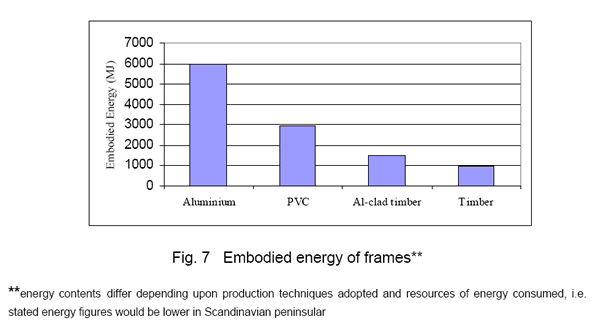
  • Embodied energy analysis has been carried out for a standard 1.2m × 1.2m window. Aluminium windows have the highest embodied energy, amounting to 6GJ. PVC, Al-clad timber and timber windows have embodied energy of 2980MJ, 1460MJ and 995MJ respectively.
  • All frame materials deteriorate to various degrees by environmental impacts. PVC is sensitive towards heat and UV radiation. Timber if not frequently treated, can easily be affected by environment. Aluminium, if not protected well by coatings, gets damaged under corrosive conditions especially in coastal and industrial areas. Al-clad frames are unlikely to deteriorate due to their protective coatings and appear to be the best choice from this point of view.
  • A survey analysis shows that aluminium and timber windows can easily last more than 40 years. Al-clad timber being new on the market, is expected to have a service life well over 40 years. PVC windows, in most cases, are reported to have an optimum service life of 25 years.

Portloe house visit

Today, Robert from ra-studio, took to visit a house in Portloe that he worked on before he set up his own practice.

Rob, post visit dropped this in an email to me:

I hope you found the trip over to Claire’s place useful yesterday – it’s sometimes good to experience spaces in a more physical sense / situation, and perhaps helps you to visualise how some of your spaces could feel. I think there are obvious parallels between Sea House and Silver Spray (connection / views / relationship with the sea), and seeing how it has been handled there, I hope was helpful for you.

Yes, well worth the visit. It was fantastic to meet such an obviously happy client (and her cool, crazy young dog, Zola).

Their project was serialised in the Telegraph:

So many things about the house, that I hope to include in Silver Spray. The feeling of space, the flow through the house, the views, the natural materials ……

The house looks over the village and was designed to fit into the slope. Without the red circle, it’d be a chunk less obvious !

You drive up the drive and see the studio on your left with the house a bit beyond.

The cladding on the studio is the same as on the house, but it hasn’t yet worn to the same more grey colour / tint.

The house has an amazing central “spine” so that as you walk up to the front door, you see through to the view.

Although the stone detail of the wall below the cladding looks stunning on this house, it’s not something I feel will work for Silver Spray. Except !!!!! maybe for the rear wall of the courtyard. Well something needs to go on that wall. Perhaps it’ll be a retaining wall held back by Gabions (steel cages of rocks). But a quick on-line search suggests the life of Gabions, which is down to the life of the steel holding them together is 50 to 60 years. I suspect less in Silver Spray site, so close to the sea. Damn, as they’d be great.

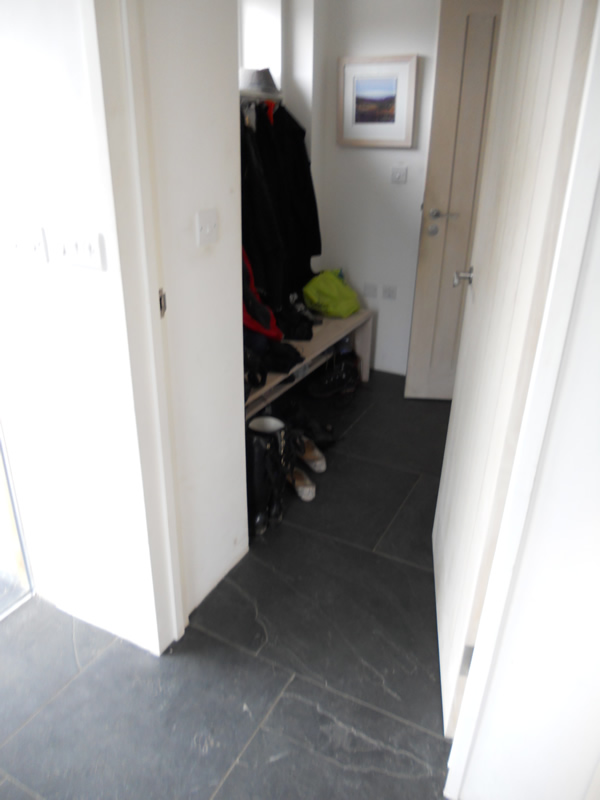
The slate flooring runs from around much of the house, straight into the house, where it’s apparently super easy to clean. The texture it gives was fantastic. The same slate was used for the external window sills.

Almost all of the windows are by Velfac, with thin profiles, nice colours etc.

This upstairs window has a piece of glass over the front to create a “Juliet Balcony”. Which will work great for the second bedroom.

I’m still not a fan of the idea of wooden decking. Here there was a mixture of slate and wooden decking.

Coat room to the left as you walk in 🙂

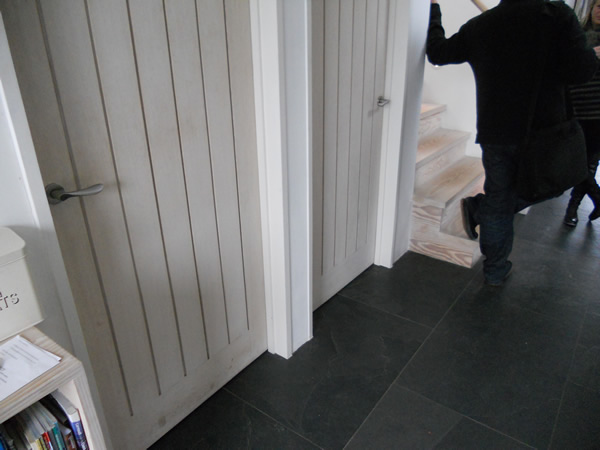
Lovely doors, floor and wooden stairs:

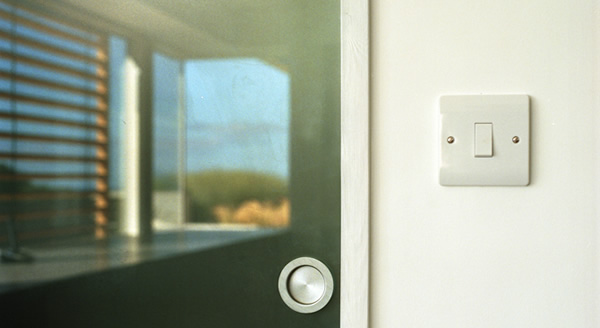
Nice detailing on this sliding door that can close over the entrance to the kitchen.

Wide, light floor boards. Interestingly, wooden floors upstairs. I was thinking carpet, but this did work well. OK they have light coloured tiles in the bathrooms upstairs. The bedrooms had good integrated storage.

The above white TV makes it less dominant on the room. Also a superb idea that it pushes against the wall, but is on an arm that can come out and so be viewed from the seating etc. This could be a great idea for in any bedrooms. Although I’m not planning TVs in the bedrooms, it’d be good to allow this future option.
Having a TV in the 2nd bedroom for guests could be a nice touch.

Pebbles in a gulley outside the door, to prevent splash up from rain onto the windows and also to drain away water flowing down the windows.

A photo from when the studio was being built:

The house has solar heating and solar electricity.

Light and ventilation tunnel ?

With the stairs going from the floor of the house, to the top and being capped by a sky-light, and also a south facing window (or two) at the top of this “column”, I was reminded of the Potton Lighthouse, with it’s “wind catcher / light funnel”.

I’m wondering if these windows could be an automatic, intrinsic way that the house heats and cools itself down?

Below is a screen shot from a PDF about the Potton Lighthouse.

Sea facing windows

I was talking to Malcom who built the end house and he said his top tip would be to not only “over spec” any windows and doors that face the sea, but also to make sure that they are installed in a way that when it’s windy the external weather pushes them tighter shut, rather than blowing them to create a gap through which wind +/or water can come.

He has since sold the house, but when he lived in it, he said you could see the windows flexing inward when there were strong winds and you could see and feel the whole house flexing. It was a timber frame construction and in order to keep as airtight a house as possible, this re-enforces the idea of going for brick or a steel frame.

A steel frame could then have panels between the steel made with wood, and sheeps wool or similar insulation to off-set some or all of the CO2 impact of the steel and other less eco building materials. The steel frame could be in such a way that, when the house is altered or taken down, it can be taken apart and recycled.

  • I’ve since this post been told by an architect (who’s done enough projects to know) that a house that flexes this much is more likely down to the building specification and construction than the materials. That you can make a solid timber frame house.

Saving money through home energy efficiency

A great article on the BBC Website on “saving money through home energy efficiency“that includes this graphic from the Energy Saving Trust on where most heat loss occurs from an uninsulated home:

For me, key is that for most existing houses, this means that double glazing is not the first thing that should be dealt with. In order the heat loss is:

  • 33% walls
  • 26% roof
  • 18% windows
  • 12% general draughts
  • 8% floors
  • 3% doors.

So in terms of which are easy to deal with, roof insulation, cavity insulate the walls, thick curtains have been shown to give as good as double glazing (or VERY close) and then general draughts.