EcoBuild: Waste Water / Drain Water / Shower, Heat Recovery

At Passivhaus levels of energy efficiency hot water accounts for more energy than space heating.

At last weeks Ecobuild, I saw a couple of systems that do this. They capture the heat from hot water that is going down the drain and feed it back into the hot water system. It seems there are 2 systems:

  1. A vertical pipe that the hot water flows down, usually slowed, around the cold water mains supply. Their is heat exchange from the waste water to the cold water, that, in these systems typically, feeds into the water heater / hot water tank.

  2. A system linked to just the shower. So that the heat in the shower waste is immediately put back into the shower. As most showers have a thermostatic valve, this means an instant and guaranteed gain.

+ & – Thoughts

Check the cost of the system Vs the predicted and probable saving for an evaluation of how long the system will take to pay for itself.

  • One of the 2 systems at Ecobuild was the, €299 retail price, system, that you can see at http://zypho.eu/english.html. So price wise, VERY worth considering,  but need to see if:
    • Have to use, what looked like, the integrated shower tray cap / valve bit, or can this work with any shower tray and it’s drainage inlet?
    • Will it cope with sand if used as the post surf outside shower?
    • What is the cost implication of this on each shower Vs a system that copes with multiple showers and other hot water drain pipes (bath, washing machine, dish washer).
    • Does it reduce the cold water pressure? (Does this matter ?)
      I’ve emailed Zypho these questions 
    • Nice write up on the Zypho unit at Ecobuild on the HardHouse blog by Mark.
      – looks good, but questions the heat exchanger and it isn’t yet fully UK approved.
  • Cost Implications:

If used for an external, post surfing, shower, will the system cope with sand, mud, dirt etc?
– it does look like the  Bristol based shower tray system could be put in post a sand trap !
– could even have this bit under the floor in the house and not outside where the cold, frosts etc. could be a problem. It could then also link in to the water outflow from the washing machine, dishwasher and any other ground water outflows of warm / hot water.
–  http://shower-save.com/Joomla_SS/pdfs/Adaptor%20to%2040mm%20for%20RT1-e.pdf
–  http://shower-save.com/pdfs/Recoh-Tray%20grey%20water%20heat%20recovery.pdf

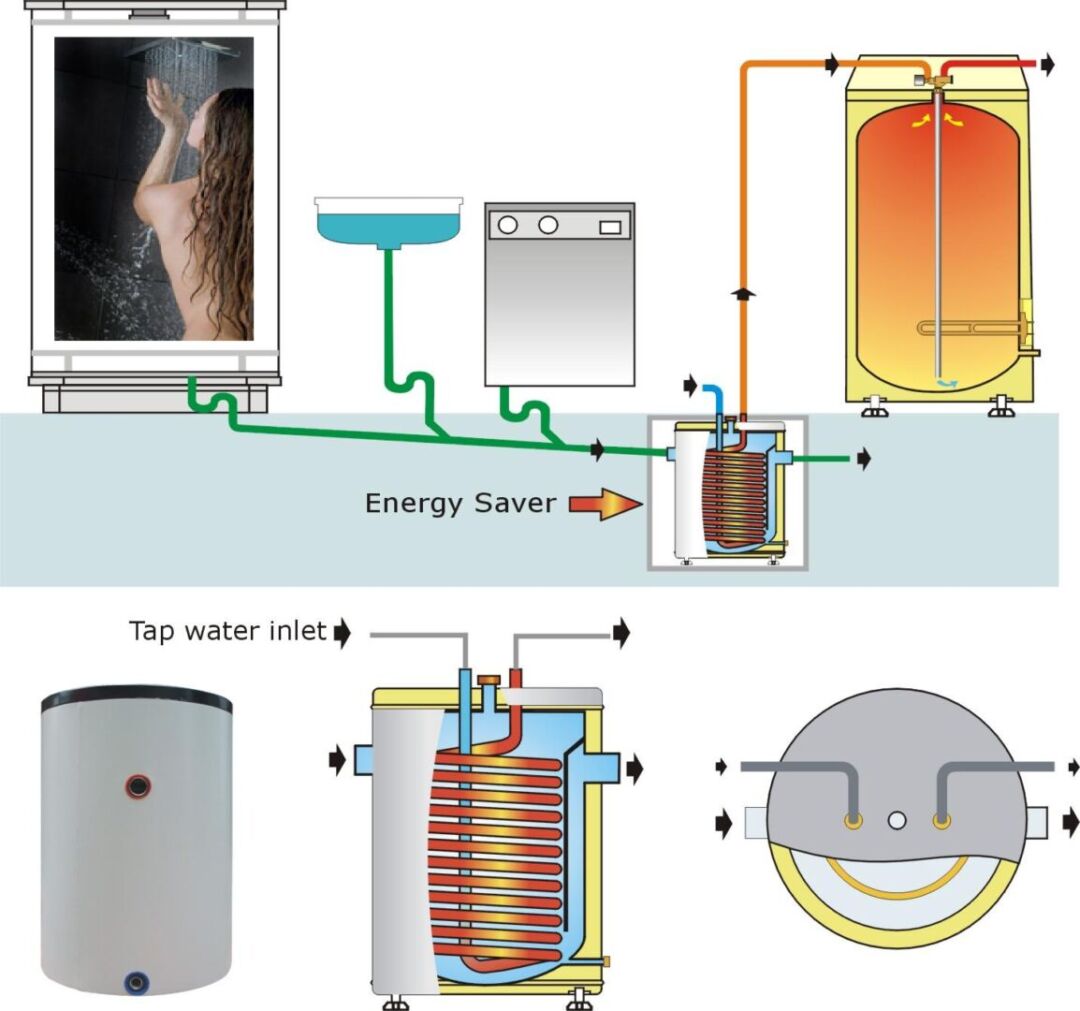
It seems that if you could get a single whole house heat recovery system that auto feeds the cold water supply to showers, and if they aren’t being used sends the preheated cold water to the water boiler (if it’s not full) would be the best. See the schematic below from http://www.gfxtechnology.com/H-3.pdf

This is also how it’s been set up in the schematic at Bristol (UK) based  http://shower-save.com/
 – also see animation they have at http://content.wavin.com/WAXUK.NSF/pages/Certus-ShowerSave-Animation-EN/$FILE/ShowerSave.swf

UK Water Heat Recovery Supplier Listing:

Test Data for Recoh Units:

From http://shower-save.com/gastec.html

  • Recoh-vert 61.2% efficient, with a mixer shower
  • Recoh-tray is 46.9% efficient, with a mixer shower

Shower-Save is even more efficient with a low flow rate or electric shower:

  • Recoh-vert 64.0% efficient with electric or other low flowrate shower
  • Recoh-tray is 52.6% efficient with electric or other low flowrate shower

Schematics of Waste Water Heat Recovery Systems

Notes from other Websites re these systems:

From http://www.gfxtechnology.com/H-3.pdf:

  • Typically, 80–90 percent of the energy used to heat water in the home goes down the drain. Heat exchangers capture some of the heat in drain-water, allowing it to be reused by incoming water. One type, called a gravity film exchange drain-water heat recovery system, has been found to save 25–30 percent of total water-heating energy needed.
  • This technology is compatible with all types of water heating systems, but it is especially suitable with on-demand water heaters and solar thermal systems. Prices range from $300–400 and paybacks are in the range of 2.5 to 7 years, depending on how often it is used.

From http://www.renewability.com/power_pipe/index.html:

  • Falling film heat exchangers have been around for decades. Other than utilizing the “falling film” effect, however, the Power-Pipe® has little in common with other Drain Water Heat Recovery (DWHR) devices.
  • First generation units suffer from high water pressure loss in the freshwater supply, which causes flow problems. Second generation units resolve the pressure loss issue by adopting a non-counter flow heat exchanger design, which delivers a low heat transfer performance.

Other Water Heat Exchange Systems & Discussions:

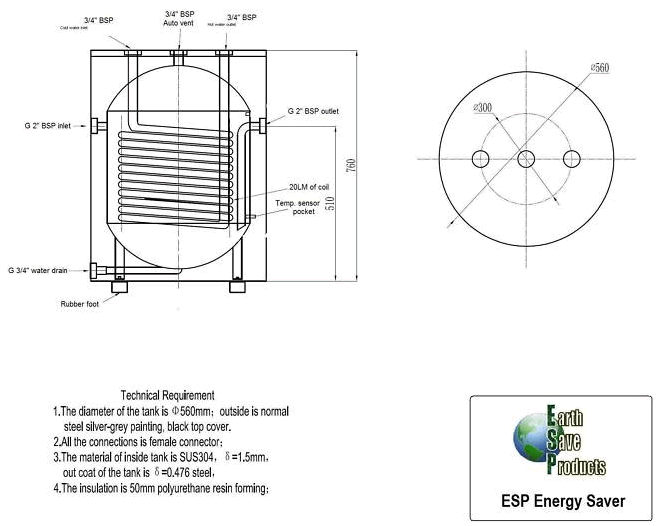
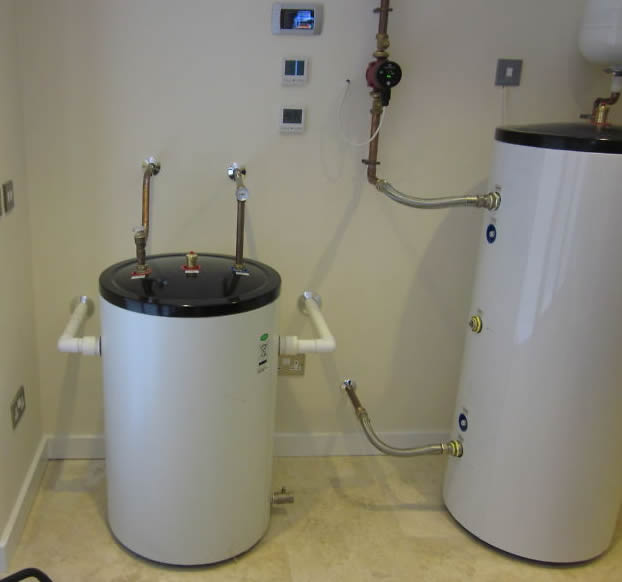
From Earth Save Products (bottom of the page) their Heat Squirrel – 120ltr heat recovery vessel (for domestic waste water)
Heat Squirrel - schematic
Heat Squirrel - installed

Change Your Behaviour – Bath water heat recovery

One behavioural solution to waste water heat recovery, is to just leave a hot bath, hot sink of water full to cool down and transfer it’s heat to the room(s) before you pull the plug. How often do we pull the plug on a bath of hot water to let that heat head off down the drain, when we could let it cool down (ie heat the interior or the house) first ?

Light and ventilation tunnel ?

With the stairs going from the floor of the house, to the top and being capped by a sky-light, and also a south facing window (or two) at the top of this “column”, I was reminded of the Potton Lighthouse, with it’s “wind catcher / light funnel”.

I’m wondering if these windows could be an automatic, intrinsic way that the house heats and cools itself down?

Below is a screen shot from a PDF about the Potton Lighthouse.

Average 57% of energy on space heating !!!

According to the Feb 2012 edition of “House & Garden”:

The average British household uses a whopping 57 percent of it’s energy consumption on space-heating, and a further 24 percent on water-heating ….

I hope / suspect this figure is coming down as the “low hanging fruit” of people putting better insulation in existing housing stock and better insulation and seals etc. into new housing stock.

Pavatex Pavatherm eco boards (incl with steel frame)

Architect Rob has said the house won’t need to be 100% a steel framework.
– Some steel given the spans is likely. But Rob says even on such an exposed site, other building materials can give a solid, non flexing building.

The spotted a magazine article about a house built on a sloop in some woods, talked about Pavatex Pavatherm in the “Eco Credentials” section of the article:

…. eco-friendly Pavatex Pavatherm Plus interlocking wood-fibre insulation boards, which we used to clad the roof and first floor ……. This made a waterproof sealed skin on the outside of the frame.

Looking at their UK reseller it’s made almost 100% from recycled materials, has good thermal and acoustic insulation properties and can be combined with a light steel frame system:

So, this could be an interesting material to consider at some point. But a long way from that!
– still working on the layout of the rooms etc !

Saving money through home energy efficiency

A great article on the BBC Website on “saving money through home energy efficiency“that includes this graphic from the Energy Saving Trust on where most heat loss occurs from an uninsulated home:

For me, key is that for most existing houses, this means that double glazing is not the first thing that should be dealt with. In order the heat loss is:

  • 33% walls
  • 26% roof
  • 18% windows
  • 12% general draughts
  • 8% floors
  • 3% doors.

So in terms of which are easy to deal with, roof insulation, cavity insulate the walls, thick curtains have been shown to give as good as double glazing (or VERY close) and then general draughts.

Perranporth Low Carbon Limited ?

Wouldn’t it be great to set-up Perranporth Low Carbon Limited ?

Attending some eco-build talks at the Eden Project, one of the speakers is involved with Hook Norton Low Carbon Limited.

It is an Industrial Provident Society, set up by Low Carbon Hook Norton members to help the community reduce its energy consumption, carbon emissions and save money, with a range of community-based schemes and individual household projects based on interest-free loans.

http://www.hn-lc.org.uk/

From the talk, it seems they coordinated getting funding and then the residents and suppliers to slowly help everybody (residents, the school, local firms ….) benefit (lower fuel bills, jobs to implement the projects …..) and move to a lower carbon / more sustainable village.

In relation to this, it’d probably make sense to chat with http://sustaincornwall.co.uk/ and the linked Cornwall Sustainable Building Trust

Photovoltaic Thermal (PVT)

Latest:

  • See this post on Photovoltaic, PVT Vs PV or PT.
    – it seems that PVT just doesn’t yet work, and may never work as they have very different optimal temperatures.

Photovoltaic Thermal (PVT) with New Form Energy ?

In late Feb 2012 I dropped an message to www.newformenergy.com (via their on-line enquiry form) for a call to chat over the Silver Spray project.

  • Saying that  the current plans (pre planning application) have allocated a 8 x 5 m (approx) flat roof area for solar panels.This is on the south facing side of the building. The long north to south edge is just over 8m, the short edge is just under 5m (about 4.8m).
  • I’ve not had a reply / response and that was almost a month ago. Not ideal. OK I know a single email from their site form could get lost but ……

Origional Post:

Photovoltaic Thermal (PVT) is relativly new, but regarded as the most efficient at year round producing electricity and hot water.

” A well insulated 200m sq. house would need a 4kWp system costing around £20,000 installed, including a heat pump and hot water cylinder.” Homebuilding and Renovation magazine.

Supplier: www.newformenergy.com, where they claim:

  • A drawback with Photovoltaic panels (PV) is that as the surface temperature of the panel rises, the output drops. PV panels typically lose efficiency of up to 0.5% per degree rise in panel temperature.
  • Solar thermal collectors for hot water can give little or no hot water when there is little or no sun.
  • Although heat pumps are potential greener than burning fossil fuels, they do still use large amounts of electricity.

So a combined system:

  • One panel for PV and thermal means that:
    • 1st the growing heat is drawn away from the panel
    • 2nd, less total roof area needed for same output.
      • The Hybrid Solar Solution, with PowerVolt panels installed on a UK house with 28m2 of available south facing roof area, will produce the equivalent annual electrical output from 38m2 of conventional monocrystalline photovoltaics. The same area of PowerVolt collectors will offset approximately the same amount of thermal energy as 8m2 of conventional solar thermal collectors (without any contribution from the heat pump). Using separate PV plus solar thermal systems would therefore require 46m2 to generate the same electrical and thermal energy produced by 28m2 of PowerVolt thermal collectors.In addition, with the size of solar installation referred to above, the heat pump can produce up to 22,000kWh of heat in winter months when the demand is highest.
  • Solar thermal+ heat pump, means that at night or when low sunlight, the panel can act as a thermal collector (not a solar collector). This, then via the heat pump generates hot water.

Summary

  • All year round solution
  • Significantly increases your electricity production
  • Fastest payback of all renewable heating systems
  • Low maintenance and user friendly
  • Solution that optimises efficiency, saves space and money.

Perranporth Low Carbon Limited ?

Wouldn’t it be great to set-up Perranporth Low Carbon Limited ?

Attending some eco-build talks at the Eden Project, one of the speakers is involved with Hook Norton Low Carbon Limited.

It is an Industrial Provident Society, set up by Low Carbon Hook Norton members to help the community reduce its energy consumption, carbon emissions and save money, with a range of community-based schemes and individual household projects based on interest-free loans.

http://www.hn-lc.org.uk/

From the talk, it seems they coordinated getting funding and then the residents and suppliers to slowly help everybody (residents, the school, local firms ….) benefit (lower fuel bills, jobs to implement the projects …..) and move to a lower carbon / more sustainable village.

Hot / warm water into the washing machine

Thanks to Simon, I ended up at a great evening at the Eden Project on Wednesday. It was run by the Cornwall Sustainable Building Trust. Some great speakers including Charlie Luxton who covered a lot of items I already knew about (it’s always great to get confirmation from somebody with heaps more experience than yourself thought !), and quite a few I didn’t.

Warm Water into your Washing Machine

For instance, modern washing machines have a single water inlet, for cold water. But what this means is that these modern washing machines are using electricity to heat the water to the desired temp for the selected wash. Eeeeek, we all know that due to (not only) transmission from power stations for most people, the efficiency of heating water by electricity is shocking (see figures below *).

How about making sure that there are mixer taps to give warm water eg 20 degrees into the back of your washing machine.

Water Temperatures

  • Central heating tends to run at 55 to 65 degrees C.
  • Under floor heating runs at around 45 degrees C.
  • A bath is going to be, 44 to 46 (a VERY hot bath) degrees C.
  • BUT need to occasionally boost the water in the tank to kill legionella:
    – 66°C Legionella die within 2 minutes
    – 60°C Legionella die within 32 minutes
    – 55°C Legionella die within 5 to 6 hours

Cement

He also mentioned that instead of cement (environmentally horrible stuff) go for GGBS  +/or fly ash cement. It seems these are cements made up from the by products of already in place (and here to stay for a while) industries such as blast furnaces and coal burning.


* Energy and Electricity

These figures are taken from an eco building book, the Green Building Bible (Volume 1):

  • 100 units of energy in fossil fuel into a typical UK power station, gives
  • 38.5 units of energy into the grid, of which a further 3.5 units are lost on transmission & distribution, so you only get
  • 35 units to a house, of which 13 lost through inefficient use

So 100 becomes 22 (or 35 if you have 100% efficient use, through good appliances, voltage regulation etc.)