EcoBuild: Thermodynamic Panels (Heat Exchanger)

Thermodynamic Panels

These black panels were on display:
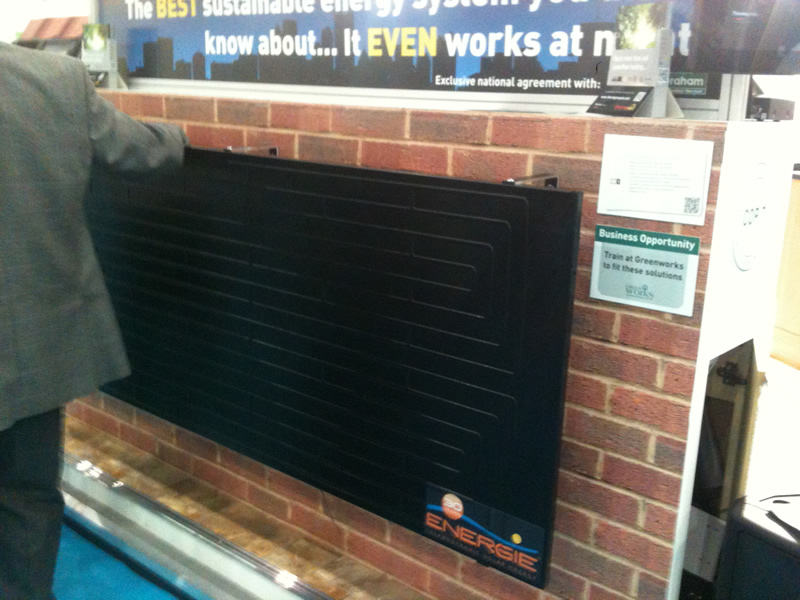
http://www.thermogroupuk.com/thermodynamic.html

These black aluminium panels have refrigerant fluid pumped into them. The heat absorbtion of the black panels changes this to a gas, that is sent to a compressor, which releases heat energy in the heat exchanger where the heat goes into the water. The gas then goes through an expansion valve, putting it back to a liquid before it goes back to the panel. (See explanation & figures below forum comments below).

Claims:

  • 55 degree C water output.
  • Can provide 100% of hot water and heating, 24/7, 365 days a year.
  • Works day or night, as it absorbs heat energy from the atmosphere. It is presumeably helped when it’s sunny !
  • Works when temps are down to -15 degrees C
  • Can be wall installed, which would work well for the Silver Spray proposal.
  • Co-efficient (COP) rating of 4.5 to 7.
  • Distributed by Jewson.
  • 1 panel system (with the boiler and reverse refrigeration bits) is about £4,500.
  • Can have multiple panels in a “toast” stack. Expo figure for that was about £6,500.

Forum Comments:

http://www.greenbuildingforum.co.uk/forum114/comments.php?DiscussionID=7740&page=1#Item_0

  • “Looks like it’s a heat pump with a solar-assisted air to liquid heat exchanger on the outdoors end.” seems to sum it up pretty well !
  • “depending on the heat pump, it’ll be better (better COP) than an ashp in sunlight, but probably worse at night unless there’s much wind to move air across it, although it will have a bigger surface area than in most ASHP’s which will compensate for this to some extent. “
  • “It also has the advantage of not needing (potentially noisy) fans”

Also from the forum, from their N. Ireland distributor:

The system is not new technology; it is basically a freezer “in reverse” and like a freezer consists of a heat collecting panel(s), refrigerant piping and an integrated electric heat pump.  It is a clever application of well tried and tested technology that has been around for almost 100 years.  The panels are made from weather protected anodized aluminium and are not vulnerable to extremes in hot or cold. They are light, weighing only 8 Kg and may be mounted in virtually any orientation or angle.  It has been estimated that 25% of the energy absorbed by a panel comes from solar irradiation, the balance taken from air and rain. Both sides of the panel are available to collect energy. The company that manufactures the system is based in Portugal and to meet growing global demand they have just built a second factory reflecting their 25 year history of success with the product.

You can check them out at http://www.energie.pt/?cult=uk

The Energie system is fully scalable from 1 – 2 panels for domestic hot water, to 4 – 24 panels for central heating right up to 40 panels for large volume hot water requirements. Note that additional panels simply mean faster water heating times, not higher water temperature which is set to between 55 and 60 C maximum.  A typical domestic installation for domestic hot water will have a 250L cylinder with a single panel mounted on the roof.

The heat pump is integrated directly into the Energie cylinder so an existing hot water cylinder cannot be used in this configuration. For central heating and large volume hot water requirements the heat pump (Solar Block in Energie speak) is a stand-alone device. Energie cylinders are either stainless steel or enamelled steel and can come with an additional coil for connecting into a backup heat source if desired. Sizes range from 200L to 6,000L.

All Energie Thermodynamic Systems are accredited under the MCS scheme.

The system uses 407A refrigerant and doesn’t need topping up. The only maintenance may be the occasional replacement of the sacrificial anode in the cylinder should you live in an area with soft water.

Another point raised concerned the panel frosting over in winter. This is possibly best addressed by personal experience.  I installed a 300L single panel system in my home at the start of this year, and although there was some frosting in the very cold weather at that time on the top surface of the panel, the bottom side was clear, and we always had enough hot water. Eight months later we have never had call to revert to either our central heating boiler which has been turned off these past 5 months, or the small integrated immersion that comes with the Energie cylinder. I estimate from measurements I have taken that the Energie system has used an average of 3.6 KWh of electricity per day over the 8 months January to August for our 4-person household at a COP of just over 3.

Hundreds of Energie systems have been installed successfully throughout Ireland over the last 4 years and having come through last winter are well tested for the vagaries of the UK and Irish climate.

Finally some additional information as supplied by Energie can be found using the link below. http://www.e3renewables.com/downloads/

More Information from ThermoGroup

From:

www.thermogroupuk.com/thermogroup_pdfs/Thermodynamic%20Technical%20Information.pdf

1. Aluminium Panels
Refrigerant fluid circulates through the panels and absorbs heat energy from the atmosphere. This increase in temperature changes the fluid into a gas.

2. Compressor
The gas then passes through a compressor and the temperature increases.

3. Hot Water Cylinder
The hot gas then flows through a heat exchanger in the Thermodynamic Block which transfers the heat into the water, which can be used for sanitary hot water, space heating or larger applications such as swimming pools.

4. Expansion Valve
The gas then passes through an expansion valve, reverts back to a liquid and flows back to the panels to
repeat the process.

Figures for Thermodynamic Atmospheric Energy Panels

I read or heard at the show, that increasing the number of panels increases the speed at which the system works. So I think you could add a panel to make the system work faster at grabbing the optimum conditions? (Need to ask them)

Air Source Heat Pump Vs Thermodynamic Atmospheric Energy Panels:

 Air source heat pumps  Thermodynamic
• COP of around 4
• Outputs of 6-18kW
• Outdoor noise pollution
• Requires regular maintenance
• Efficient to just below 0 degrees C
• Fixed sizes
• Fan assisted, low active surface area
• COP of up to 7
• Outputs of 1.7 – 53 kW
Silent outside
• Only one moving part
• Works down to -15 degrees C
• Total flexibility
• Active surface area of 3.2m2 per panel
 Standard Solar Thermal Panel  Thermodynamic
• Provides up to 70% of your hot water
• Must be mounted south facing for best results
• Needs backup from a boiler or immersion heater
• Needs sunlight – low performance in winter/night
• Can only assist central heating
• Fragile glass panels
• Provides up 100% of your hot water.
• Can be mounted south/west/east/north on a wall
• No backup required – Not connected to boiler
• Works in the dark and down to -15OC – 24/7
• Can provide 100% of your central heating
• Aluminium – tough, long lasting, anti corrosive
They can work on a north facing wall, but work best the more direct solar exposure they get.

Case Studies and Cost

Running Cost:

From www.thermogroupuk.com/thermogroup_pdfs/Thermodynamic%20Case%20Studies.pdf:

  • 4 bed house, one panel & 280 L cylinder, for hot water only = £109.50 pa
  • 3 bed house, 6 panels & thermodyanmic block for central heating only = £346.75 pa

So how much would a central heating and hot water system cost per annum ?
– those figures have an assumed electricity tariff of £0.14/kWh. If the system is part driven by my own solar panels, the cost would be reduced (although you need to factor in the capital cost of the solar panels.)

Purchase Cost:

Need to add in the cost of having it all installed and signed off to the level that’ll hopefully get the Renewable Heat Incentive.

From www.thermogroupuk.com/thermogroup_pdfs/Thermodynamic%20Kit%20Retail%20Prices.pdf

Thermodynamic kits ship pre-gassed, ready for installation and include the following:

  • Thermodynamic Panels/s
  • Panel Fixing Kit
  • Hot Water Cylinder with Thermodynamic Block
  • 30m Copper Pipe
  • 30m Low-loss Lagging

The above thermodynamic kits are suitable for supply of sanitary hot water in domestic applications. Thermodynamic systems for Ambient heating or larger applications require a more detailed specification to ensure we provide you with the right solution.

I’ve emailed them for a rough quote.

EcoBuild: Air Source Heat Pumps

Air Source Heat Pumps

The installers / advisors to projects that were speaking at the lectures for self builders were all very positive about air source heat pumps in terms of how they work and how they stack up from an environmental / energy / sustainable point of view.

There are now automated systems for (for example) an air source heat pump to kick in when Photo Voltaic (PV) panels are producing more electricity than the house is using, and so at those times top up the water thermal store in the building. This can then be used for hot water or heating (under floor works at lower temps) at other times (if needed).

EcoBuild: Waste Water / Drain Water / Shower, Heat Recovery

At Passivhaus levels of energy efficiency hot water accounts for more energy than space heating.

At last weeks Ecobuild, I saw a couple of systems that do this. They capture the heat from hot water that is going down the drain and feed it back into the hot water system. It seems there are 2 systems:

  1. A vertical pipe that the hot water flows down, usually slowed, around the cold water mains supply. Their is heat exchange from the waste water to the cold water, that, in these systems typically, feeds into the water heater / hot water tank.

  2. A system linked to just the shower. So that the heat in the shower waste is immediately put back into the shower. As most showers have a thermostatic valve, this means an instant and guaranteed gain.

+ & – Thoughts

Check the cost of the system Vs the predicted and probable saving for an evaluation of how long the system will take to pay for itself.

  • One of the 2 systems at Ecobuild was the, €299 retail price, system, that you can see at http://zypho.eu/english.html. So price wise, VERY worth considering,  but need to see if:
    • Have to use, what looked like, the integrated shower tray cap / valve bit, or can this work with any shower tray and it’s drainage inlet?
    • Will it cope with sand if used as the post surf outside shower?
    • What is the cost implication of this on each shower Vs a system that copes with multiple showers and other hot water drain pipes (bath, washing machine, dish washer).
    • Does it reduce the cold water pressure? (Does this matter ?)
      I’ve emailed Zypho these questions 
    • Nice write up on the Zypho unit at Ecobuild on the HardHouse blog by Mark.
      – looks good, but questions the heat exchanger and it isn’t yet fully UK approved.
  • Cost Implications:

If used for an external, post surfing, shower, will the system cope with sand, mud, dirt etc?
– it does look like the  Bristol based shower tray system could be put in post a sand trap !
– could even have this bit under the floor in the house and not outside where the cold, frosts etc. could be a problem. It could then also link in to the water outflow from the washing machine, dishwasher and any other ground water outflows of warm / hot water.
–  http://shower-save.com/Joomla_SS/pdfs/Adaptor%20to%2040mm%20for%20RT1-e.pdf
–  http://shower-save.com/pdfs/Recoh-Tray%20grey%20water%20heat%20recovery.pdf

It seems that if you could get a single whole house heat recovery system that auto feeds the cold water supply to showers, and if they aren’t being used sends the preheated cold water to the water boiler (if it’s not full) would be the best. See the schematic below from http://www.gfxtechnology.com/H-3.pdf

This is also how it’s been set up in the schematic at Bristol (UK) based  http://shower-save.com/
 – also see animation they have at http://content.wavin.com/WAXUK.NSF/pages/Certus-ShowerSave-Animation-EN/$FILE/ShowerSave.swf

UK Water Heat Recovery Supplier Listing:

Test Data for Recoh Units:

From http://shower-save.com/gastec.html

  • Recoh-vert 61.2% efficient, with a mixer shower
  • Recoh-tray is 46.9% efficient, with a mixer shower

Shower-Save is even more efficient with a low flow rate or electric shower:

  • Recoh-vert 64.0% efficient with electric or other low flowrate shower
  • Recoh-tray is 52.6% efficient with electric or other low flowrate shower

Schematics of Waste Water Heat Recovery Systems

Notes from other Websites re these systems:

From http://www.gfxtechnology.com/H-3.pdf:

  • Typically, 80–90 percent of the energy used to heat water in the home goes down the drain. Heat exchangers capture some of the heat in drain-water, allowing it to be reused by incoming water. One type, called a gravity film exchange drain-water heat recovery system, has been found to save 25–30 percent of total water-heating energy needed.
  • This technology is compatible with all types of water heating systems, but it is especially suitable with on-demand water heaters and solar thermal systems. Prices range from $300–400 and paybacks are in the range of 2.5 to 7 years, depending on how often it is used.

From http://www.renewability.com/power_pipe/index.html:

  • Falling film heat exchangers have been around for decades. Other than utilizing the “falling film” effect, however, the Power-Pipe® has little in common with other Drain Water Heat Recovery (DWHR) devices.
  • First generation units suffer from high water pressure loss in the freshwater supply, which causes flow problems. Second generation units resolve the pressure loss issue by adopting a non-counter flow heat exchanger design, which delivers a low heat transfer performance.

Other Water Heat Exchange Systems & Discussions:

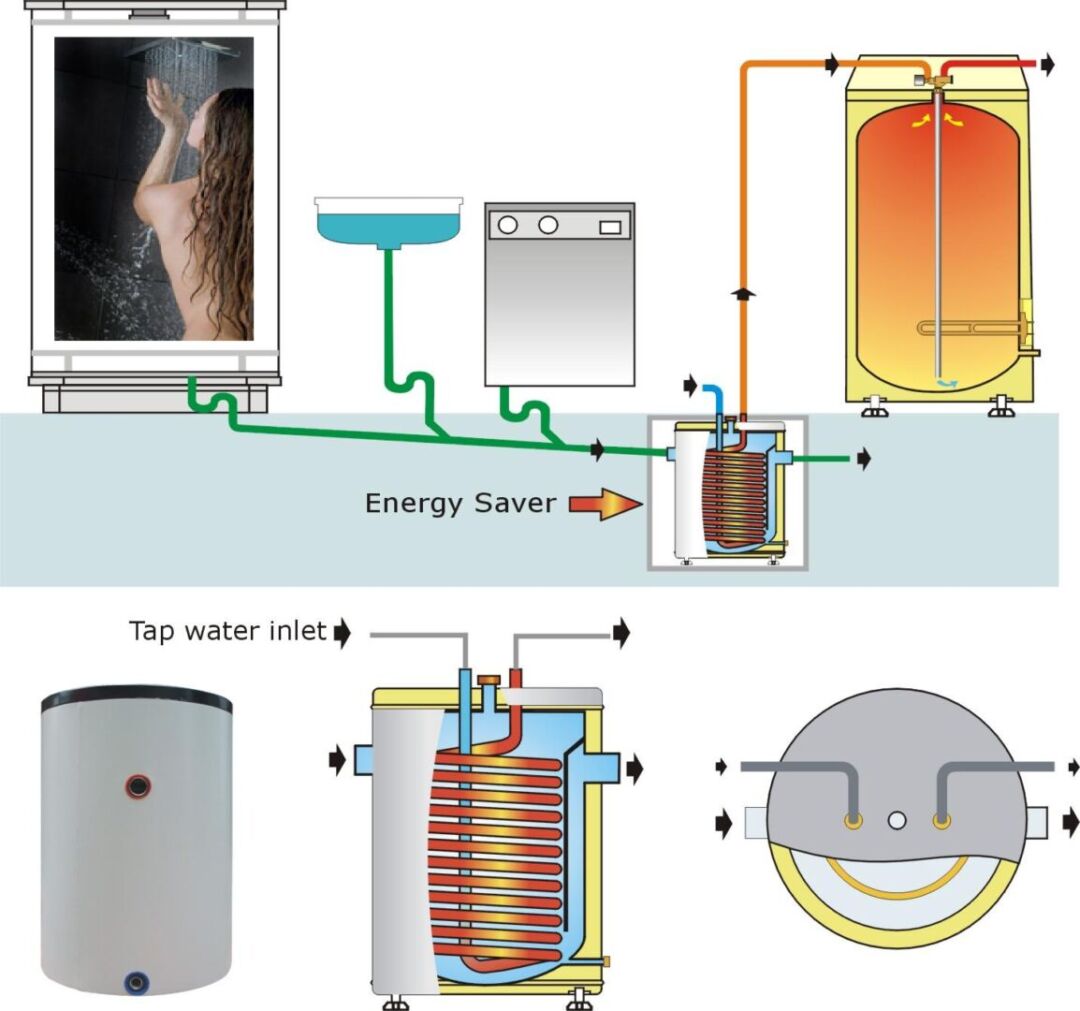
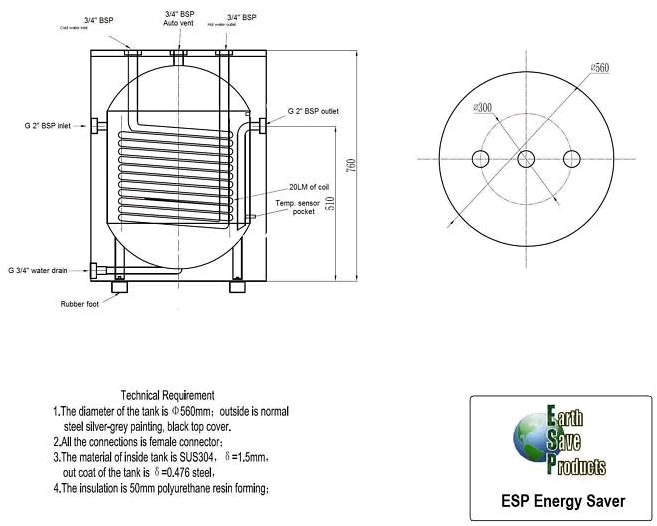
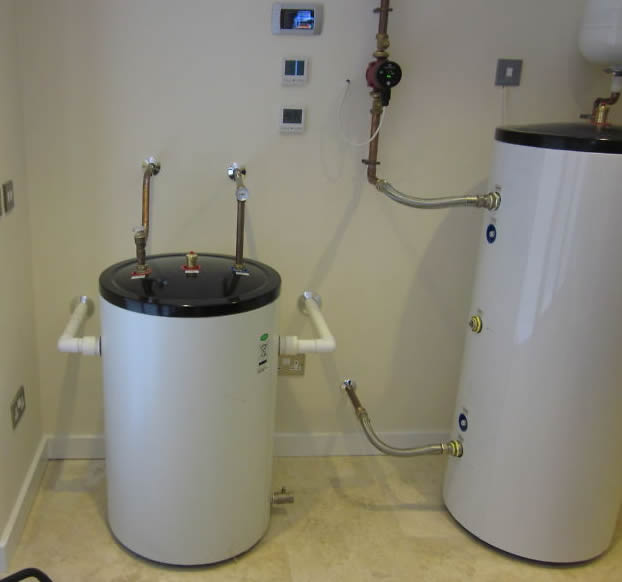
From Earth Save Products (bottom of the page) their Heat Squirrel – 120ltr heat recovery vessel (for domestic waste water)
Heat Squirrel - schematic
Heat Squirrel - installed

Change Your Behaviour – Bath water heat recovery

One behavioural solution to waste water heat recovery, is to just leave a hot bath, hot sink of water full to cool down and transfer it’s heat to the room(s) before you pull the plug. How often do we pull the plug on a bath of hot water to let that heat head off down the drain, when we could let it cool down (ie heat the interior or the house) first ?

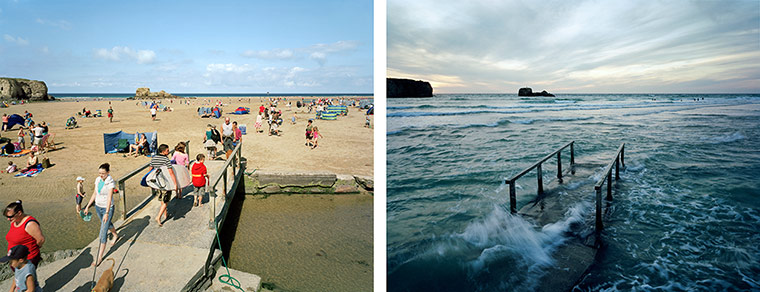
Perranporth beach at low and high tide

Some great photos of Perranporth beach at low and high tide by Michael Marten in the Guardian on Saturday.

Perranporth, Cornwall. 29 and 30 August 2007. Low water 12 noon, high water 8pm

Perranporth, Cornwall. 28 and 29 August 2007. High water 6pm, low water 11.20am

Hot tub ?

mmmmmm

It seems my friends are more inspired by the house having a hot tub than anything else!

Yes, it would be great fun, to sit in a hot tub outside the lounge or on the balcony at the top by the study. BUT can I find a way to be a bit eco about how to heat the water ? (Lets face it, having a big body of heated water outside, can’t be that efficient). So, ideas on the best way to achieve the idea:

  • Use hot water that is heated by the solar panels and a back burner on the fire?
  • The Scarlet Hotel hot-tubs aren’t metal as I thought, but made out of  Glass Fibre Polyester. Looking at the Website of the Dutch firm that makes these log fired hot tubs, you can use a hose to fill them. So maybe you could use the house hot water tank to pre fill the tub with the 800 litres of  hot water. Then use the fire to keep the water warm.
    • These tubs are 170 x 260 cm wide (specification),
    • “The weight of the Dutchtub can reach 1400 kg / 3000 lbs, a small platform under the tub can spread the total weight on more square meters than just the four legs of the tub.” (Safety).
    • The English agents are www.BigFire.co.uk


Photovoltaic Thermal (PVT)

Latest:

  • See this post on Photovoltaic, PVT Vs PV or PT.
    – it seems that PVT just doesn’t yet work, and may never work as they have very different optimal temperatures.

Photovoltaic Thermal (PVT) with New Form Energy ?

In late Feb 2012 I dropped an message to www.newformenergy.com (via their on-line enquiry form) for a call to chat over the Silver Spray project.

  • Saying that  the current plans (pre planning application) have allocated a 8 x 5 m (approx) flat roof area for solar panels.This is on the south facing side of the building. The long north to south edge is just over 8m, the short edge is just under 5m (about 4.8m).
  • I’ve not had a reply / response and that was almost a month ago. Not ideal. OK I know a single email from their site form could get lost but ……

Origional Post:

Photovoltaic Thermal (PVT) is relativly new, but regarded as the most efficient at year round producing electricity and hot water.

” A well insulated 200m sq. house would need a 4kWp system costing around £20,000 installed, including a heat pump and hot water cylinder.” Homebuilding and Renovation magazine.

Supplier: www.newformenergy.com, where they claim:

  • A drawback with Photovoltaic panels (PV) is that as the surface temperature of the panel rises, the output drops. PV panels typically lose efficiency of up to 0.5% per degree rise in panel temperature.
  • Solar thermal collectors for hot water can give little or no hot water when there is little or no sun.
  • Although heat pumps are potential greener than burning fossil fuels, they do still use large amounts of electricity.

So a combined system:

  • One panel for PV and thermal means that:
    • 1st the growing heat is drawn away from the panel
    • 2nd, less total roof area needed for same output.
      • The Hybrid Solar Solution, with PowerVolt panels installed on a UK house with 28m2 of available south facing roof area, will produce the equivalent annual electrical output from 38m2 of conventional monocrystalline photovoltaics. The same area of PowerVolt collectors will offset approximately the same amount of thermal energy as 8m2 of conventional solar thermal collectors (without any contribution from the heat pump). Using separate PV plus solar thermal systems would therefore require 46m2 to generate the same electrical and thermal energy produced by 28m2 of PowerVolt thermal collectors.In addition, with the size of solar installation referred to above, the heat pump can produce up to 22,000kWh of heat in winter months when the demand is highest.
  • Solar thermal+ heat pump, means that at night or when low sunlight, the panel can act as a thermal collector (not a solar collector). This, then via the heat pump generates hot water.

Summary

  • All year round solution
  • Significantly increases your electricity production
  • Fastest payback of all renewable heating systems
  • Low maintenance and user friendly
  • Solution that optimises efficiency, saves space and money.

Hot / warm water into the washing machine

Thanks to Simon, I ended up at a great evening at the Eden Project on Wednesday. It was run by the Cornwall Sustainable Building Trust. Some great speakers including Charlie Luxton who covered a lot of items I already knew about (it’s always great to get confirmation from somebody with heaps more experience than yourself thought !), and quite a few I didn’t.

Warm Water into your Washing Machine

For instance, modern washing machines have a single water inlet, for cold water. But what this means is that these modern washing machines are using electricity to heat the water to the desired temp for the selected wash. Eeeeek, we all know that due to (not only) transmission from power stations for most people, the efficiency of heating water by electricity is shocking (see figures below *).

How about making sure that there are mixer taps to give warm water eg 20 degrees into the back of your washing machine.

Water Temperatures

  • Central heating tends to run at 55 to 65 degrees C.
  • Under floor heating runs at around 45 degrees C.
  • A bath is going to be, 44 to 46 (a VERY hot bath) degrees C.
  • BUT need to occasionally boost the water in the tank to kill legionella:
    – 66°C Legionella die within 2 minutes
    – 60°C Legionella die within 32 minutes
    – 55°C Legionella die within 5 to 6 hours

Cement

He also mentioned that instead of cement (environmentally horrible stuff) go for GGBS  +/or fly ash cement. It seems these are cements made up from the by products of already in place (and here to stay for a while) industries such as blast furnaces and coal burning.


* Energy and Electricity

These figures are taken from an eco building book, the Green Building Bible (Volume 1):

  • 100 units of energy in fossil fuel into a typical UK power station, gives
  • 38.5 units of energy into the grid, of which a further 3.5 units are lost on transmission & distribution, so you only get
  • 35 units to a house, of which 13 lost through inefficient use

So 100 becomes 22 (or 35 if you have 100% efficient use, through good appliances, voltage regulation etc.)