Steel (not timber) frame ?

8 Dec 2011 Update on this topic:

I found this company, http://www.eurban.co.uk, who specialise in pre-made timber panels (SIPs) that by their construction are already weather proof (apparently).
On this project (that was on Grand Designs, it’s the Mimi and Andre De Costa project), http://www.eurban.co.uk/Projects/PRIVATE+HOUSES/Headcorn+Minimalist+House, the PDF factsheet, says that Eurban provided the structural design of hybrid timber and steel superstructure. The used materials were crosslam, steel and exposed timber finish throughout. Installation took 4 weeks. The stored carbon due to the wood panels was 139 tonnes of CO2.

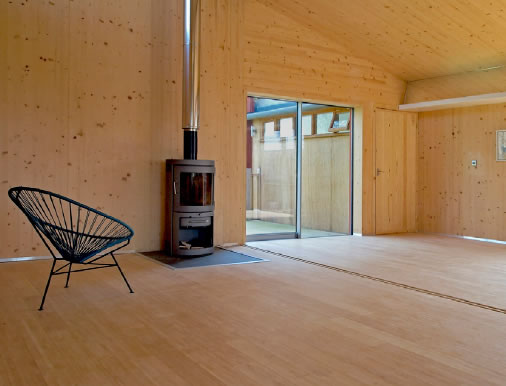
I also like the possible idea of leaving the inner walls wooden !
There are firms about such as the one in Bodmin and http://www.modcell.com/ that make units with straw or other insulation, that could go into a steel frame.


Origional Post:

One of the architects I’ve been chatting with has suggested / pointed out, that given the site a timber frame could flex too much in the exposed site, so damaging the building envelope.

He comes from a background of creating sustainable / environmental buildings and has no building /builders allegiance, so I’m taking the comment as not biased.

Stell has high embodied energy, so the environmental “cost” of building with stell goes up, but it is potentially a lot more recyclable in the long run than say brick or concrete.

I have therefore been thinking and looking out for an eco/sustainable way to build a steel framed house with timber and natural insulation between within and between the steel frame.

And up pops a Grand Designs programme about a house that is almost exactly this !

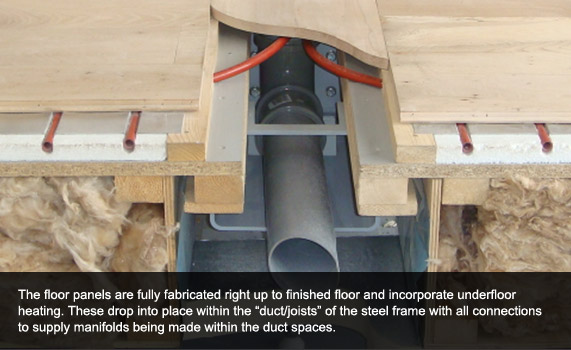
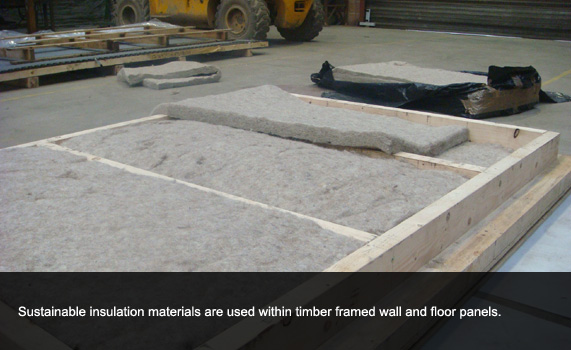
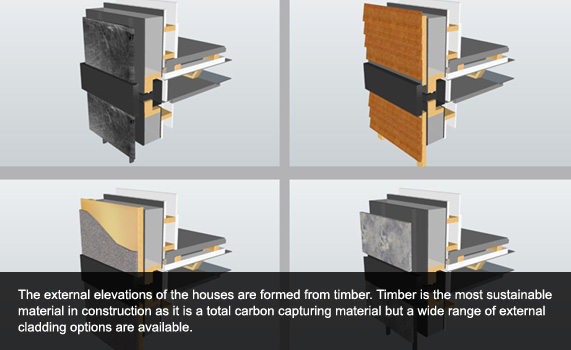
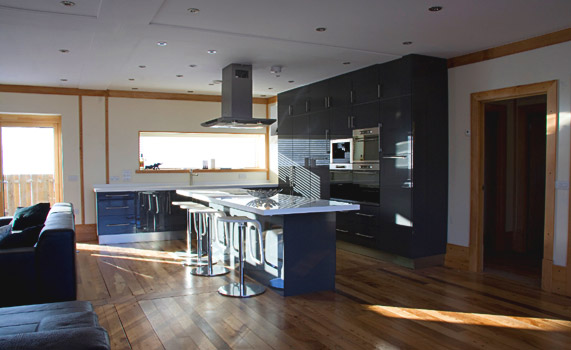
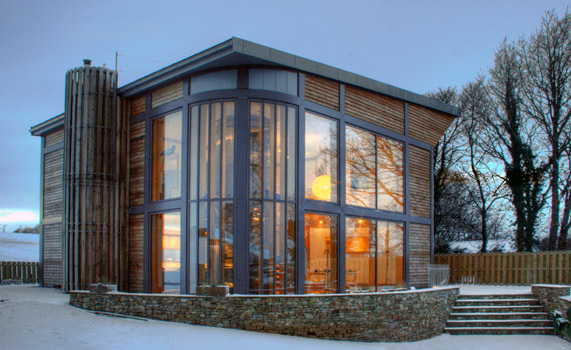
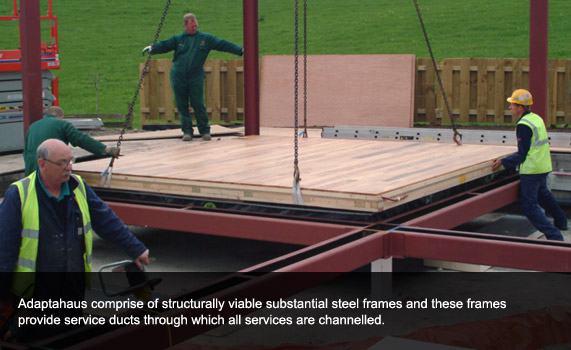
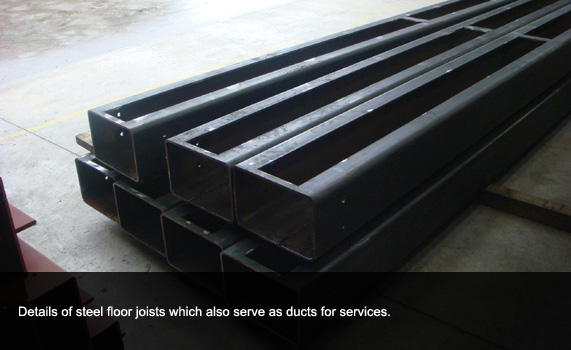
The house, built by www.adaptahaus.co.uk has a steel frame, then wooden and naturally insulated panels. They also have a funky looking system where you can move internal walls about at a future date !

On their http://www.adaptahaus.co.uk/buy.php page they have:

Budget on £180 per square foot for the completed house (not including renewable energy systems)

  • £180 per sqare foot = £ 1937.50 per square meter (so a higher end price).
  • Although the PDF brochure from their site (great detailing of their system) has a price indication of “£1000-£1800/m² depending on the requirements.”
  • From http://www.adaptahaus.co.uk/benefits.php, they imply that the price is for all of the house (there is the earlier caveat that the price excludes renewable energy systems:
    “The house will be delivered to a completely finished site with all hard landscaping in place and bolted together on to prefixed and levelled anchor bolts. The house will be weathertight within 1 week and fitted with fixed furnishings (kitchen and bathrooms) and commissioned within a further 2 weeks.”

Also, nice to see that “our system achieves a level 4-5 CSH qualifi cation, which is above the current standards for social housing.”

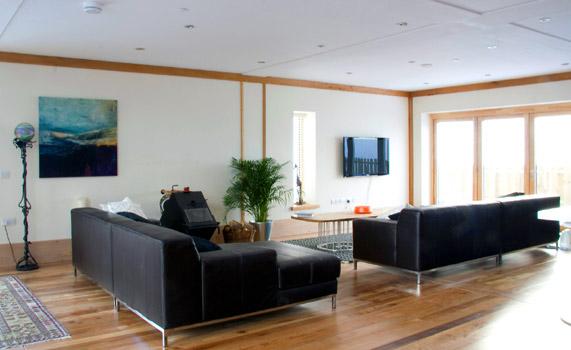
Pictures from Adaptahouse below.


Notes on Steel Houses from 4Homes site:

One thing that can be important though if it is near the sea is to ensure that the steel is galvanised, which will stop it from eroding too quickly.
– I was assuming it’d also make sense to have no or minimal exposed steel.

How Eco-Friendly Is Steel?

Possible erosion is one of only very few downsides to building with steel. However, another is its lack of green qualities. Compared to timber, steel is not as environmentally friendly. A spokesperson for eco homes and sustainable development portal www.whatgreenhome.com says, ‘Whichever way you look at it, steel can’t be considered a “green” material. Making it requires burning fossil fuel bi-products at extremely high temperatures, which uses large amounts of energy and releases CO2 into the atmosphere.’

Kane notes that compared to building with timber, steel constructions don’t require cutting down trees. It is a fair point – if indiscriminate or illegal felling is practised – but from an environmental perspective, when trees are forested (managed) and only used from FSC sources they are beyond compare because no CO2, which is the major greenhouse gas that causes climate change is emitted when trees are felled.

What Does Steel Cost?

On the issue of price Kane says steel costs less than either masonry or brickwork. ‘There isn’t really an approximate cost, though. It really depends on the size of the building as it is priced per tonne and the amount used in any one building may not be the same as any other. It is a very cost-effective material though, which is another reason it is used in the construction of so many modern skyscrapers. Another benefit is that it can help to keep labour costs low because the work can be done so quickly.’
Perranporth Low Carbon Limited ?

Wouldn’t it be great to set-up Perranporth Low Carbon Limited ?

Attending some eco-build talks at the Eden Project, one of the speakers is involved with Hook Norton Low Carbon Limited.

It is an Industrial Provident Society, set up by Low Carbon Hook Norton members to help the community reduce its energy consumption, carbon emissions and save money, with a range of community-based schemes and individual household projects based on interest-free loans.

http://www.hn-lc.org.uk/

From the talk, it seems they coordinated getting funding and then the residents and suppliers to slowly help everybody (residents, the school, local firms ….) benefit (lower fuel bills, jobs to implement the projects …..) and move to a lower carbon / more sustainable village.

Hot / warm water into the washing machine

Thanks to Simon, I ended up at a great evening at the Eden Project on Wednesday. It was run by the Cornwall Sustainable Building Trust. Some great speakers including Charlie Luxton who covered a lot of items I already knew about (it’s always great to get confirmation from somebody with heaps more experience than yourself thought !), and quite a few I didn’t.

Warm Water into your Washing Machine

For instance, modern washing machines have a single water inlet, for cold water. But what this means is that these modern washing machines are using electricity to heat the water to the desired temp for the selected wash. Eeeeek, we all know that due to (not only) transmission from power stations for most people, the efficiency of heating water by electricity is shocking (see figures below *).

How about making sure that there are mixer taps to give warm water eg 20 degrees into the back of your washing machine.

Water Temperatures

  • Central heating tends to run at 55 to 65 degrees C.
  • Under floor heating runs at around 45 degrees C.
  • A bath is going to be, 44 to 46 (a VERY hot bath) degrees C.
  • BUT need to occasionally boost the water in the tank to kill legionella:
    – 66°C Legionella die within 2 minutes
    – 60°C Legionella die within 32 minutes
    – 55°C Legionella die within 5 to 6 hours

Cement

He also mentioned that instead of cement (environmentally horrible stuff) go for GGBS  +/or fly ash cement. It seems these are cements made up from the by products of already in place (and here to stay for a while) industries such as blast furnaces and coal burning.


* Energy and Electricity

These figures are taken from an eco building book, the Green Building Bible (Volume 1):

  • 100 units of energy in fossil fuel into a typical UK power station, gives
  • 38.5 units of energy into the grid, of which a further 3.5 units are lost on transmission & distribution, so you only get
  • 35 units to a house, of which 13 lost through inefficient use

So 100 becomes 22 (or 35 if you have 100% efficient use, through good appliances, voltage regulation etc.)


Triple glazed windows PLUS minimised environmental impact during manufacture!

Ecoplus3 is our new flagship range of handcrafted windows and doors, for beautiful, sustainable homes. Made in our workshops in West Yorkshire, Ecoplus3 comes with triple glazing as standard* and systematically addresses the environmental issues relating to window manufacture. Ecoplus3 is the third evolution of our Ecoplus range since its launch in 1995, taking its thermal performance to a new level.

More details at http://www.greenbuildingstore.co.uk/page–ecoplus-natural-timber-windows-doors.html

Low Carbon Living Experiment Ends. Did The Lindell Family Achieve a One Tonne Life?

An interesting article on this great project to try and live at 1 tonne per person.

http://www.treehugger.com/files/2011/06/low-carbon-living-experiment-ends-one-tonne-life-results.php?campaign=daily_nl

It seems the “rucksack” (or baggage) of CO2 from the construction of where we live and what we use is what stopped them getting to the target 1 tonne:

Their “rucksack” of 900 kilograms stopped them from reaching the one tonne target. This “rucksack” consists of the CO² emissions that take place when various products are manufactured, such as the house, solar panels, car, furniture and clothes. However, they demonstrated that it is possible to get very close to one tonne, however it does involve a change in lifestyle and the information to make the right changes.

So, you can massively reduce your CO2 impact !

– Transport emissions dropped more than 90%
– CO2 emissions produced in the home were halved
– Food carbon emissions were reduced 84% by going vegan
– Manufacturing of house and goods prevents a ‘One Tonne Life’

The family used to live at “a regular high of 7.3 tonnes”. The new systems and way of living comfortably got to comfortably reach a constant low of 2.5 tonnes. Then “through a strict diet of using one less room in the house, no TV, no shopping and only eating vegan food they managed to reduce their footprint to 1.5 tonnes per person.”


Solar Panel Guide – Pay, free or try then buy ?

The Money Saving Expert team have written a new updated guide to “Free Solar Panels”.

Full details at http://www.moneysavingexpert.com/utilities/free-solar-panels.

They give 3 main routes:

  • Buy panels for £8,000-£14,000. If you have cash, on top of electricity savings the Govt’s feed-in tariff scheme could pay back double your spend. Eg, a £12,000 system could net £25,750 over 25 years (see How To Buy Solar Panels).
  • Free panels, but you don’t keep ‘feed-in’ tariff. If you’re in England, Wales or, in a few cases, Scotland, some companies fit panels for free, but they then keep the big-money feed-in gain. You just keep the £70 electricity saving, though prices are predicted to rise massively over 20 years, so the saving could jump.
  • Try free then buy. An interesting new option from E.on.
    You get free panels, but it lets you buy ’em out, you can do it at a reasonable price to gain the feed-in tariff.

Buyer Beware :: Solar panel selling scam

An interesting article on the danger of listening to sales people who are probably very commission driven and not necesarily regulated very efficiently (by the goverment, their industry or their firm).

http://www.theregister.co.uk/2011/06/24/solar_misselling/

Solar panel selling scam shown up by sting

Solar panel sales cowboys are – surprise! – exaggerating the benefits of the energy technology, a sting operation by consumer magazine Which? has found.

Which? invited 12 solar companies to survey a house and produce cost and benefit estimates for a solar PV system. Seven out of the 12 recommended putting the panels in the shade, and some overestimated the benefits by thousands of pounds.

“It seems extraordinary that the Government’s rules require companies to ignore whether you live in Cornwall or Scotland when working out how long it’ll take to pay for the solar panels,” says Which? executive director Richard Lloyd. “It’s obvious that the more sun you get, the faster the payback. The Government has to put this right.”

Evidence of pressure selling was also unearthed.

The generous feed-in tariff (FIT) – whereby the taxpayers subsidises the ‘surplus’ electricity for a domestic solar installation by paying several times over the market price – has seen a rush of middle-class households seeking to install solar PV units. For the well-off who can afford one, it’s printing money; and has been condemned as a regressive wealth redistribution by some prominent Greens. Sort of like Robin Hood in reverse.

Strangely Which? ignores this aspect.

Solar panel selling scam

On Wednesday the Energy and Climate Change department DECC published its microgeneration strategy. It’s become a political flagship for the Conservatives, as this passage notes:

Such projects can engage individuals, neighbourhoods and communities in becoming involved with generating local heat and power. This offers a powerful symbol of the move from centralism to local action – the ‘Big Society’ in the UK’s energy landscape.Power to the people? They probably believe it, too.

The predicted rise of solar

A list of predictions that argue the dramatic rise of solar power over the next 5 to 50 years.
http://www.fastcompany.com/1760900/five-energy-predictions-for-the-future?partner=rss

  • Solar Energy Will Be More Economical Than Fossil Fuels In 10 Years
    – but only if the solar industry continues to rapidly improve solar cell efficiency and create economies of scale
  • Solar Power Will Be As Cheap As Coal in Two Years
    – But what of our natural  gas glut? Will that slow solar development?
  • Natural Gas Will Kill Renewables
    – In part because renewables are weather dependent, so utilities will always opt for always-on fossil fules.
  • Renewable Energy Use Will Grow, But So Will Coal And Natural Gas Use
    – so carbon emmissions will continue to rise 🙁
  • We Could Power 100% Of the Planet With Renewable Energy By 2050
    – The only problem: somehow beating back the fossil fuel industry to a point of nonexistence. This is a pipe dream at best–but one that we should at least aspire to.