Saving energy and water :: Pipework

An interesting GreenBuildingForum.co.uk thread.

Long +/or copper pipes mean that the amount of water that needs to flow to a tap, before you have a hot tap can be a lot. Shorter plastic (that don’t absorb the heat, until they heat up) pipes will have a big impact on reducing the amount house users will run a tap in order to get their hot water needs / desires.

Also discussed is having thinner diameter pipework. If you have enough pressure, this means there is less water sitting in the pipes between times the hot water is requested. Suggestion is 12mm pipework.

Ecobuild: Grey Water Harvesting

Notes from Ecobuild expo talks on Grey Water use:

  • Greywater is waste water from showers, baths, washbasins, washing machines and kitchen sinks.
  • Greywater reuse is the use of untreated greywater.
  • Greywater recycling is the use of treated greywater.

Key technical issues to overcome using Grey Water:

  • The age of the water..
  • Stagnant water generates bioforms leading to unpleasant odours.
  • User interaction.
  • Anticipating users bathing habits.
  • Low level of maintenance.

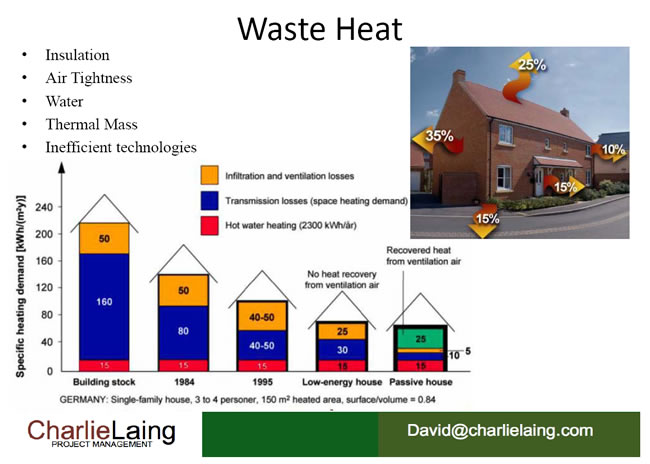
Ecobuild: An “air tight” building

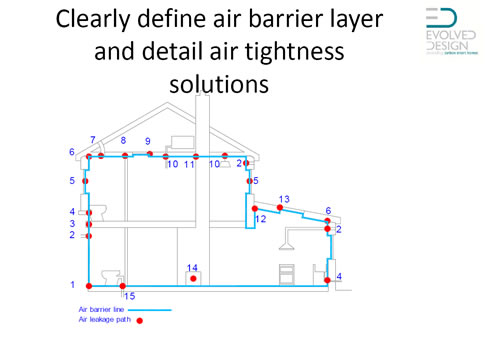
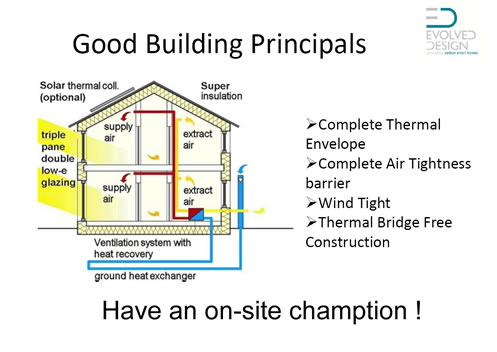
A principal of modern buildings to achieve thermal efficiency and improved health is to make an “air tight” building .

The aim is to head towards and perhaps meat the Passivhaus standard of air change rate of no more than 0.6 air changes per hour @ 50 Pa. (UK Building Regulation Standard is 10m³/m²/hr @ 50Pa).

Then to control / manage the air, by a mechanical ventilation heat recovery system (MVHR) that exchanges inside air with outside air, BUT heat exchanges the outgoing air with incoming air, so you don’t loose the warmth.

The idea worries people, “I want to sleep with the window open ….”. But reading more and more about this, even sceptics rapidly find the air quality is better in these buildings than those with open windows. And, you can just open the window if you want to ! (eg in summer).

Notes from  the Ecobuild expo talks:

I’ve read elsewhere, that the builders being on-side re the thermal, sealed objectives is key.


Appliance Energy Saving Tips

http://www.homebuilding.co.uk/unmissable-energy-saving-tips-by-appliances-online

Siemens have recently brought out a miracle A+++ fridge; the KG36EAW40. It has the best energy rating on the market right now. Annually it costs you £18 a year to run, compared to a more modest A rated model, which costs you approximately £51. That’s a saving of £33.

Get a frost free freezer

Don’t leave cooking appliances such as your microwave on standby. It wastes approximately 7kW of energy per day – annually that’s a huge £84 per appliance.

An induction hob is the most efficient hob you can get: it’s 90% more efficient than gas or electric, mainly because the hob only heats up when it recognises the pan so no energy is wasted when the pan isn’t present.

Another good tip is to use halogen lighting in your oven as they’re 20% more efficient and 36% brighter than standard light.

The Bosch Logixx WAS32461GB washing machine, which has a function that measures the exact amount of water needed depending on the weight of your wash. It means you won’t waste any extra water or energy to get the load washed. It’ll only cost you £22.68 a year to run, which is minuscule compared to other machines.

EcoBuild: Toilets (waterless urinal & sensor on water tap)

Two toilets and a commercial tap sensor stood out at the Ecobuild expo:

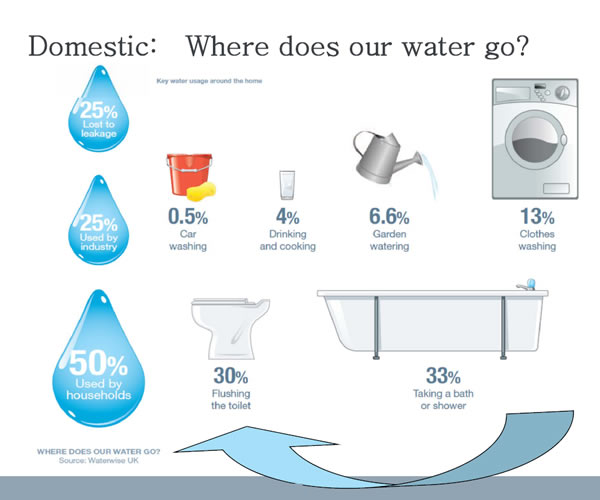
One of the efficiency and eco objectives is a house that is water efficient.

Two slides, from different sources on domestic water use / water consumption:

My initial straw polling, is getting a strong reaction to the idea of a urinal, let alone a waterless urinal, from  at least 50% of the girls reacting!

Waterless Urinal

This has the potential to drastically reduce the amount of water used in the house.

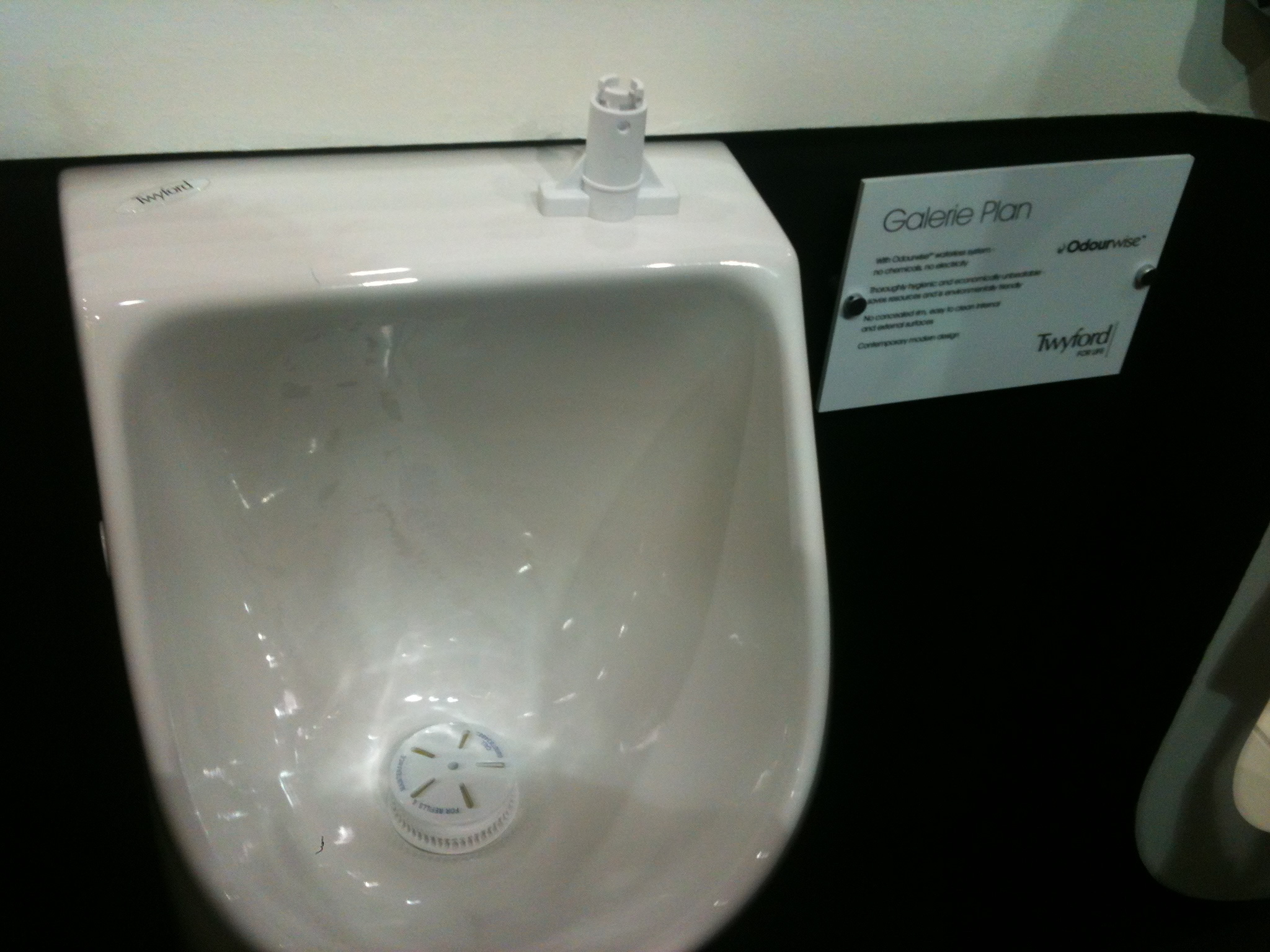
They are marketed as “clean, green, odour free and waterless”.

I had it all explained to me on the Odourwise and Twyford stands. The module that fits into the bottom of the urinal converts all uric acid to a form that prevents lime scale, clogging up the system, takes away the smell etc. It seems that urine and water are a big source of limescale and other loo waste pipe problems, hence trying to dilute this away with (usually) lots of water.

All you need to do, is a few times a year (depending on use levels) replace the cartridge. In this photo the plastic bit on the top is the device to extract the Odourwise bit so that it can be replaced with a new cartridge.

A google search reveals there are a few alternatives, so more research needed.

My current thought is a urinal in the bathroom  off the main living area and also one in the bathroom off the study.
Also on show at Ecobuild 2012 will be the Odourwise™ Waterless urinals. Twyford Bathrooms offers the revolutionary Odourwise™ Waterless system for two of its urinal ranges, Centaurus and Galerie Plan. Centaurus is the first hybrid urinal that is truly waterless, combining maximum water savings with enhanced hygiene. The cutting-edge Odourwise™ Waterless technology requires neither chemicals nor electricity, keeping it eco-friendly as well as economical. The urinal is also entirely rimless, making it easy to clean (both within and outside the bowl). Installed with the Odourwise™ Waterless system, Galerie Plan offers the same cost-effective and eco-friendly benefits as Centaurus.

Toilet Sink Taps to be Sensor Driven?

Why use your hands to touch the tap to get the water flowing, before you’ve washed your hands ?

Why have the water running when hands aren’t beneath the taps ?

I need to check out the cost and any other implications. I assume they use a tiny amount of electricity, but best to check.

Combine the Sink and Loo ?

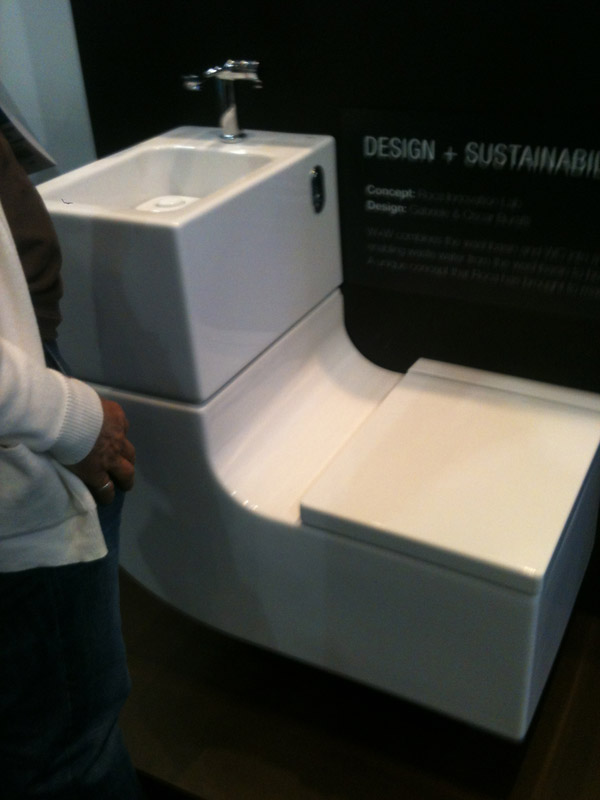
This great combined unit captures (there is an optional bypass if you don’t want it to, eg if you’ve cut your hand) the water you use to wash your hand and then stores this to flush the loo. Integrated 1 unit grey water system.

BUT, £2,500 !!!!!

I’m pretty sure I can have an entire house grey water system for a similar amount.
 

EcoBuild: Solar Panel Angles

There may be a problem with the current Silver Spray plans and the angles for the solar panels. The current plan is for the panels to be bolted onto the proposed flat roof at the back.

  • Solar panels should be south facing and between 20 and 60 degrees.
    • I’ve heard / read that the ideal angle for solar panels in Cornwall is for them to be at 30 degrees (and south facing).
    • Below 20 degrees panels don’t self-clean when it rains. Dirty panels are less efficient
    • The angle that solar panels are normally mounted on flat roofs is usually low to reduce the amout they can get grabbed by the wind and ripped off the roof !
    • It could just be that a framework for the panels is factored into the building so that there is no chance it can be ripped off by the wind.
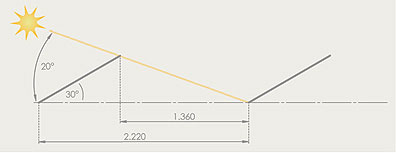
    • Flat roof mounting systems for panels all seem to be at about 10 degrees, so that the gap between panels is around 38 cm, and so that their is reduced possible “wind load”
    • Current rear flat roof area is about 4.1 x 8m = approx 32.8 sq m. If panels are all flat, a 4kW system takes about 28 sq m. So will need to see how the space works out.
    • See http://www.bauder.co.uk/photovoltaics-and-rooflights/photovoltaic-energy/baudersolar/pv-modules – images below – gap between panels moves up to 1.36m from 0.38m as solar panel angle of tilt changes from 10 to 30 degrees. But see reasons below for wanting 20 degrees or more tilt.
    • The Energy Saving Trust matrix for PV angle of tilt and how much south facing, that suggests optimum is south facing and between 20 and 30 degrees tilt.

  • More vertical panels do better in the winter, when the sun is lower in the sky. You are more likley to want more hot water in the winter (for space heating) and more electricity generation (to power feed the air source heat pump). BUT only 10% of generation output will be in the winter, so best to angle the panels for max, over the year, output.

I ran figures through the Energy Saving Trust calculator for a few variations at the Silver Spray postcode location:

  • South slope, XLarge 4Kw, 90 degrees = 2,688 kWh pa
  • South slope, XLarge 4Kw, 60 degrees = 3,499 kWh pa
  • South slope, XLarge 4Kw, 50 degrees = 3,643 kWh pa
  • South slope, XLarge 4Kw, 40 degrees = 3,716 kWh pa
  • South slope, XLarge 4Kw, 30 degrees = 3,715 kWh pa
  • South slope, XLarge 4Kw, 20 degrees = 3,640 kWh pa
  • South slope, XLarge 4Kw, 10 degrees = 3,492 kWh pa
  • South slope, XLarge 4Kw, 0 degrees = 3,274 kWh pa

EcoBuild: Photovoltaic, PVT Vs PV or PT

Photovoltaic Thermal:: EcoBuild Expo Update

At the Ecobuild expo, there were a LOT of companies who had photovoltaic elec or water heating systems.  Few were combined PVT (both electricity and heating water). So I started asking why. Speaking to those that make the panesl and installers / advisors the consistent reply was that the reduction in output of both systems was more than 50% down on what you’d get if each was stand alone. One company that produced PV and PT panels said that:

  • A PV panel could produce around 280 Watts  of elec, a PVT panel about 120 Watts
  • A PT panel over 200 (I think degrees) water, but only 40 degrees from PVT.

Yes, it’s still good to cool down PV panels, with ventilation, or even surrounding green roofing. But it seems that cooling them, by linking in pipes to generate hot water doesn’t work. It seems that the temp hot water panels work at is so high to be efficient, that takes out too much electricity production. Or you compromise the amount of hot water production by having the panels at a much lower temp. ie to be efficient they both operate at vastly different temperatures.

So that means looking at seperate systems for electricity production (PV), hot water productin (PT) and something for when the sun isn’t shining for hot water (for taps and heating).


EcoBuild: Air Source Heat Pumps

Air Source Heat Pumps

The installers / advisors to projects that were speaking at the lectures for self builders were all very positive about air source heat pumps in terms of how they work and how they stack up from an environmental / energy / sustainable point of view.

There are now automated systems for (for example) an air source heat pump to kick in when Photo Voltaic (PV) panels are producing more electricity than the house is using, and so at those times top up the water thermal store in the building. This can then be used for hot water or heating (under floor works at lower temps) at other times (if needed).