50 Ways to Make Your Life More Environmentally Friendly

A great list.

OK US biased, but easy to adapt to UK living.

1 – Grow your own food.
2 – Eat less meat.
3 – Cut down on processed foods.
4 – Don’t eat foods or drink from BPA-lined containers.
5 – Open windows to let in fresh air.
6 – Open blinds to let in natural light.
7 – Fight “vampire power”. (ie appliances on standby, that still consume energy, sometimes lots!)
8 – Get energy-efficient appliances and electronics.
9 – Take shorter showers.
10 – Wash clothes using cold water.
11 – Hang clothes on a clothesline to dry.
12 – Use leftover bathwater or “greywater” to water plants.
13 – Turn off lights when not in use.
14 – Turn off water when brushing teeth.
15 – Don’t let water run while washing dishes.
16 – Run the dishwasher or washing machine only when there is a full load.
17 – Use waterless car wash to wash your car or bike.
18 – Take public transportation.
19 – Walk or ride your bike.
20 – Use a proven fuel additive when you do drive.
21 – Combine multiple errands into one trip.
22 – Get rid of chemical cleaners.
23 – Use natural materials to clean.
24 – Make your own natural shampoo.
25 – Make your own natural lotion, skin masks and cleansers.
26 – Get outside every day for some sunlight and fresh air.
27 – Print documents as little as possible.
28 – Recycle bottles, cans, newspapers, etc.
29 – Donate items you no longer need or use.
30 – Use reusable bags at the grocery store.
31 – Use reusable containers at home.
32 – Make meals using leftovers.
33 – Freeze foods before it goes bad.
34 – Reduce your food waste.
35 – Compost.
36 – Plant a tree.
37 – Start or contribute to a community garden.
38 – Landscape your own yard with native plants.
39 – Buy used rather than new.
40 – Set thermostat 1-2 degrees lower.
41 – Get a reusable water bottle (and use it!).
42 – Opt for paperless billing.
43 – Pay your bills electronically.
44 – Do a home energy audit.
45 – Fix any leaky faucets to prevent water waste.
46 – Turn old t-shirts into “new” cleaning rags.
47 – Get rid of one-use items (disposable razors, diapers, plasticware, etc).
48 – Read magazines, newspapers and other publications online.
49 – Unsubscribe or cancel all junk mail.
50 – Unplug at least once a day so that you can enjoy nature and the environment around you.

 

The Code For Sustainable Homes (CFSH)

The Code For Sustainable Homes (CFSH) is a government established national standard for the design AND construction of properties.

Level 0 is equivalent to a Building Regulation pass.
Level 6 is a zero carbon house with at least 17.6 points via the CFSH scheme.

“The Code measures the sustainability of a new home against nine categories of sustainable design, rating the ‘whole home’ as a complete package. It covers Energy/CO2, Water, Materials, Surface Water Runoff (flooding and flood prevention), Waste, Pollution, Health and Well-being, Management and  Ecology.” (From www.communities.gov.uk/planningandbuilding/sustainability/codesustainablehomes/)

There is a nice 4 stage explanation of a strategy to achieve a high CFSH score at http://www.wolseleyselfbuild.co.uk/sustainable-build-eco-homes:

  • Step 1 – Design the building to minimise energy demand
  • Step 2 – When energy use is unavoidable try to use renewable sources
  • Step 3 – Strive to use products with the lowest environmental impact
  • Step 4 – It is not enough to simply understand products and design

The PDF of the CFSH covers:

  • Energy
    • Carbon neutral, defined as zero net emissions of carbon dioxide (CO2) from all energy use in the home, over a year. eg the amount of consumed electricity (from the grid) is less than put back into the grid from PV’s (Photovoltaic solar panels).
  • Water consumption
    • A normal household uses 120 litres per person per day. For level 5 or 6 the minimum is 80 litres per person per day.
  • Materials used to build the house are all over an environmental impact threshold.
  • Surface water run-off is to be no greater than before for the site.
  • There is a site waste management plan, with monitoring for the construction.
  • Household waste storage to facilitate recycling.
  • Heat loss from the building is specified.
  • Energy efficient internal and external lighting
  • Clothes drying area
  • Rating levels for white goods.
  • Cycle storage
  • Home office
  • Rain water collection and use system.
  • Responsible and environmental ranking of the selection and sourcing of building materials, all the way to finishing elements. eg roofing, windows, timber certification, insulation materials etc.)
  • Composting facilities (it’d be nice to plan in where the wormery is going to go)
  • Good natural daylight.
  • Good sound insulation.
  • A private or partially private outside space
  • Ecological evaluation and where possible ecological enhancement of the site.

Other Green Home Information

Watch out for the fire

“I do not recommend wood burning stoves in a building as efficient as a
Passivhaus because of the dangers of overheating, but clients are quite often
insistent and these may be more controllable.”

– taken from http://www.building.co.uk/technical/sustainability/passivhaus/incentives-key-for-passivhaus-in-uk/5019141.article

So it seems that I’m not alone in wanting a wood or multi fuel burning stove in a Passivhaus.

I guess this means it’ll be key to pick a smaller than you’d normally go for “wood burner” so that it can get up to operational temperature, but not cause the house to over heat.

The economics of solar panel installtion

A bit of an eye catching headline “Solar Panels Never Make Economic Sense, Says Fuzzy Math” that first points out the well know detail “that insulation, weatherization and other energy efficiency measures should come before solar”.

Or to put it another way, “Adding photovoltaics to a non energy-efficient house is like exercising to burn off cake – much more efficient to stop eating cake…”. Not that sure about this quote. Eat cake and then exercise a bit more makes perfect sense to me! OK, I do get it, the environmental hit of an inefficient house just doesn’t stack up. Step 1 make the building / property as environmentally efficient as you can, BEFORE you then sort out how you provide the energy sources.

Back to the linked article, it did end that if you include some assumptions on future electricity prices, feed in tariffs etc. the article ends with the estimated “current payback of power-generating PV panels was 13 years”. As the PV panels should last 20+ years, that means they should be a good economic investment too.


Solar cells reach 18.7% efficiency

The Previous Record was 17.6%
Scientists at Empa, the Swiss Federal Laboratories for Materials Science and Technology, have made flexible solar cells made of copper indium gallium selenide (CIGS) with a light-conversion efficiency of 18.7 percent, a new world record. This milestone, about 1% higher than the previous record, might seem like a small step forward, but when looked at in the context of constant incremental improvement, it is significative. What truly matters is the rate of improvement, and how it can be leveraged (1-2% multiplied by many gigawatts of capacity makes a huge different).

http://www.treehugger.com/files/2011/05/flexible-solar-cells-reach-record-efficiency-18-percent.php?campaign=daily_nl

Direct sunlight through the year

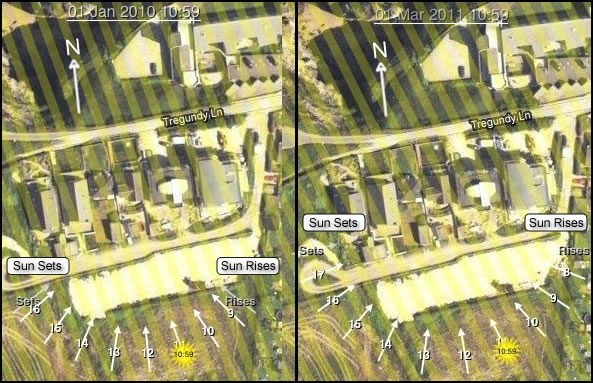
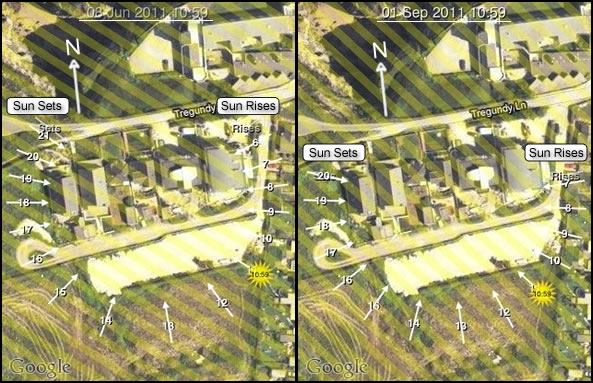
iPhone Sun Seeker app to see where the sun rises and sets in relation to Silver Spray during the year. You can make out the dates at the top of these iPhone screen grabs.

Very much meaning that solar panels for water heating or electricity generation should be angled to slope down away from the sea facing front of the house.

Sunlight, 1st of Jan, 1st of March

Sunlight 8th June and 1st of September


7 Reasons to Consider Eco-Friendly Rural Living

There is plenty of evidence that the lowest per person carbon footprint is achieved by urban living. This is then countered by the increased stress and often reported reduced quality of life from urban Vs rural living.

So nice to see this post on “7 Reasons to Consider Eco-Friendly Rural Living“:

  1. Peace and quiet, and peace of mind
  2. Open space equals self-reliance
  3. Privacy
  4. Cleaner air and water
  5. Outdoor activities enables interaction with nature
  6. Cheaper cost of living
  7. A sense of community